Autumn twining and training method for climbing roses, making messy branches obediently behave
[Growing potted roses on the balcony like this] Series
Part 10
Growing roses in autumn and winter, twining and training method for climbing variety branches
Climbing roses
Can climbing roses be grown on a balcony? Of course they can!
However, the key to climbing roses lies in:twining and training.
In plain terms, twining and training climbing roses is much like styling a bonsai. If you want your climbing roses to look good and bloom abundantly, you really need to master the techniques for training them!
Training of climbing varieties should usually be carried out from December to early January of the following year.
If trained early in November, the bent branches may sprout prematurely and get frostbitten.
If delayed until February, the buds will have already begun to swell and are prone to falling off during training, missing the best growing period.
So neither too early nor too late will do; you should complete the training operation at the appropriate time.
In this article, let's learn about the twining and training method for climbing rose branches.
Items to prepare for twining and training climbing rose branches
· Potted climbing variety plants
· Support (a tower frame is used here)
· Twine (or plastic string)
· Scissors
Methods and steps for twining and training climbing rose branches
1. Place the branches on the outside
Below is the method for twining the long branches of climbing varieties onto the support. First fix the support in the flower pot, and place the branches on the outside of the support; placing them on the inside makes twining difficult and removing the frame very hard.
2. Test twining
Compare the longest branch against the size of the support, adjust the number of loops and the direction of twining, and find the best position for even distribution.
Once the suitable position is basically determined, fix the branch starting from the lowest point with twine; plastic string can also be used instead.
Wrap the twine around twice and fix it to the support.
3. The state after twining the first branch
The photo shows the state after the longest branch has been twined.
4. Twine the second branch
Arrange the second branch as much as possible to fill the gaps and twine it onto the support; the twining direction can be opposite to that of the first branch.
5. Complete the training
Twine the third branch evenly onto the support as well, and the training is complete. If there are branches extending beyond the range, prune them off.
6. May of the following year
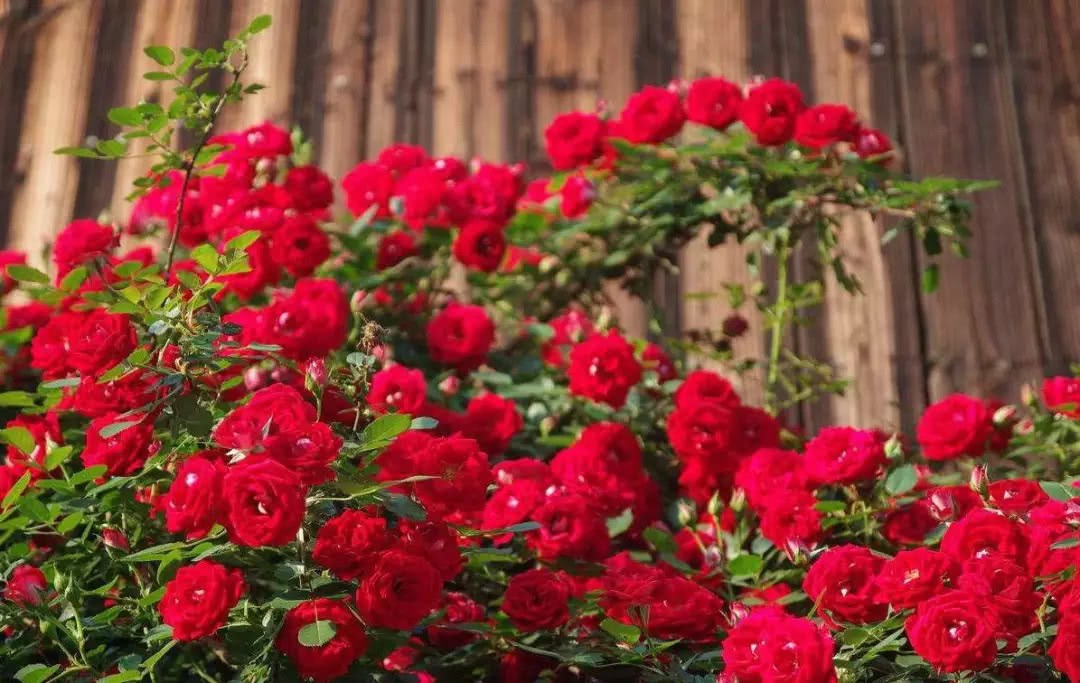
This is the climbing rose beginning to bloom. The new branches growing at the lower left should also be tied up.
Skillful hands produce fine work, and good work produces good results.
Time says nothing; quietly wait for the flowers to bloom.
I wonder, has the editor explained it clearly and in detail? For friends who didn't quite understand, the editor has written an acrostic poem especially for you; it may not be well written, but it can help you find the editor.
More wonderful articles are all in an acrostic poem:
A gentle breeze lightly strokes, flowers stay ever present
Strolling in spirit, wandering to the sunny south of the mountain
Searching for wonders and clever finds at Copper Sparrow Terrace
Planting reds and greens, rising above the blue clouds
--Come take the challenge: a four-line acrostic-and-tail poem; link the first characters together + link the last characters together, and you get an eight-character maxim to summon the editor's true self! When you come, remember to say: "Editor, your secret has been cracked by me!"