Autumn winds rise in September: succulent care must guard against this hurdle
Brilliant days
リフレイン
moumoon
00:00/04:06
BGM:moumoon——brilliant days
In just a few days it will be White Dew. Having endured the dog days and End of Heat, many northern cities are already gradually cooling down. Although some southern regions are still quite hot during the day, the nights also bring cool breezes.
At times like this I think of that line by Li Bai: On the jade steps white dew forms, as the night wears on it soaks her silk stockings. Then she lowers the crystal blind, gazing through its lattice at the autumn moon.
And even more so, "thick grow the reeds, white dew turns to frost" - we have heard it for so long; these few short lines announce that autumn is near. Check the meteorological bureau's forecast: before long, cold air will duly let us feel the coolness of early autumn.
Some succulents have actually quietly started to color up.
But we still cannot let our guard down now. Keep managing your succulents carefully. If you slip up in September, you will still be collecting empty pots in October.
Today let's talk about preparations before autumn:how to water, mix soil, repot, and the effects of sunlightand so on.
/Main text begins/
- Watering -
Watering is the most important thing. At this time succulents have slowly begun to recover, and we need to give them strong support too!
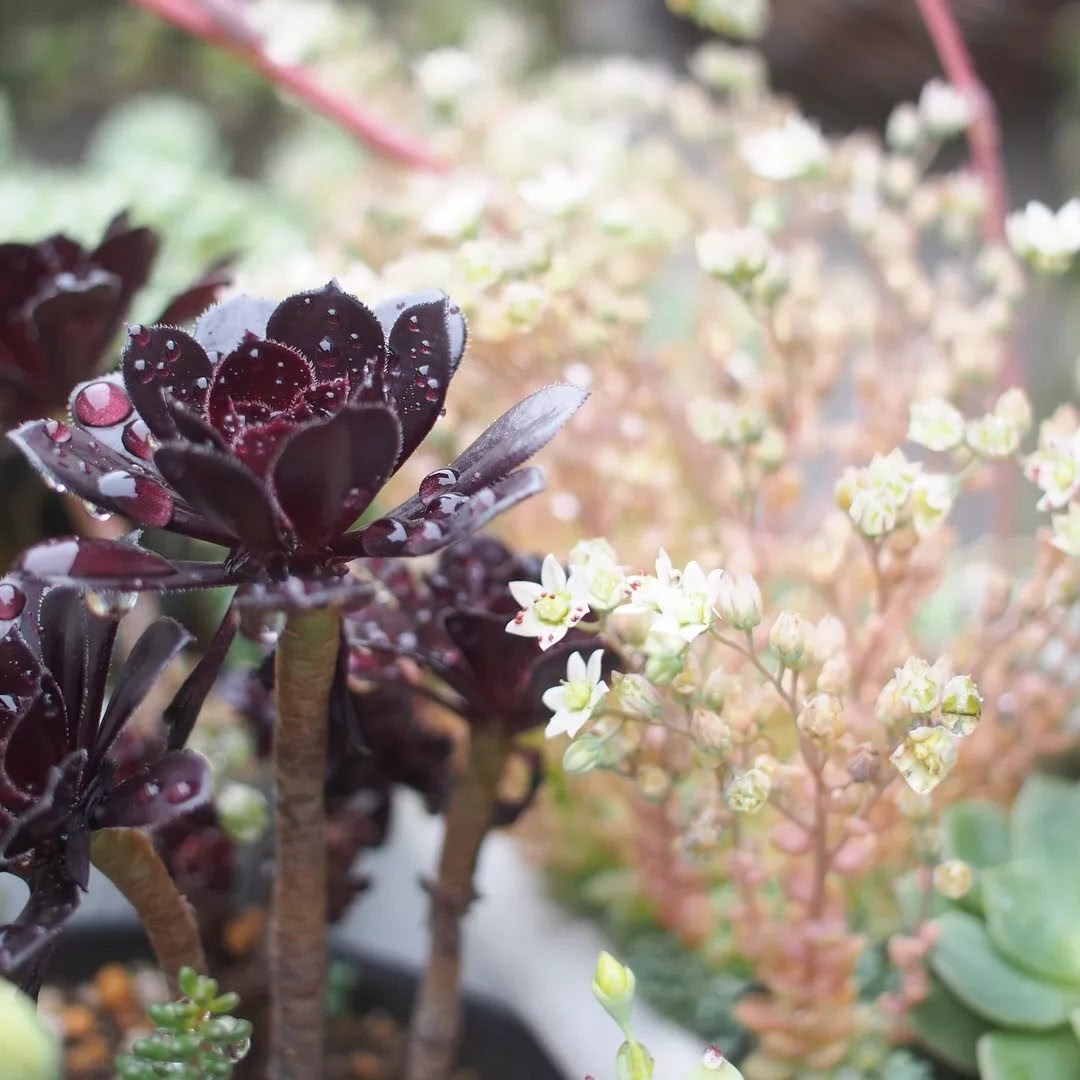
For example Aeonium, along with fellow Aeonium genus members like Mountain Rose, and summer-dormant succulents such as the Dudleya genus White Chrysanthemum and Apple Leaf, may not have had a drink for two or three months, staying in a dormant state the whole time. Give water little by little, and be careful not to give a big soak all at once!
Mountain Rose - Emerald Ball
What problems come from giving a big soak all at once?
1. A big soak wakes up the succulent, and also wakes up the black rot pathogens. They will march merrily up along the roots, speeding up black rot.
2. Even without black rot, giving a big soak all at once will make the succulent grow leggy. If it suddenly eats too much, of course it will get fat.
For other Crassulaceae succulents, if you did not cut off water in summer, they recover quite quickly in autumn since their constitution is good. At this time water normally, and you can water a bit more than in summer, in small amounts but more often.
- Can they be rained on? -
If the temperature is low, let them get rained on. But not too much, or they will grow leggy. Eat too much at once and they will get so fat they turn into little piglets.
If the temperature is high, forget it. Once the rain stops, black rot comes easily. Because rainwater is rich in oxygen, letting the roots breathe, continuous rain actually will not cause black rot.
A friend's area is only 25°C right now, so they decisively let their succulents take a comfortable bath. All at once it shifted from the muggy summer to the cool autumn.
- Repotting and soil -
Repotting is a path every succulent must go through. Summer is not suitable for repotting, and having finally made it to September, is this a good time to repot? If the temperature is already below 25°C, then you can definitely repot.
Which succulents need repotting?
1. You think it needs repotting - no reason needed.
2. The soil has become compacted and cannot drain water. This is the type most in need of repotting, because it cannot grow well.
3. The pot size is too large or too small. It should not be too large or too small, just right is best.
If part of the root system is growing well, there is no need to trim the roots. Just shake the soil ball around the roots loose and repot it directly.
Repotting steps:
1. Remove the soil, 2. Trim the roots, 3. Air-dry the roots (2~3 days), 4. Repot.
If the pot and soil are both old, try to disinfect once to prevent pathogen infection, then mix in some new soil.
So what should gardening friends in other still-hot regions do?
Q: For example, I have a Bear's Paw that dropped all its leaves in summer. Seeing its withered look is so painful. Can I repot it? I feel it will wither and die if I do not repot.
A: Repotting at 30°C will only cause greater harm, and it will die even faster~
Southern succulent growers, while the weather has not yet cooled, hurry and stock up on pots and soil. That way, when the time comes, you will not be stuck after finally removing the soil and trimming the roots with nowhere to put the plant. Isn't our advantage exactly this: free shipping for Jiangsu, Zhejiang and Shanghai.
- Soil mixing -
For healthy Crassulaceae succulents, when repotting use a high proportion of granular soil (granules : peat = 8:2) to make it easy to bring out their colors in autumn and winter.
Unhealthy succulents may have been unable to grow all along because of soil problems, so giving them a new environment is also good. However, the granular proportion should not be too high; peat : granules = 3:7 is about right.
Granules used for Crassulaceae succulents: maifan stone, green zeolite, volcanic rock are all fine. For old stems use large granules. For peat, Dahan peat 422 is recommended, a peat in a size specially for succulents.
Everyone has their own secret soil formula, no need to be stubborn about it. What suits you best is best.
White Moon Shadow
For Haworthia genus plants such as Haworthia cooperi, Haworthia retusa and Haworthia maughanii, use soft granules like akadama soil and kanuma soil. Hard ones like green zeolite and volcanic rock will cut the plump roots of Haworthia cooperi and are not suitable.
- Sunlight -
As the angle of direct sunlight changes, the sunlight from summer to autumn and winter becomes gentler and gentler, and the daylight hours also get shorter. The sunlight we may have found too harsh in summer will then be something we cannot wait to have.
The summer sky - scenery like this will only become rarer in the days ahead.
So when can the shade net put up in summer be taken down? Still that standard: when the average high temperature is below 25°C, you can remove the net and let the succulents receive the nourishment of sunlight~
Succulents moved to the north balcony can also be moved to the south balcony. Go step by step and let the succulents slowly adjust to this sunlight. The same goes for indoor succulents.
Blue Stone Lotus under the shade net
If the temperature is still very high - in Hangzhou it is 33°C this weekend - go to the balcony at ten and the sunlight could practically melt me! Remove the net and they sunburn easily.
Growing succulents is not easy. Change with the seasons. In autumn and winter all things wither, and that is exactly the best time for succulents to take the stage!
·END·
—Welcomesubmissions, there are rewards, contact us now.—