How should succulent leaf cuttings be cared for so they take root and sprout?
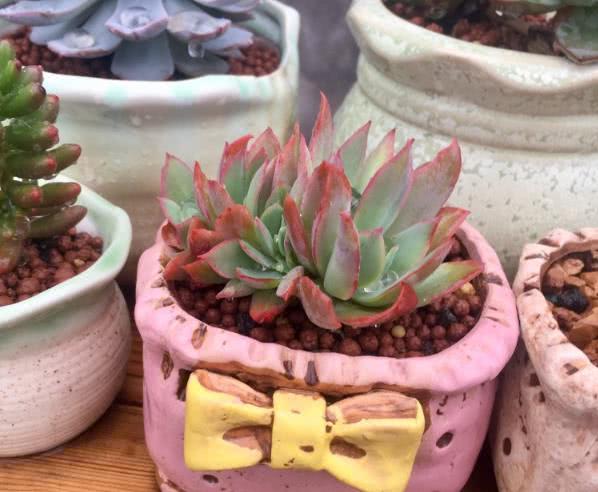
I love succulents not only because they are cute, but even more because of their strong vitality and ease of propagation. Ceramic pots, plastic boxes and foam boxes are the three common containers for leaf cuttings, and it is fine whether the bottom of the container has holes or not. Whether you are doing leaf cuttings or growing mature succulents, you cannot just dig up some soil yourself and plant them in it. Digging your own soil may seem like a way to save money, but if you get it wrong it can kill the succulents. Leaf cuttings generally use propagation soil. You can mix your own soil (usually peat plus perlite), or you can just buy ready-made propagation soil. If you are a beginner, it is recommended to buy ready-made soil.
Which season is suitable for leaf cuttings? Doing leaf cuttings in an environment with too high a temperature makes the leaves prone to rot. Doing leaf cuttings in a low-temperature environment means the small shoots are less likely to rot but grow slowly. Leaf cuttings are generally done in spring or autumn. Newly planted leaves should be placed in a spot with diffused light, and must not be exposed to blazing sun. Once small shoots have grown, you can give them a few hours of sun every day.
After succulent leaf cuttings have grown roots and shoots, I plant the leaf cuttings that have grown roots and shoots into flower pots. The potting soil I use is homemade: 5 parts peat, reason: leaf cuttings need plenty of nutrients, so there should be more peat. 3 parts perlite, reason: it plays a role in aeration, letting the roots of the small seedlings breathe better. 2 parts fine sand, reason: after being mixed with fine sand, it can help the potting soil breathe and drain, and moreover, it can anchor the seedling roots.
It is best to disinfect the potting soil before use. After planting, spray the soil surface moist and place in diffused light, in a ventilated spot. If there is no ventilation, it is best to also manually help ventilate for at least one hour every day, in order to prevent rot and let the succulents breathe some fresh air and return a little to nature. After the mother leaf gradually dries up, remove the mother leaf. The next day, water thoroughly once along the edge of the pot. If water droplets get on the small seedlings, blow them off with a bulb blower. At this point they can be exposed to direct sunlight (except in summer), and normal care can begin.
Any rotten leaves must be thrown away promptly. Leaf cuttings are usually many leaves placed in one container, so when you see leaves that have turned transparent or black, throw them away promptly, otherwise they will affect the other healthy leaves. The time for leaf cuttings to sprout depends on the variety and the environment. They generally grow roots in one to two weeks, and after the root system has grown they will slowly sprout. During this period, do not forget to keep misting them. (Some varieties also grow shoots first and roots later.)
When doing succulent leaf cuttings, if the potting soil is dry, watering it a little, or occasionally misting it, can raise the humidity around the leaves and stimulate them to take root. But sometimes it is generally advised not to get water on the leaves when watering or misting, to avoid infection and turning to mush.
This is a gathering place for succulent lovers, sharing succulent care tips. You are welcome to follow and exchange ideas.