Recommended Flowers with High Beauty, Long Blooming Periods, and Easy Care
This article is about 1,000 words. If you find it very long, it is probably because there are many comments.
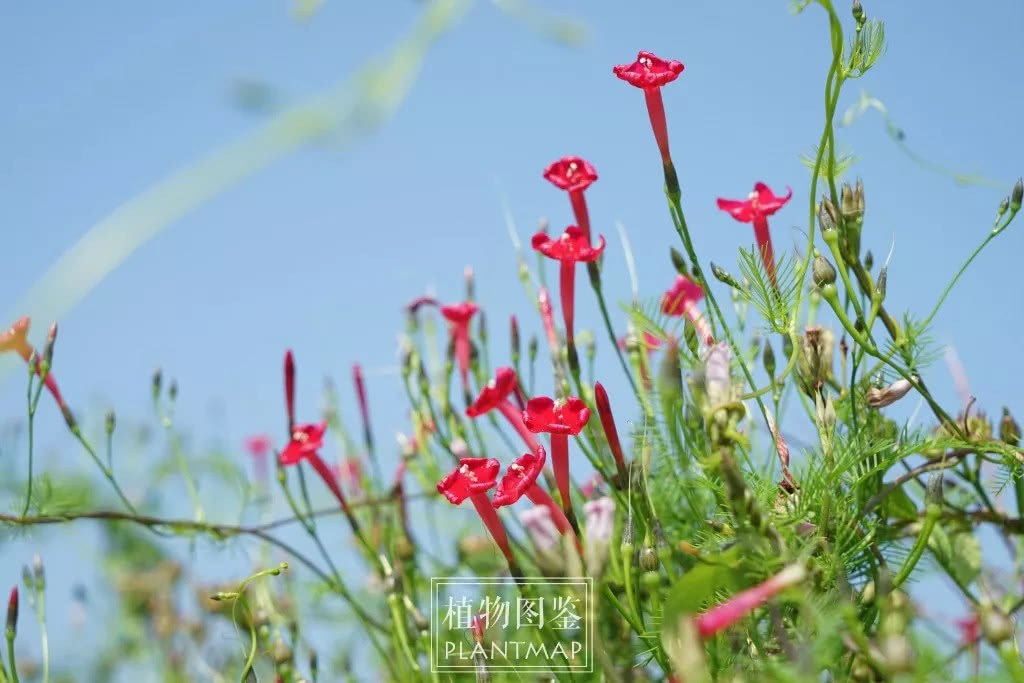
Cypress vine is a small red flower that blooms in summer and autumn and is cultivated across the country.
[ Cypress vine Quamoclit pennata] Convolvulaceae >> Quamoclit
In Flora, the official name of cypress vine is Quamoclit pennata.
The botanical name Quamoclit pennata, in the family Convolvulaceae, was originally placed in its own genus, but was later included in the genus Ipomoea in FOC, and its scientific name was changed to Ipomoea quamoclit.
Quamoclit pennata -- the "pine" in its Chinese name naturally refers to the leaves. The leaves of cypress vine are pinnately parted to the midvein, and the lobes are slender, indeed somewhat like pine needles.
But generally people omit the "pine" character and simply call it niaoluo. The name niaoluo sounds quite cultured, and when talking about it, some people associate it with the Book of Songs.
The Book of Songs says: "The niao is the female luo, spreading over the pines and cypresses," saying that both niao and luo are plants parasitic on pines and cypresses, implying that brothers and relatives depend on one another.
There are differing views on whether niao is mulberry mistletoe or oak mistletoe; there are also differing views on what female luo is -- it may be dodder, or it may be Usnea, a type of lichen.
Image source: Illustrated Names and Objects of the Book of Songs
Image source: Wikipedia
Overall, the ancient niao and luo probably have nothing to do with today's cypress vine. Today's cypress vine does not parasitize pines and cypresses, but is a vine often cultivated along fences. Vines are often called some kind of luo, such as Usnea, female luo, and wisteria; how the niao character in cypress vine came about is unknown. Today's cypress vine is also not native to China, but comes from tropical America. What can basically be confirmed is that cypress vine was introduced no earlier than the compilation of the Book of Songs.
Setting these aside, cypress vine's high beauty and easy care may be the main reasons people like it.
Around mid-August, cypress vine enters its full blooming period. Seen from afar, its blooms are grand and brightly colored; seen up close, the cute, sharply angled trumpet-shaped flowers are even more surprising.
The front of its corolla is a standard five-pointed star shape (occasionally four- or six-pointed), with a long corolla tube behind. Therefore some people also call cypress vine red star flower or red five-pointed star flower.
In the center of the corolla, 5 stamens and 1 pistil stick out; the filaments of the stamens are red, while the pistil is white.
The pollen of cypress vine is relatively large, appearing as translucent little spheres. There is always a lot of pollen stuck to the corolla, as if a shining red star were radiating light.
Cypress vine is also very easy to grow. It is an annual vine with strong self-seeding ability; scatter a handful of seeds, and it will bloom every year. Self-seeded cypress vine generally sprouts in late spring and can cover a fence thickly in one or two months.
Cypress vine can also be propagated by cuttings. One year during a flower show at Hangzhou Botanical Garden in university, I secretly pinched off a small section of cypress vine and took it back to plant in a flowerpot, using a disposable chopstick as its climbing frame. Unexpectedly, it rooted, although it only opened a single lonely flower.
The above is maple-leaf cypress vine.
Besides the cypress vine with pinnate leaves, there is also the orange-red cypress vine with orange-red flowers and heart-shaped leaves, the maple-leaf cypress vine with turtle-shell-shaped leaves, and the cypress vine with white flowers.
In early September, although the weather gradually turns cold, the blooming of cypress vine will continue...
Author: Jiang Mouren
Images: Jiang Mouren (unless otherwise noted)
This work is licensed under the (CC BY-NC-ND 4.0) license agreement.
Please retain the above statement when reposting.