A century-old Buddhist pine (Podocarpus macrophyllus) underwent a transformation over more than ten years after root pruning, and people wanting to buy it are lining up
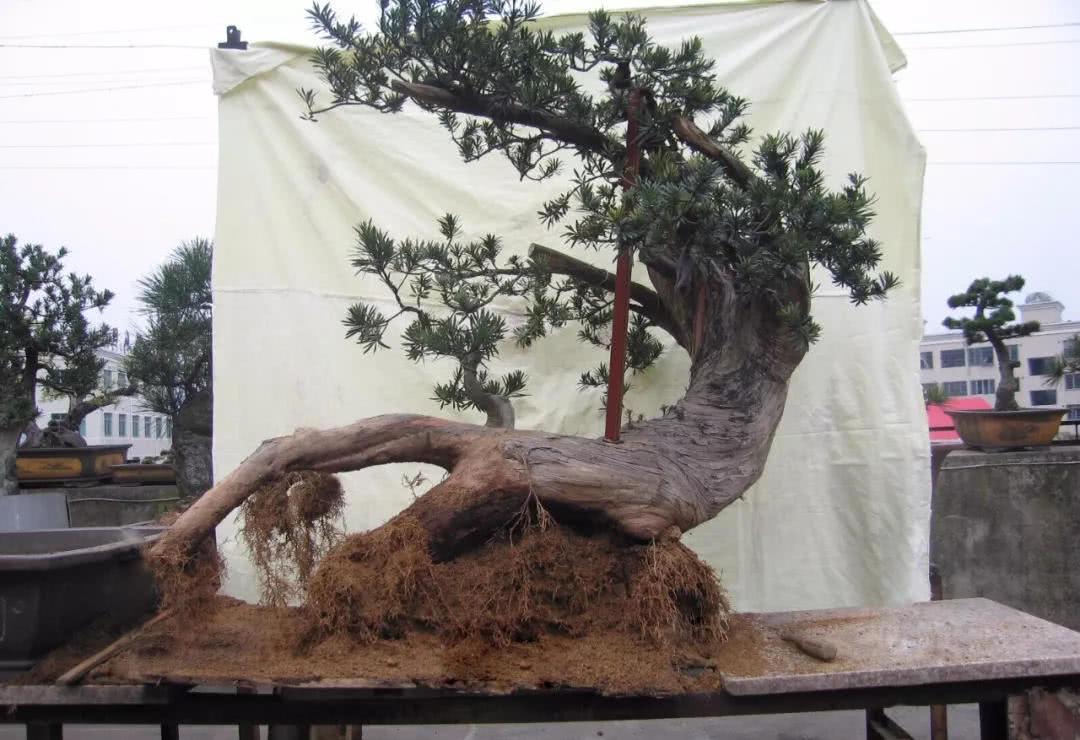
A century-old Buddhist pine (Podocarpus macrophyllus), after root pruning and more than ten years of transformation, has people lining up to buy it
If you want to grow a fine bonsai, it really cannot be done without more than ten years. Even an old stump with a hundred years of age, if it cannot be properly tended and cared for, is just useless dead wood like firewood. A gnarled Buddhist pine (Podocarpus macrophyllus) branch acquired in 2006, when bought, by eye it already had a history of over a hundred years. Its twisting, coiling curves were quite powerful, and its ancient simplicity still carried a majestic posture. Now more than ten years have passed, and after rebirth as a bonsai, people wanting to buy it come in an endless stream!
The original stump of this bonsai was very large. When bought, it did not have many leaves and almost no fine roots, only two thick roots. My experience in growing bonsai told me this stump could survive. After buying it at a high price and transporting the stump home, for a time there was no place to plant it, so I wrapped it in burlap, sprayed it with water to keep it moist, and kept it indoors like this for half a month. Later I made a wooden box, mixed coarse sand with loess, and transplanted the original stump into it.
After planting it in the wooden box like this, it was cultivated for as long as 1 year. During this period no fertilizer was applied, and usually only clear water was used, ensuring sufficient light and suitable temperature. After 1 year, the stump finally showed signs of life. Only then did I slowly begin applying very dilute fermented rapeseed cake water. In this simple way I grew it for another 2 years. The stump survived in this one-meter-long wooden box, the branches and leaves began to grow lush, and many fine roots emerged.
The stump survived, but the shape of the main roots was not very attractive, so when potting it I cut off part of the roots and also thinned out excessive fine roots. I wonder, if you like growing bonsai, how would you handle a root system lacking roots? After root pruning and careful care for a period of time, the original root area not only became fuller, but also had no scars. After that, I patiently cultivated it for another two or three years. When the branches grew thick, I would prune and shape the bonsai. In this way another three or four years passed, repeating over and over and advancing step by step, and the bonsai finally gradually approached the desired effect in its styling.
Half a year later, when the bonsai had become even more robust, I planted it into a purple clay pot, and after that began a more refined shaping process. This cultivation took another three or four years, and only then did it have the strange, smooth, and indescribably wonderful shape it has now. Of course, it still has a long way to go before final maturity. If every bonsai grower cultivated a beloved bonsai for more than ten years as if it were a single day, then even if people lined up to buy it and wore out the threshold, they probably would not hand it over to anyone else!