How to care for jasmine in autumn? Do these four things well, and it will bloom wave after wave and easily fill the pot
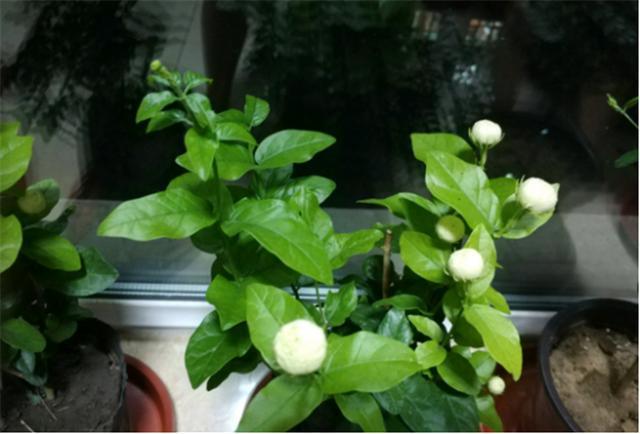
The pure and beautiful jasmine has been one of China's famous flowers since ancient times, and the fact that it was written into a famous song and spread widely proves how much Chinese people love it. As everyone knows, jasmine is a flower of summer, but in autumn, as long as it is cared for properly, it can still grow plump and strong. Not only can it produce autumn flowers, but it can also overwinter safely, so that next year it blooms bigger and better. So how can you give jasmine a "autumn fattening" to help it grow better? Below we have summarized four methods, and we hope to share them with you who grow jasmine. Let's take a look together.
1. When autumn arrives, don't rush to use the scissors first!
Many people who grow flowers and plants give their plants a "haircut" after autumn arrives, cutting off some excess branches and leaves to balance the nutrients the plants need. But jasmine may be a little different. Especially in early autumn, you must not prune jasmine. Why let little jasmine keep its long hair? Because in early autumn, due to the existence of the autumn tiger, the temperature in the air remains at a relatively high level. Jasmine still needs a large number of leaves for heat dissipation and photosynthesis. From another perspective, this is also a process of the jasmine itself accumulating energy, so we are in no hurry to prune.
Especially in most provinces in the south, during weather with the autumn tiger, jasmine can even bloom a few more times. Wouldn't it be a pity to cut it off directly? So large-scale pruning is not needed, but it is still fine to cut off some dead branches and rotten leaves on ordinary days, because these also affect jasmine's nutrient intake.
2. There are particularities to repotting jasmine
After blooming throughout the whole summer, jasmine has already consumed most of the nutrients in the soil by the time autumn arrives, and considering that winter is still ahead, many people complete the repotting of jasmine in autumn. This is very scientific, but there are also many particularities involved. If you are slightly careless, it may affect jasmine's subsequent growth, and in worse cases, it may even directly cause its death.
So what are the precautions here? The answer is that when repotting, you must not damage jasmine's roots. If you must repot it, remember to ensure throughout the whole process that the root-protecting soil around jasmine's roots is always present. Never wash the roots or break apart the soil ball wrapping the roots for the purpose of checking the roots. Simply replant it into new potting soil.
Of course, another point to note is that the new soil used for repotting jasmine should ideally not differ too much from the medium of the original soil. In this way, after being potted, jasmine can adapt to the potting soil more quickly! If jasmine establishes itself quickly, we will have more time to strengthen jasmine's root system before winter arrives, so jasmine will be safer in winter!
3. Give it a sunbath, and jasmine will not grow leggy
Jasmine cannot grow without sunlight. Throughout the summer, considering the fierce sun, we set up shade netting for jasmine at noon. But when autumn arrives, as the sunlight gradually becomes milder, we should let jasmine sunbathe even more, because otherwise jasmine is very likely to grow leggy. It is best to grow it outdoors if possible, as this can both promote flower bud differentiation, and jasmine is less prone to yellow leaves.
Of course, if you do not want to see flowers, then at this time you need to pay attention to making jasmine strong. After post-bloom pruning, you can appropriately apply a little fertilizer, but it should be little. Using too much nitrogen fertilizer will promote new shoots. If the new shoots are not woody enough, overwintering will be difficult, and it will be hard to see flowers next year.
4. Apply light fertilizer frequently, and jasmine will grow abundantly and strongly
When talking about "autumn fattening," how can we not consider the issue of fertilizer? But because the temperature throughout autumn keeps dropping, our fertilizing also needs to be done with care. First, the time for fertilizing can be chosen in the cooler evening. Dilute the fertilizer with clean water, then slowly pour it along the edge of the flowerpot onto the potting soil, and it is best to water with some "revival water" the next morning for even better results.
As for the choice of fertilizer type, it is best to use a fertilizer solution rich in and balanced with nitrogen, phosphorus, and potassium. Nitrogen fertilizer strengthens branches and leaves, phosphorus fertilizer promotes autumn flowers, and potassium fertilizer nourishes the roots and supports them. None of the three should be favored over the others. Only with balanced nutrient intake can jasmine truly become strong!
The four methods above are our special secret formula for giving jasmine an "autumn fattening." Those who are interested can give it a try.