A 4 sq m enclosed balcony blooms with tens of thousands of flowers, with something in bloom all year round
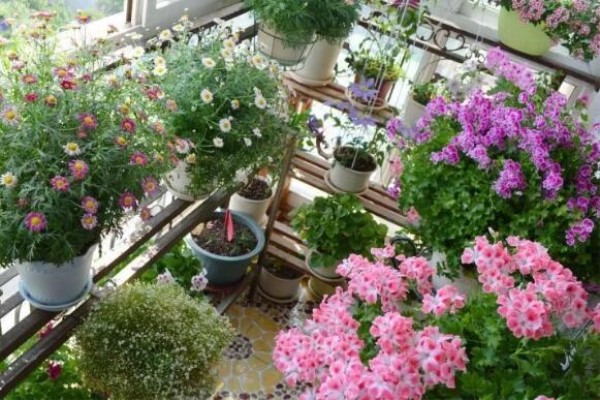
"Deep Blue Deep Purple Doudou" says she has a small balcony, 3.5 m long and 1.2 m wide, so roughly 4 sq m. It counts as an enclosed south-facing balcony, but the light is very good, and after opening the window the ventilation is usually good too. This is where she grows her flowers!
Flower lovers with a yard or a terrace can build a rose wall, but what can small balcony growers do? Why not try a little nasturtium waterfall to satisfy the craving!
The nasturtium sown in autumn bore bright red flowers. The nasturtium started out hanging at the front side of the balcony, and its own trailing habit made it grow longer and hang down more and more, which in turn affected the flowers on the flower stand, so its position had to be adjusted and it was placed on the inner flower stand.
The light on the inner flower stand is average; it only gets a bit of sun when the sun sets. Many people say nasturtiums love strong light, and at first she worried it would not open many blooms, but unexpectedly she got a full curtain of flowers cascading down!
Several tiers of shelves were set up on the side of the small balcony, and the one occupying half the space is naturally the geranium that all flower growers love!
The small balcony has limited space, and there are many geranium varieties she wants to grow, so choices must be made, and those free-flowering varieties must be selected.
For upright varieties, you can choose Princess, Mountain Palace, Ice Orange and so on. In summer, keep backup seedlings and continue growing them in autumn; getting through the summer is basically very easy. When repotting in autumn, add some base fertilizer and the flower quantity will be even greater!
Among the Regal Pelargoniums there are also many beautiful varieties, but because they need vernalization, many balcony growers simply give up on them. On a balcony, if vernalization cannot be achieved, the number of flowers produced is noticeably sparse. So you might as well grow Candy Pelargonium: it does not need low-temperature vernalization, and it keeps blooming, even through summer!
The Angel family is also a good group among geraniums; basically, once you grow it, you absolutely will not want to discard it!
The rest of the small balcony is basically taken over by all kinds of small herbaceous flowers that bloom into balls! Many people say Million Bells are hard to grow, but in fact the hardest part to grow is the roots! When they are seedlings, you must build up the roots; after the roots fill the pot, then plant them in place. After moving them to a large pot, start watering less, and do not let the potting soil stay wet all the time, otherwise the roots easily suffocate and the plant suddenly wilts and dies.
When it first arrived, it was still a small seedling!
It was first potted temporarily into a 9 cm two-color pot, and planted in place once the roots grew a bit stronger.
Once the roots of the Million Bells have filled the small pot, it can be potted up!
After planting in place, remember to keep pinching promptly and continuously, so the seedlings can send out more side branches, and only then can they burst into bloom as quickly as possible in spring!
In just a few months, Million Bells can bloom all over the small balcony!
The baby's breath sown in autumn in September, by late January, had turned into the shape of a flower ball and begun a strong takeover of the whole balcony!
How did her baby's breath burst into a flower ball? "Deep Blue Deep Purple Doudou" says she used seedling blocks, peat soil and perlite, and also mixed a little slow-release fertilizer into the soil. At the beginning, she sowed with seedling blocks and placed them in scattered light before germination, then gave them sun after germination. Because space was limited, she did not want to grow them in large pots, so she planted them directly in place.
After planting in place, do not water heavily from the seedling stage on; winter has few sunny days and water does not evaporate easily, so better dry than wet, and never let the roots suffocate. During the growing period of baby's breath, pinching is very important: more branching means more flowers. Generally, once a branch has more than 2 pairs of leaves, start pinching, and in this way the plant will keep producing more and more branches.
From the seedling stage to the medium-seedling stage, you should also keep pinching; but once the dense little flower buds emerge, there is no need to pinch anymore. In only 6 months, baby's breath goes from one seed to a big flower ball!
Besides baby's breath, you can also try lobelia when sowing in autumn. Similar to baby's breath, it also needs 6 months to bloom into a full flower ball!
For the soil for sowing lobelia, you can choose peat + perlite; for base fertilizer, you can choose fermented black chicken manure, bone meal and so on; for the water-soluble fertilizer used during the growing period, you can use something like Bikailflower.
If you want lobelia to bloom abundantly and burst into flower, frequent pinching is also indispensable. From the seedling stage on, it must go through continuous pinching to make the plant shape more compact.
Of course, choosing the right variety is also important. For example, Vieira belongs to the upright series; as it grows it basically does not easily fall apart, the plant shape is full, and it forms a flower ball especially easily!
Now let's talk about the rather popular marguerite! This flower is easy to grow and bursts into a full pot, absolutely worth growing one pot! This flower is good in every way except that it takes up too much space, especially for balcony growers, a pain and a joy at the same time. Although it does not show much at the seedling stage, once it blooms, one pot of flowers practically takes up the space of 3 pots of flowers!
The first one you see is Yellow Hydrangea. The lowest layer of petals of Yellow Hydrangea is white, and above it pile up little clusters of fluffy yellow flower centers; the plant shape is relatively compact and the flower stems are not long, so it is a variety worth keeping.
The pink double-petaled one has relatively long flower stems, but the color is very fairy-like, and it is even a gradient color, from light pink to divine pink; it is very beautiful when photographed up close.
Of course, lemon yellow, red double-petaled and Red Ma are all good choices!
Of course, the best-looking one must be Candy Marguerite! This flower can burst into a ball even without pinching, making it absolutely a must-have flower for lazy balcony growers!
And oxalis is also a flower that bursts into a full pot super easily! Whether placed directly on the windowsill or hung on a rack, the small balcony immediately becomes beautiful!
Clematis was just planted this spring. In winter the plant completely withered, and she thought it was going to die. Unexpectedly, it actually sprouted and bloomed in spring; she could not help but marvel at how tenacious its vitality is!
Besides these, there are also pansies, violas and all kinds of lilies, all blooming abundantly on the small balcony!
"Deep Blue Deep Purple Doudou"'s balcony has been like this for 6 years now.
According to her own words, as long as you are dedicated, even a small balcony of only a few sq m can burst into tens of thousands of flowers!