How to restyle a Japanese red pine bonsai "Crane Elder of the Deep Mountains"? Watch Huang Aoxun's process
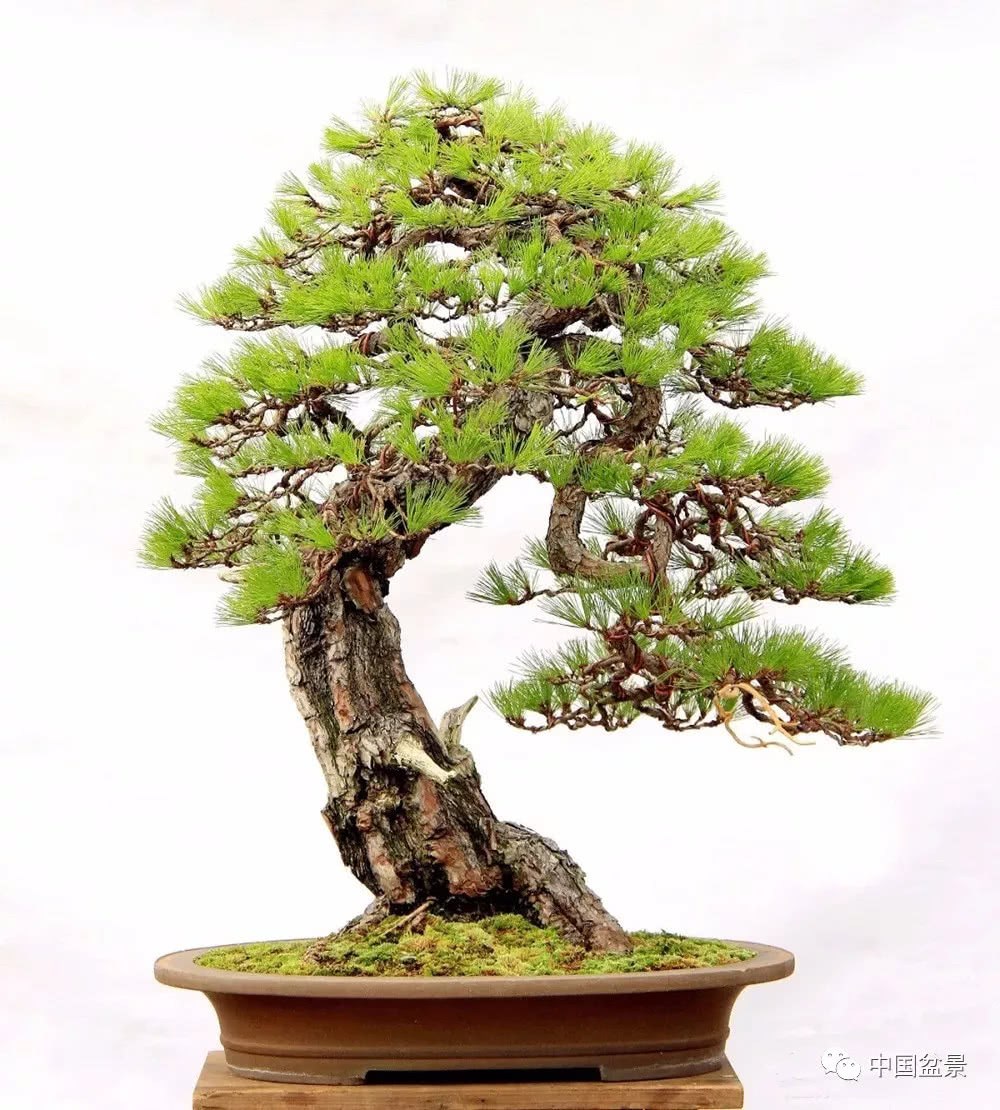
Huang Aoxun's restyled Japanese red pine bonsai "Crane Elder of the Deep Mountains"
Introduction
The pine, braving frost and snow, stands proud and unmatched. It first appears in the "Book of Songs - Minor Odes - Si Gan." Because of its long lifespan and its needles that do not wither through winter, it was used to wish longevity and symbolize eternal life: "Rank upon rank the Si Gan, deep and secluded the southern hills. Like bamboo clustering, like pine flourishing." Mr. Huang Aoxun likens it to the red-crowned crane, which likewise symbolizes longevity and in ancient times often accompanied Daoist cultivators - a truly fitting pairing.
How to restyle a Japanese red pine bonsai - The story of the birth of "Crane Elder of the Deep Mountains"
Original photos and text by | Huang Aoxun
This article was first published in "Chinese Bonsai & Viewing Stone" magazine, 2013 Issue 10. It was also published on the WeChat public account "Chinese Bonsai & Viewing Stone" on September 4, 2018. Chinese Bonsai obtained authorization from the original author for publication.
Analysis of the material
This is an extremely precious Japanese red pine. The previous author (owner) had already devoted a considerable amount of time to its cultivation. The main framework had already been adjusted into place, and it only needed the aluminum wire removed so it could be grown out freely. To date, this Japanese red pine work should be considered to be at the semi-finished stage of the creative process. Experienced viewers who see a work at this stage are invariably stirred by it.
The greatest highlights of this material are: a stable root base and trunk base, a main trunk with an ancient appearance, and its leaning trunk movement that is extremely varied, with natural transition from bottom to top. The first downward-hanging branch has an appropriate thickness ratio. In addition, after years of cultivation by the previous author, the branches and foliage are also relatively lush. These merits are enough to bring the restyler tremendous excitement and make them eager to try!
Gold is never pure, let alone bonsai! The shortcoming of this work is the branching habit of this species - overly long, disjointed branches leave the author feeling less than fully satisfied. But this Japanese red pine work has already eliminated this shortcoming at the current stage. If this work is to reach its peak of appreciation, it still requires constant cutting back and shortening of the existing twisted branches during maintenance, making the branch framework smoother and enhancing the strength of the branch momentum.
Appearance before restyling; on the right is attached the table of the restyling theme plan; tree height 104 cm
Concept and design
When I first learned bonsai long ago, my teacher once said, "In bonsai creation, one should establish the concept first, then shape it." At the time, I felt this was impossible to achieve. There were many reasons for this perception, mainly insufficient insight, following the crowd, and lacking the pursuit of art.
From the moment this Japanese red pine work entered the garden, after a period of observation and deliberation, the author envisioned a scene of a wise and robust old man living in seclusion deep in the mountains. The author then imagined his spiritual character - seeking no fame or profit, contending with no one - which cannot but inspire profound respect! Then there appeared in the mind scenes of a small stream, flowing water, empty mountains and secluded valleys, and flowers in full bloom. The author seemed to also hear the sound of cranes crying amid the soughing of pines - simply a paradise on earth in one's dreams. Thus, the work was titled "Crane Elder of the Deep Mountains," and the drawing of the "concept sketch" began. Next, the arrangement of branches and the layout of space were carried out around this theme. The restyled work and the theme bring out the best in each other, giving a feeling of being there in person.
Reflections on the restyling process
(1) First, draw back the branch that originally extended to the left a little, then bend the upper-right branch in coils toward the main trunk, turning the original extended branch into a downward-hanging branch. The overall loose tree form then contracts into an upright form, matching the thick, stable root base and the ancient, rugged trunk texture. The spatial variation between trunk and branches is cleverly utilized.
Tighten the original first extended branch on the left and turn it into a hanging branch
Adjust and correct the overall main framework, mainly by pulling and wrapping with thick copper wire, focusing on contracting the outer silhouette that expands to the left and right
Treatment of the back branch: break up the original crossing branches and pull them up
Copper wire alone is not strong enough; a thick copper rod is needed for support
In addition, the treatment of the hanging branch is also a difficulty: as a combined group (unit). It is both an independent hanging branch and must not lose its connection in terms of pictorial composition and transitional connection with the layer above. In actual operation, it is handled in stages. From thick branches to thin branches, each is positioned one by one. After the overall shaping is done, the "picture" is adjusted (as in the two photos below, which show an obvious difference. The upper photo shows the effect before detailed adjustment, and the lower photo shows the effect after the first detailed adjustment).
(2) Grasp the outer silhouette based on the root base and the directional tendency of the main trunk, achieving overall coordination and balance. At the same time, move closer to the theme "Crane Elder of the Deep Mountains," so that the overall tree form matches the theme.
(3) Reasonable matching of the overall branch framework and expression of style: The so-called restyling of this Japanese red pine can also be said to be a one-time shaping operation, in which there is great plasticity and freedom. It is precisely this freedom that brings the author both convenience and challenge. The convenience is that there is no risk in adjusting branches; only slight changes on the original basis are needed. The challenge lies in the arrangement of branches and space for this scene. In some aspects, even a tiny change can produce a difference in the quality of the "picture." It is like painting on a blank sheet of paper, bringing a test to the author in the exercise of creative style and consciousness. For this Japanese red pine, there are likewise two major thematic requirements: ancientness and harmony. The former is the aged tree age created through the baptism of nature over decades or even a hundred years; the latter pours in the author's spiritual pursuit. At the same time, bonsai is also a challenge to "spatial beauty." How the author cleverly uses space to let the work express overall harmonious beauty can all be presented in the scene. Such as richly varied layer distribution; just-right back branches for contrast; enhanced depth of the work through perspective effects; changes in solid and void conforming to pictorial composition; handling of details and deepening of the ancient feel of shari (deadwood) and the use of jin (dead branches), etc. Through the above techniques, the bonsai possesses both the serene and harmonious beauty of stillness and a majestic, spectacular sense of movement.
Front tree appearance after readjusting layers and space
Back tree appearance after readjusting layers and space
Left-side tree appearance after readjusting layers and space
Right-side tree appearance after readjusting layers and space
In the treatment of branches and pads, there are both clearly defined clump structures distributed in a staggered manner (like fine brushwork painting), and natural connections between layers and pads, making it appear relatively rugged (like freehand painting). The author's consistently used branch-arrangement style of combining "fine brushwork and freehand" is expressed to the fullest.
Summary
Bonsai creation is a long process, and the style of a work varies from person to person. Therefore, the restyling of this Japanese red pine is still at an early stage, and it is too soon to speak of good or bad. Only by improving the tree's quality through repeated restyling can the charm precipitated by time in the work be highlighted! At this point, the work obviously still has quite a few deficiencies, the obvious ones being as follows:
(1) The branch framework is not smooth enough. In the future, sectional cutting back and shortening are needed, gradually reducing unnatural twisted branches through continuous accumulation.
(2) The balance of layers and pads is not sufficient, and maintenance is likewise needed. This is especially shown in the lack of foliage volume in the crown; the hanging branch portion needs its increase controlled and appropriately reduced; the outer silhouette portion needs strict control of widening on the left and right sides, with appropriate adjustment of spatial variation.
(3) In the coming years, the relationship among trunk, branches, and leaves needs to be gradually adjusted, so that the charm of the bonsai increases and it becomes more pleasing to view over time.
(4) Although the height of this pot is suitable, the outward-flaring rim is too large, giving an unstable feeling when paired with this scene; it needs to be re-potted.
Highlights replay:
Chinese Bonsai welcomes you!
Enjoy anytimeBonsai exhibition hall
Promote bonsai culture, exchange bonsai skills!
Appreciate bonsai art, share a happy life!