Potted plants growing so vigorously they burst out of the pot, full of positive energy and vitality
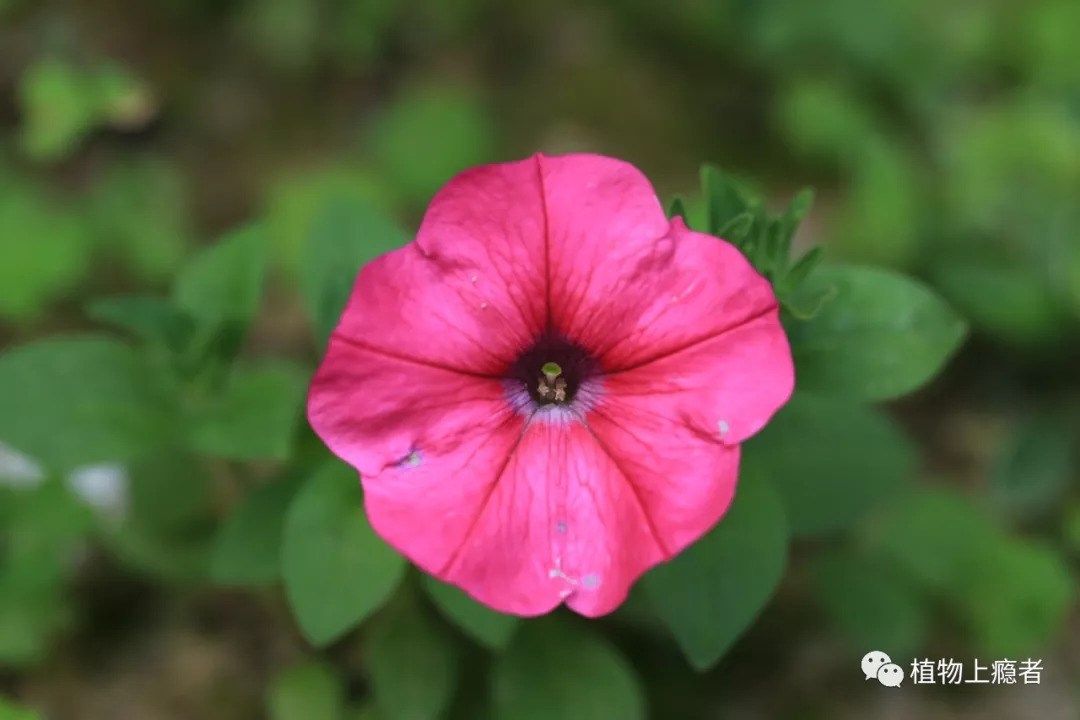
This is my own home-grown petunia
Petunia
Petunia hybrida
Also known as: Bidongqie
Solanaceae, Petunia genus
Annual herbaceous
Last issue's hibiscus was "someone else's flower"; this issue's petunia is the opposite - it's my own flower.
Chongqing's summer is too hot, shut in the air-conditioned room from morning to night, the delicate petunia flowers add vibrant life to the indoors, making me feel like I'm quite good at living well. Just like that, the petunia won the affection of the whole family.
Stamens of unequal length
The whole plant is fuzzy
What I grow at home, strictly speaking, is the small-flowered (multiflora) series of petunias, also called wuchunhua or million bells. Its flowers are solitary in the leaf axils, with a funnel-shaped corolla, flat limb, 5 distinct creases, about 4 cm in diameter, with five shallow lobes at the margin.
At a rough glance, it does look a bit like a morning glory, but on closer inspection you'll notice the difference: morning glory is radially symmetrical with 360-degree coverage, while petunia is not - it's somewhat two-lipped, not quite so standard.
The most unique feature of petunia is its stamens. Unlike most Solanaceae plants, its five stamens are of unequal length, usually 4 long and 1 short. But in reality, often only two can be seen at the throat of the flower, much like another oddball in SolanaceaeBrunfelsia. The style protrudes from the stamens, with a flat round stigma, jade-green, like emerald.
The whole plant is fuzzy: leaves, stems, slender pedicels, five-deeply-lobed sepals, and even the corolla. But these hairs are not rough at all; instead, they make its delicate flowers look even cuter.
Small-flowered (multiflora) petunias are usually potted or made into hanging baskets; the plants are more miniature, and the flowers are somewhat smaller, but the flower quantity is denser - with good care, it's easy to achieve a pot-bursting effect. Some taxonomists have given small-flowered petunias an independent scientific name, Calibrachoa hybrids, classifying them under Solanaceae, Calibrachoa genus (wuchunhua genus), but more botanists still tend to regard them as petunias. Small-flowered petunias were only developed abroad in the last dozen or so years, and are also a hybrid species, likewise possessing extremely rich flower colors.
Encountered on the way to work
Zhichi. Photographed in Zhenyuan, Guizhou
True petunias, also called large-flowered petunias, are also very common, usually planted as flowerbed plants. Their flowers are larger, the flowers on the stems are relatively sparser, and the plant form is more sprawling.
Large-flowered type, usually planted in the ground to beautify flowerbeds
The genus name Petunia comes from the French petun, meaning tobacco, referring to its flowers resembling tobacco - they're both in Solanaceae after all. Its other Chinese name, Bidongqie, comes from the transliteration of the genus name. The species epithet hybrida means "hybrid," and according to Flora of China, it was bred from a cross between P. integrifolia (creeping purple-flowered petunia) and P. axillaris (night-scented petunia). For more on the origins of hybrid petunias, see this article from Species Calendar: "Young one, is the 'morning glory' you see really what it seems?"
To this day, this hybrid species has far outstripped its two parents in prominence. Petunia is the most user-friendly Solanaceae plant, and countless cultivars have been developed so far - all kinds of colors, all kinds of stripes, even the rare black; long blooming period, abundant flowers; easy to grow. Breeding new petunia varieties has now become a big business.
Encountered on the street
Jiexian. Photographed in South Australia
The Petunia genus has over 20 species, all native to South America. The Maya and Inca peoples believed that their floral fragrance could drive away underground monsters and spirits. Their bouquets could be made into beverages with magical effects (juiced?), and according to folklore, petunias only grow in places with positive energy - they won't go to bad places.
Wang Anli. Photographed in Japan
Indeed, this is also why I love petunias: they are so down-to-earth, living joyfully wherever they are, just like those friends around us who know how to live well. For example, Teacher Wang Anli, who photographed the black and double-petaled petunias above - besides excelling at his day job, he also grows flowers beautifully, cooks beautifully, appreciates the elegance of calligraphy and poetry, and is a good father; his elementary school daughter, under his example and teaching, has also fallen in love with plants.
Another friend, the kitchen god @Ziranerran, named this ability "life force," and I think that's a great word. She explained, "Everyone has the desire to create a more interesting life. Life force is to small certain happiness what leadership is to the workplace - indispensable."
Especially when it comes to cooking, I give this ability a particularly high score. Haven't you seen how, no matter how pampered a little princess or young master is at home, once they go abroad to study, the first thing they need to learn is to cook for themselves. There's no other reason - the difference in quality of life between cooking for yourself and eating takeout all the time is enormous. This is a quality that no amount of money can buy. Teacher Wang Anli humbly says that being good at cooking is a "minor skill" - I can't agree. Confucius said, "Food and sex are human nature, the great desires of people" - concise and to the point, hitting the nail on the head.
A couple of days ago I saw the news: the new world's richest man, Amazon founder Bezos, said, "The most sexy thing I do is wash the dishes for my wife at home every day." This is likewise a quality of life that money can't buy.
Patagonian petunia (Petunia patagonica)
A small shrub native to Argentina and Chile, with solitary terminal flowers, pale yellow corolla densely covered with violet veins. Image from the internet.
In South America, petunias are also a popular gift. Giving petunias usually has two meanings: either to represent comfort, or to express anger and resentment. Quite contradictory, huh.
Although I've always been more used to calling it aidianniqian rather than bidongqie, I should still remind you: it has no family relationship with morning glory. Morning glory is in Convolvulaceae, a climbing vine, while petunia is in Solanaceae, an upright annual herb.
When it comes to naming plants, we've maintained the ancients' fine tradition of "expressing the essence, capturing the spirit," and the result is this: a whole bunch of plants with very distant blood relationships share the same Chinese name.
The article and plant photos (unless otherwise credited) are all original works by the author
Your sharing and appreciation are my greatest support
Plant Addict
WeChat ID: plantfiend
Discovering the unique beauty of every plant