The detailed 1700-year archive leaves me feeling as powerless as facing AlphaGo
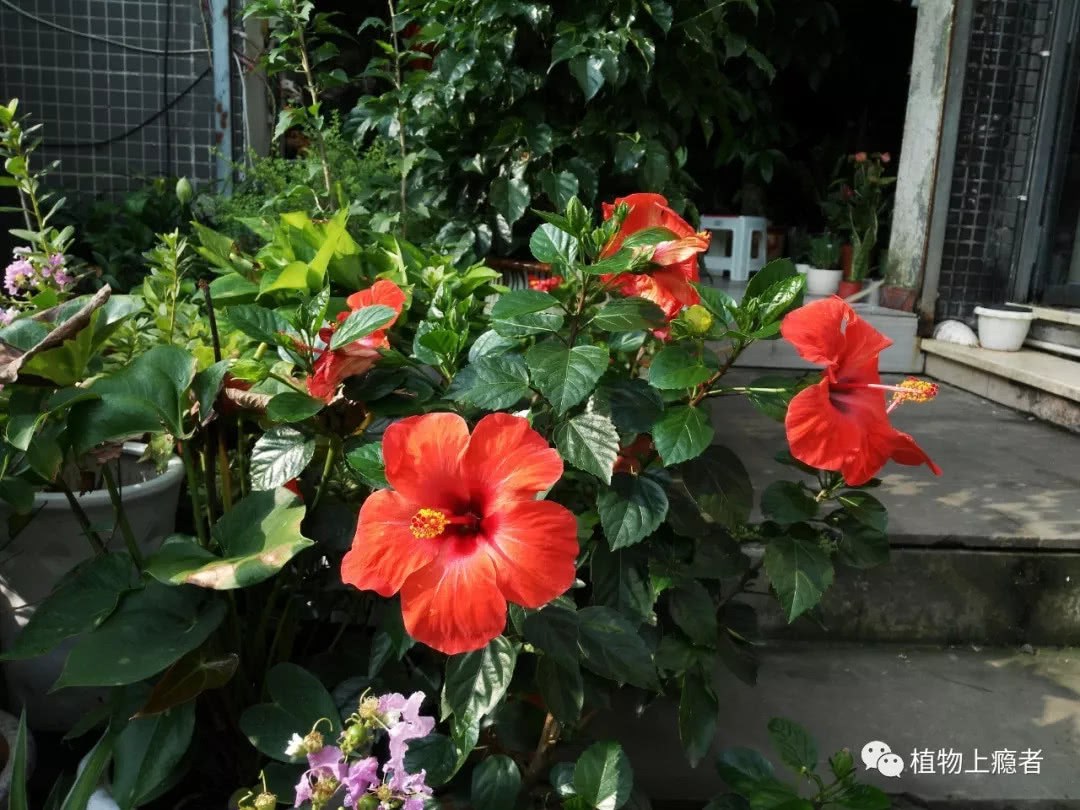
Hibiscus
Hibiscus rosa-sinensis
Malvaceae family, Hibiscus genus
Evergreen shrub
To me, the hibiscus has always been "someone else's flower."
I've encountered it in many places: along the road by the Zhou Mansion at Zengjiayan in Chongqing (where Premier Zhou once lived), the Nanshan Botanical Garden, a neighbor's garden in my residential compound, the flower market near my home; on the streets of Spain and Portugal... in every color, every flower shape.
To be honest, the hibiscus has large flowers and vivid colors - even among the Malvaceae family, which is packed with beauties, its looks are quite outstanding. But it seems I've always been just short of a real connection with it.
I've always had this quirk: for a plant to be formally "introduced" to me, I have to touch it with my own hands and dissect it before I can begin a real relationship with it. My mom said we actually used to grow them at home, but unfortunately I have no memory of it at all. It wasn't until recently that I finally had the chance to pick my first hibiscus (stolen, no less) and examine it closely.
This is a genuine hibiscus: five imbricate petals, crimson as blood, the flower measuring a full ten centimeters across - wider than my palm. The fused staminal column extends far beyond the petals, with anthers borne on the upper part of the column, kidney-shaped, versatile, releasing golden pollen after pollination. The pistil emerges from within the staminal column, its stigma divided into five branches, like five tiny red pompoms on top - very striking.
The petals of this large red hibiscus are relatively rounded. The one below was photographed last summer at Chongqing Nanshan Botanical Garden - also bright red, but with petal tips forming shallow wavy lobes, the entire flower drooping, giving it a more graceful and delicate posture.
Flowers solitary in the axils of upper leaves, often drooping
Staminal column extends far beyond the petals
The genus name Hibiscus comes from the Greek name hibiskos for a type of marsh mallow, and the species epithet rosa-sinensis means "rose of China." But today, the hibiscus is no longer just red - there are pink, yellow and white varieties too.
Pedicel articulated near the base, epicalyx bracts 6-7, linear; calyx bell-shaped, with 5 lobes
Double-flowered horticultural varieties are a bit harder to distinguish, especially when looking only at photos, because the flowers are all a crumpled mass. In that case, look at the leaves: Hibiscus syriacus leaves are usually lobed, while Hibiscus rosa-sinensis leaves are not lobed, with coarse serrations only on the upper half of the leaf margin, somewhat like mulberry leaves - hence the Chinese alias "Fusang."
Double-flowered hibiscus
Note that as a plant name, "Fusang" first appeared in the Classic of Mountains and Seas: "Fusang is a great tree, where the sun resides." But that Fusang is not this Fusang - according to expert research, the prototype of this legendary divine tree reaching to heaven is actually the white birch (Betula platyphylla). The true use of "Fusang" to refer to the hibiscus shrub began with Li Shizhen's Compendium of Materia Medica: "In the East Sea where the sun rises there is a Fusang tree; this flower is brilliant and shines in the sun, its leaves resemble mulberry, hence the comparison."
Leaves resemble mulberry leaves, hence the name Fusang
There is a category of flowers that is hardest to write about, because their history is so long that every pore has been thoroughly studied, and it's hard to write anything new. For example, plum blossom, peach blossom, camellia, and hibiscus. In greater China, the recorded archives for hibiscus span 1700 years. Whatever information you want to know, a quick online search yields detailed answers. Writing this installment was quite a struggle - I deeply felt the sense of powerlessness that Lee Sedol felt facing AlphaGo.
Let me share a few classic passages at random. The earliest record dates back to 304 AD, from the Nanfang Caomu Zhuang (Plants of the Southern Regions) by Ji Han of the Western Jin Dynasty:
"Its flower resembles the rose of Sharon but is deep red in color, and is called zhujin (vermilion hibiscus). Its stem and leaves all resemble mulberry, the leaves glossy and thick; the tree grows only four to five chi tall, with spreading branches and foliage. It blooms from the second month until midwinter, then stops. Its flowers are deep red, with five petals, as large as hollyhock. There is a single stamen, longer than the petals, tipped with golden particles; when the sunlight shines on it, it seems as if flames arise. On a single clump, hundreds of flowers open in a day, opening in the morning and falling at dusk; a cut branch stuck in soil will root. It comes from Gaoliang Commandery. Also called chijin, also called riji."
This passage is very classic and packed with information:
First, the hibiscus is closely related to the rose of Sharon,hollyhockand their flowers are very similar.
Second, the trait of opening in the morning and falling at dusk is the same as the rose of Sharon, but it's said that many improved hybrid varieties now can bloom for two or even three to four days.
Third, the hibiscus has a very long flowering period, nearly year-round.
Fourth, Gaoliang Commandery is today's Maoming and Yangjiang area in Guangdong. This shows the hibiscus carries tropical genes - no wonder Nanning in Guangxi, Maoming in Guangdong, Yuxi in Yunnan and Kaohsiung in Taiwan, China all chose it as their city flower. In Malaysia, the national flower known as the "Bunga Raya" is also the hibiscus.
Especially the four lines "There is a single stamen, tipped with golden particles; when the sunlight shines on it, it seems as if flames arise" - very vivid. I had never even noticed this unique dynamic beauty of the hibiscus - very impressive.
In the "Red Plum" chapter of the Beihu Lu by Duan Gonglu of the Tang Dynasty, the method of eating them is recorded in detail - good news for foodies:
"The plums of Lingnan are smaller than those east of the Yangtze; the locals pick them, mix them with hibiscus flowers, and expose them to the sun with salt. The plums become dyed by the hibiscus flowers, and their color is lovely."
It's said that foreigners even eat the tender leaves of hibiscus - I'm a bit skeptical; that seems a bit too Chinese in style.
Poems about the hibiscus are even more numerous than could be carried by oxen - you could totally hold a themed poetry contest. I've picked a few contestants at random; you decide who wrote the best.
Articles and plant photos (unless otherwise credited) are all original works by the author
Your shares and appreciation are the greatest support for me
Plant Addict
WeChat ID: plantfiend
Discovering the unique beauty of every plant