Thank goodness I didn't judge by appearances, or I would have missed such an interesting soul.
"The Beauty of Ferns"
05
Tuberous Sword Fern
Nephrolepis cordifolia
Aliases: Shihuangpi, Sword Fern, Centipede Grass
Family: Nephrolepidaceae Genus: Nephrolepis
The Lygodium japonicum, Cyrtomium fortunei, Pteris multifida, and Centipede Grass I wrote about before are all wild ferns. The Tuberous Sword Fern is different - the vast majority are cultivated.
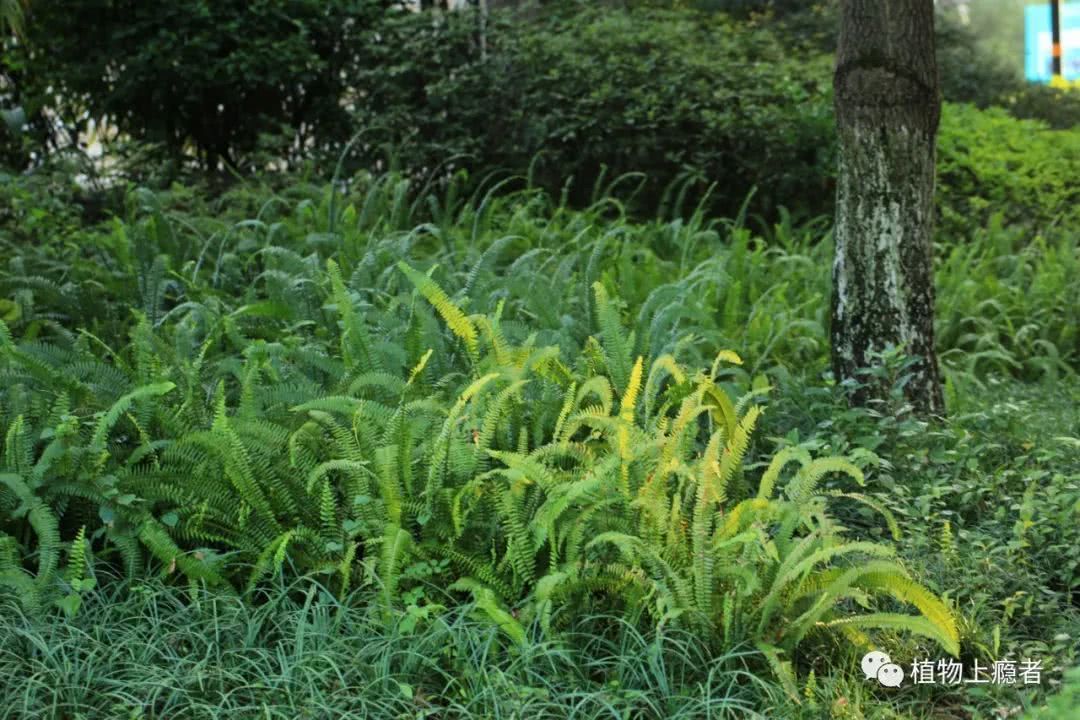
However, I didn't use to think the Tuberous Sword Fern was beautiful. It lacks the lively charm of wild ferns. Tuberous Sword Ferns are often used to fill in the blank spaces of neighborhood green spaces, or to enrich hedge varieties, and thus have a dull look unique to urban hedge plants. Even worse, when gardeners prune them, they often ruthlessly cut them in half at the waist - a pitiful sight.
But regardless, the Tuberous Sword Fern is one of the most commonly cultivated ornamental ferns in the world, and worth getting to know.
First, the name "Tuberous Sword Fern" comes from its kidney-shaped sori. This season, you can easily find spores arranged in two rows on the underside of its pinnae, with pale-colored indusia on top, also kidney-shaped. The genus name Nephrolepis is composed of the Greek roots nephros (kidney) + lepis (scale), referring precisely to this feature.
This season, spores are easy to find
The spores are kidney-shaped, also like a crescent moon
The sori are arranged in two rows on the underside of the pinnae
It was only when I flipped through my dad's red treasure book of Chinese herbal medicine that my interest was truly sparked. The Tuberous Sword Fern's alias is "Shihuangpi" (stone yellow skin), "its underground tubers are semi-transparent pale yellow, oval-shaped, named for resembling the fruit wampee." The Flora of China also says, "The tubers are rich in starch, edible, and also medicinal." Wampee is a tropical fruit, not commonly seen in Chongqing. A friend once brought some back from Guangzhou for me to taste, so I have a faint impression of it.
Wampee fruit, photo by Yifan
Last Saturday, I pulled up four Tuberous Sword Ferns in my neighborhood, but didn't find any Shihuangpi. That evening, lightning flashed and thunder roared, and rain poured down, sweeping away the stuffy heat that had lasted for many days. The next morning, the air was very cool and pleasant, and my dad and I took a walk to the top of the small hill near our neighborhood. Passing by the mid-hill clubhouse, there were several tall tropical landscape trees in the courtyard, their trunks covered with Tuberous Sword Ferns. I stopped to take photos, and soon discovered that the tree trunks were actually studded with round, semi-transparent gems - weren't those Shihuangpi? Truly, what you seek comes easily without effort.
This unexpected harvest left me satisfied all day. The Shihuangpi I picked up varied in size, hard to the touch, really like stones, but easily sliced in half with a fruit knife, with watery juice immediately flowing out from the cut surface, looking quite moist - truly "stone outside, water inside." Who invented this wonderfully apt name Shihuangpi? I really want to pay tribute to them, hehe.
Lots of Shihuangpi growing on the tree trunk
When I looked up the "Handbook of Common Chinese Herbal Medicines," the entry for Centipede Grass actually corresponded to the Tuberous Sword Fern, not the Centipede Grass I wrote about last time. Indeed, Centipede Grass and Comb Grass are both aliases of the Tuberous Sword Fern. Both ferns have odd-pinnate compound leaves, and once mature they're not hard to distinguish: the Tuberous Sword Fern's pinnae are short and dense, while Centipede Grass's pinnae are slender and sparse, and their spore forms are completely different. The appearance of the curled young fronds just as they unfurl is also completely different; but at some point in their youth, they do look somewhat similar.
The Tuberous Sword Fern's pinnae are short and dense, with a very dark midrib
The pinna margins have fine serrations, the middle pinnae are about 2 cm long
The upper base has an ear-shaped protrusion, covering the rachis
Young fronds, clearly different from Centipede Grass
How to tell them apart? The Tuberous Sword Fern's pinnae have several characteristics. First, the midrib is very dark in color, like a thin dark blue-purple line, while the young pinnae of Centipede Grass are pure green. Second, the base of the Tuberous Sword Fern is heart-shaped - its specific epithet cordifolia means "heart-shaped leaves" - but this heart is slanted, off-center. The upper side of the pinna base usually has a distinct ear-shaped protrusion, arranged in an imbricate pattern on the leaf underside - just like old-style tiled roofs, one piece overlapping another.
The most special feature of the Tuberous Sword Fern's pinnae is a ring of transparent water sacs along the margins, like a border of inlaid diamond chips, clearly visible to the naked eye. The position of these "diamond chips" is very particular. On both sides of the Tuberous Sword Fern's midrib are pinnate lateral veins extending diagonally upward, and these lateral veins branch again into veinlets that reach near the leaf margin. The "diamond chip" water sacs grow at the tips of these veinlets.
Perhaps you've already guessed that the spore positions on the underside of the Tuberous Sword Fern are not random either - they grow at the tips of the upper veinlet in each pair.
Water sacs like diamond chips
The placement of both spores and water sacs is very particular
At this point, the Tuberous Sword Fern's exquisite structure had completely won me over. Those Tuberous Sword Ferns growing freely in the wild must be far more beautiful than the ones I've seen, right? The Tuberous Sword Fern prefers forest understories and stream banks, distributed in Yunnan, Guizhou, Tibet, Hunan, Zhejiang, Fujian, Taiwan, China, Hainan, Guangdong, and Guangxi, and is also widespread in tropical and subtropical regions worldwide.
I already had a slight impression of the Tuberous Sword Fern before. I had read a book about plants in films, "A Chapter of Flowers Cast in Light and Shadow" (by Lan Zi Qing Hui). One chapter was about the film "GREEN CARD" and the Boston Fern.
Writing about the Tuberous Sword Fern this time reminded me, so I found this old film to watch. The male lead is the big-nosed Depardieu, and the female lead is Andie MacDowell, who starred in "Four Weddings and a Funeral." Andie plays a horticulturist who has her eye on an apartment with a greenhouse, but the landlord refuses single people; Depardieu is a Frenchman stranded in New York who desperately needs a green card. The two enter a sham marriage, each getting what they need. A very delicate, tender romance film. The Boston Fern appears in the greenhouse of this apartment.
According to the Missouri Botanical Garden, the Boston Fern (Nephrolepis exaltata "Bostoniensis"), known in English as Boston Fern, is one of the most popular, easiest to grow, and most famous indoor ferns in history, and many years ago earned the reputation of "the classic parlor fern." The "Boston" fronds initially grow upward, but at a certain age they gracefully curve and droop, making them especially suitable for hanging baskets or placing on high cabinets, letting the fronds elegantly cascade down. This variety prefers humid environments, so it grows better in bathrooms or kitchens.
Arching, drooping fronds are the main difference between "Boston" and the Tuberous Sword Fern. In addition, the original variety of "Boston," Nephrolepis exaltata, is known in English as sword fern, while the Tuberous Sword Fern is known in English as Tuberous sword fern. I suspect the Boston Fern probably doesn't have Shihuangpi.
The most famous Tuberous Sword Fern, "Boston," image from the internet
Even the most ordinary plant can withstand the most fastidious scrutiny. The process of getting to know the Tuberous Sword Fern was full of surprises, delight, and satisfaction - like newly befriending a plain-looking person, but as you get to know them, you discover they're not only knowledgeable and full of distinctive charm, but also humorous and fun. At that point, you'll silently say to yourself: Thank goodness I didn't judge by appearances, or I would have missed this interesting soul.
The article and plant photos (unless otherwise credited) are all original works by the author
Your shares and appreciation are my greatest support
Plant Addict
WeChat ID: plantfiend
Discovering the unique beauty of every plant