This clever little trickster, who could blame me for loving it so much
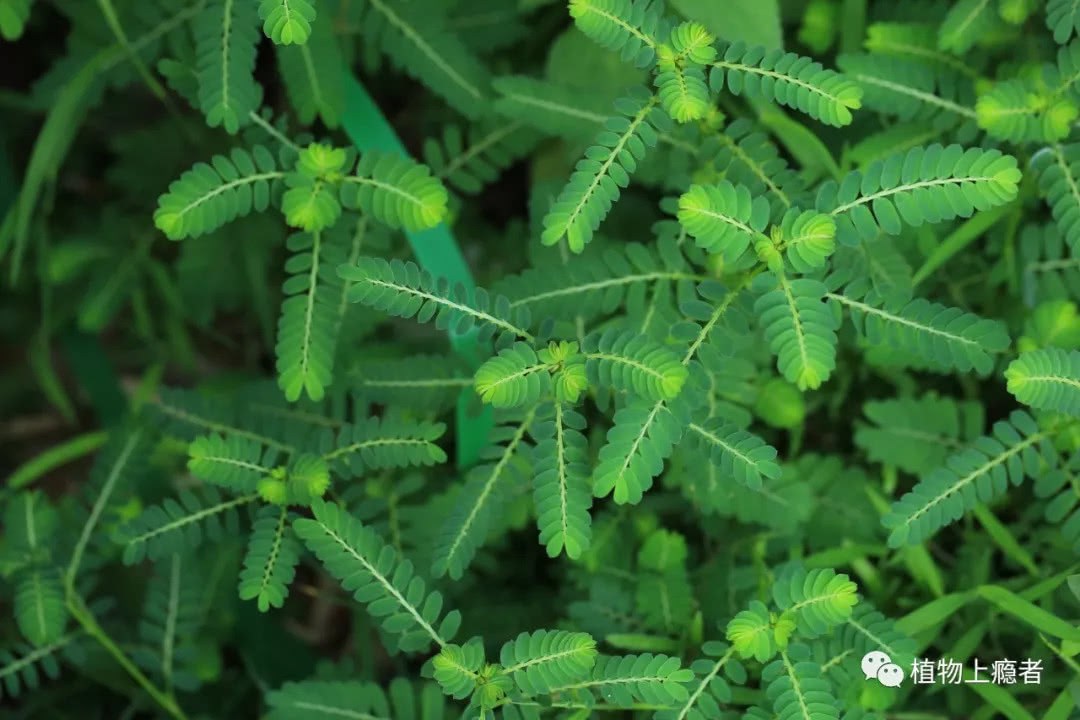
Phyllanthus urinaria
Phyllanthus urinaria
Phyllanthaceae, Phyllanthus
Annual herb
After I finished writing this article this morning, I was just about to do the layout when the article suddenly disappeared, probably deleted by accident. I tried two data recovery programs but couldn't find it either. Forget it, I'll just honestly write it all over again~
Phyllanthus urinaria, its name is beautiful and evocative, yet it is actually the most ordinary weed in the garden.
With the high temperatures and continuous clear skies, both people and trees have been wilted by the sun, yet it seems to do no harm to the vigorous vitality of Phyllanthus urinaria. All summer long, throughout the entire garden, it is the domain of Phyllanthus urinaria. They are lush and verdant, spreading a cool carpet over the earth. The word "weirui" means "the appearance of flourishing vegetation with drooping branches and leaves," and I think it is very fitting to describe the temperament of Phyllanthus urinaria.
Phyllanthus urinaria and I are old acquaintances who have known each other for many years. Every year when I notice it, it is in the height of summer, when its little green beads hang beneath the leaves. This is exactly the origin of the name Phyllanthus urinaria. It is said that after maturity, the green beads turn into red beads. I have not yet seen this with my own eyes, and I am very much looking forward to it.
Green beads and red beads are both the capsules of Phyllanthus urinaria. This bead is very cute, seemingly round and lustrous as a pearl, but it is a typical case of "beauty created by distance" - once magnified enough, you will see that its surface is actually covered with small protruding prickles.
Beads beneath the leaves
The surface of the bead is actually uneven
The leaf margins are also hairy
If there is fruit, there must first have been flowers. However, the flowers of Phyllanthus urinaria are truly too small; if you do not deliberately look for them, the result will inevitably be that you miss them. That is how it was last year. This year I learned my lesson, and finally caught them.
The flowers of Phyllanthus urinaria are divided into male and female, unisexual but on the same plant. Male flowers grow at the upper end of the branchlets, female flowers at the lower end. Male flowers are usually in clusters of several, but usually only one develops, appearing solitary in the leaf axil, with 6 yellow-green semi-transparent sepals, a disc of the same color, and 3 stamens. Female flowers are usually solitary, also with 6 yellow-green sepals and a disc, slightly smaller than the male flowers. The orange-yellow anthers make it easy to distinguish male flowers from female flowers.
You may have noticed that I did not mention the petals of Phyllanthus urinaria. Its flowers simply have no petals.
Male flower, with orange-yellow anthers
Female flower
Male flowers grow on the upper part of the branchlets, female flowers on the lower part
The leaves of Phyllanthus urinaria are also very deceptive, looking just like little green feathers. I naturally assumed it was a once-pinnately compound leaf, but I was wrong. Flora of China states it very clearly: leaves solitary, arranged in a pinnate pattern due to the twisting of the petiole.
But I am very curious: the longitudinal axis between the two rows of leaflets, is it a branchlet or the petiole of a compound leaf, and by exactly which criterion is this judged? Some readers have asked me the same question before, especially when identifying twice-pinnately compound leaves.
The answer is here: whether it can produce buds and flowers. What can flower on it is a branchlet; what cannot flower is a leaf rachis. I thought back, and for roses, black locust, or various Senna species whose leaves are once-pinnately compound, indeed, flowers never bloom on the leaf rachis.
Simple leaves alternate, disguised as pinnately compound leaves
That is not all - Phyllanthus urinaria continues to "deceive" me. When observing the specimen, I thought its delicate little leaflets were entire and hairless, which at one point made me suspect I had misidentified the species, because one of the identifying features of Phyllanthus urinaria is that "the lower margin of the leaf blade has 1-3 rows of short stiff hairs." It was not until I photographed it with a macro lens and magnified it that I clearly saw this feature (see the close-up image of the prickly fruit above).
The significance of nitpicking over such minutiae as "hairy or not hairy" is that the genus Phyllanthus is a large family, with nearly 800 species in total, and China has 30+ species as well. Many species look extremely similar. For example, the following Phyllanthus ussuriensis - Zhang Yongmei did not even notice it when photographing, but it was the sharp-eyed little Lele who spotted the difference.
Phyllanthus ussuriensis, photographed by Zhang Yongmei in Xiamen
This specimen was pulled up for me by my dad. It was growing in a large flower pot downstairs from my home, about 30 cm long. Very quickly, its two rows of leaflets folded together, and no matter how you tried, you could not pull them open, just like Mimosa. This often makes people mistakenly think it is a plant of the Fabaceae family. The alternative names "day-open night-close grass" and "door-closing grass" both refer to this characteristic of Phyllanthus urinaria. An even more interesting record comes from the Flora of Guangzhou: "Children in Meixian during the summer months pull up this plant by the fields, chanting 'hu xiuxiu,' and its leaves soon close, hence it is commonly called hu xiuxiu."
The name Phyllanthus urinaria first appeared in the Qing dynasty work Illustrated Investigation of the Names and Actualities of Plants (1880) by Wu Qijun: "Phyllanthus urinaria is commonly found in Jiangxi and Hunan beneath walls and in shady spots. It is four or five cun tall, just like the newly emerged buds of the night-closing tree, and its leaves also open by day and close by night. Beneath the leaves, along the stem, it bears seeds like millet, yellow when fresh and purple when ripe. Folk physicians say its nature is cool and that it can dispel miasmic qi."
The genus name Phyllanthus is formed from the Greek roots phyllon, meaning leaf, and anthos, meaning flower, referring to flowers borne on the back of the petiole-like branch. The species epithet urinaria means "belonging to urine." I recall that when I first became acquainted with it, my dad told me that Phyllanthus urinaria can "tonify the kidney." In traditional Chinese medicine, it is said that "the kidney governs the two excretions." Among Chinese herbal medicines, Phyllanthus urinaria is classified among those that promote water metabolism and relieve strangury, and it mainly treats urinary tract infections, urinary tract stones, and so on - truly full of urine character.
I have always had a private fondness for Phyllanthus urinaria. This "urine-natured" temperament of its actually suits me very well: what you see is often not the truth. To see the truth, you need to spend extra time, patience, and attention. In this era, attention and time are the scarcest resources, so being able to do this is, of course, true love.
Phyllanthus urinaria teases me truly anytime and anywhere. For example, its juvenile leaves, which look completely different. In the flower pots on the balcony, many always grow, and they once confused me greatly. Of course, by now, even if you were reduced to ashes I would still recognize you, hmph hmph.
Juvenile leaves
He Zhizhang's poem says: "Young I left home, old I return; my accent unchanged, my temple hair thin. Children see me but do not know me, smiling they ask, where does the guest come from." What the villagers remember is his youthful face. In the plant world, I have repeatedly encountered the opposite experience: I recognize the adult appearance of plants, yet often fail to recognize them when young.
Like the Koelreuteria bipinnata blooming profusely right now. This is one of my favorite trees. The year before last, I wrote an article for it"Koelreuteria bipinnata | All the beauty in this world is not as good as meeting you for the first time". I thought I was quite familiar with it. However, this small sapling, which is found everywhere in the garden, I still misidentified at first.
Young Koelreuteria bipinnata
Across from the office, Koelreuteria bipinnata is blooming beautifully
Distribution:
Produced in the provinces and regions of Southwest, South China, Central China, East China, Shanxi, Shaanxi, Hebei, and others, usually growing in open flat land below 500 m in elevation, dry fields, mountain roadsides, or forest edges. It is also distributed in India, Sri Lanka, Indochina, Japan, Malaysia, Indonesia, and as far as South America.
The article and plant images (unless otherwise credited) are all original works by the author
Your sharing and appreciation are the greatest support for me
Plant Addict
WeChat ID: plantfiend
Discovering the unique beauty of every plant