Lithops Summer Care Tips: A Two-Part Sharing Series by Nuan Er
Preface
Follow the Encyclopedia · Meet Beauty (WeChat ID: duoroubaike)
The main text begins:
Thanks to the author [Nuan Er] for theoriginal authorizationsharing
Source: Xianzhenyuan
Edited and compiled by: Encyclopedia Jun
Location: Tianshui City, Gansu Province
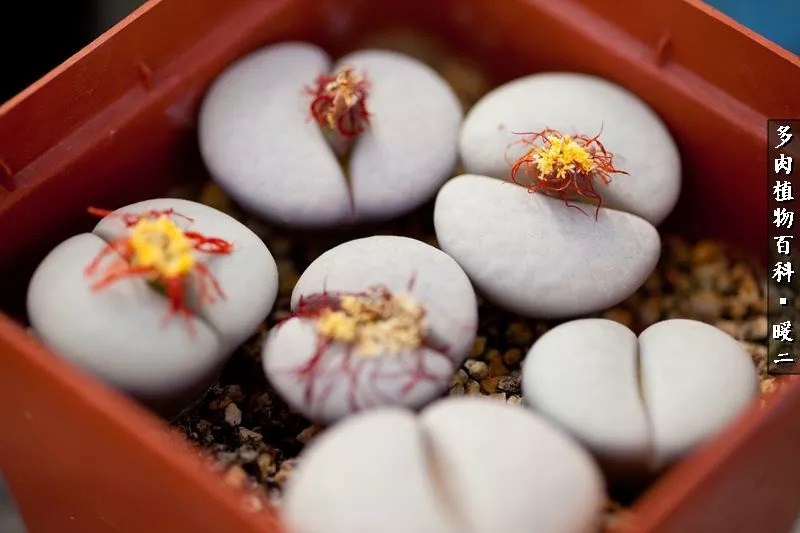
Recently it's been flowering season, busy as can be every day, coming home as worn out as a dead dog, but fortunately I don't have many Lithops pseudotruncatella 'Kogure' plants, and lately there's basically no pollen to pollinate, so taking advantage of tonight's cool weather, here's an update!
Once summer arrives, the whole country from north to south switches into barbecue mode, with everyone wailing, quitting the hobby every summer, and then buying buying buying again every autumn! So much for swearing off spending!!!
Personally I think lithops (Lithops) are quite heat-tolerant. In summer, in my own greenhouse at noon with no wind, the temperature will be between 50-60 degrees, and as long as there's no extreme situation, there's basically no damage over a summer, including first-molt seedlings.
I feel the reason lithops suffer losses over summer is probably like this:
1. No shade net.
Many growers' losses are because the temperature suddenly rises and they don't hang up a shade net in time. I generally start hanging mine in mid-April each year, using a four-pin shade net, and here there's generally no problem in summer. Growers elsewhere can refer to their own physical indicators: if you feel the temperature starting to rise and you need a thin jacket plus a T-shirt, then you can consider it.
After you start hanging the shade net, don't give too much water. If after watering you find slight etiolation, that means there's too much shading, so just remove it or switch to a sparser shade net!The hanging height especially needs attention. Balcony growers had best keep it at a height of 1.5 m or more, because black shade nets absorb heat, and about 40 cm below the shade net the temperature will be very hot, so the hanging height is key.
For greenhouses I generally suspend the shade net, keeping a distance of about 20 cm from the roof, so the high temperature under the shade net won't conduct to the roof and the interior will be a bit cooler. The position of the shade net also needs to take the sun's direction into account; autumn afternoon sun is quite fierce, so note that the west side also needs shading.
2. Improper watering.
Watering won't cause lithops to die; rather, after watering, the outer leaf walls of plump lithops become thinner, and when they meet scalding-hot soil they get scorched, which then leads to death. Or, because the soil isn't breathable, heat can't escape and they get steamed, which is the more common case.So watering is best done in the evening or at night when the temperature drops, and the watering method should preferably be the soak-and-drain method, with as little water as possible. Growers with a lot of peat must absolutely not wait until the soil surface is wet before taking the pot out; just leave it in the water for a few seconds and take it out. Don't give too much, otherwise if the water doesn't dry in a day, the next day when the sun shines, it'll turn white in no time! Growers whose lithops have split into doubles must be careful not to pour a lot of water between the two heads; if it's always wet between the two legs they can easily die!
3. No ventilation.
Ventilation is the most important thing in summer. Southern growers feel that northern conditions are a bit better, and that's on the ventilation issue: southern growers have high air humidity, and sometimes even without watering the plants grow tall, precisely because ventilation is poor.Lithops like a somewhat ventilated and dry environment. In my greenhouse some got scorched because of my improper watering, but once the daytime temperature rises the wounds dry quickly and won't keep rotting into mush, and after autumn molting they can start over as new plants. So if southern growers find rot caused by scorching, don't use carbendazim (using carbendazim on a rotting wound may speed up the plant's death); using a heat gun on low to dry the wound may be a better choice.
Summer losses, apart from insects eating and rodents gnawing, are often due to factors like these, or several of these factors mixed together. And summer is the flowering season for lithops, when you often need to give the flowers more water and fertilizer, which invisibly increases the chance of losses. So watering requires some experience, and the accumulation of experience is often accompanied by the death of flowers. I hope everyone will be diligent and reduce losses as much as possible, letting the flowers accompany us a while longer.
Appreciate the author:If you like this article, besides sharing it to your Moments, you're also welcome to long-press and scan the WeChat appreciation code above to tip the author of this article!
This article has beenauthorizedby the author. WeChat public account: Succulent Plant Encyclopedia (ID: duoroubaike). The content of the article does not represent the views or stance of the public account! The Encyclopedia has signed with a third-party internet copyright enforcement company and has launched website-wide rights protection. Unauthorized reproduction by other platforms is strictly prohibited! If plagiarism is discovered, infringement liability will be pursued! Netizen reports are welcome!
Advertisement ADVERTISEMENT
Succulent culture needs you and me to promote it! Remember to share good articles more, so more people fall in love with succulents! Use the power of plants to influence and heal the people around us!