Recalling Twenty Years as a Student of Bonsai Master Kong Taichu
1976, birthday banquet at Panxi Restaurant in Guangzhou. First from the left is Guan Yao, first from the right is Kong Taichu, second from the left is He Ji, third from the left is Tang Xin, and Liu Zhongming is in the blank direction.
I was originally the accountant at Wanchang Teahouse in Xiguan, Guangzhou. After the public-private joint operation, I was transferred to the catering industry in the Xicun area of Liwan as an accountant, and in the 1960s I worked at the Xinguanhua Teahouse at the end of Xihua Road. I began growing bonsai as a hobby in my spare time at the age of 40 (1961), and two years later I met Lingnan bonsai master Kong Taichu, who was then working at Liuhua West Garden. Over the following twenty years, I studied the art of bonsai cultivation under Teacher Kong in my spare time, and I hereby recall below the impressions that Teacher Kong's words and deeds left on me during the twenty years of our teacher-student association.⟧
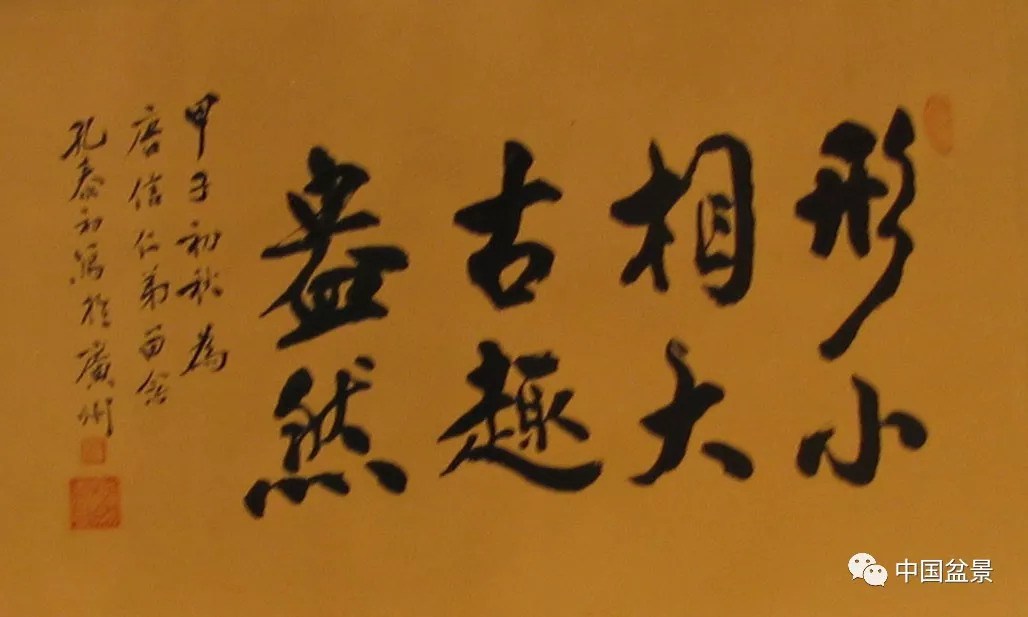
Teacher Kong was originally the heir to the ancestral business of Shengmaotai Tea House on Jianglan Road in Xiguan, Guangzhou. He was born in 1903. In his youth he loved calligraphy and painting, and because the area around Jianglan Road had by then formed a "shuzaitou" (bonsai tree stumps) market, Teacher Kong naturally combined his love of calligraphy and painting with the pursuit of bonsai art. On the rooftop of his home he grew more than a hundred pots of bonsai, including orange jasmine (Murraya paniculata), sour plum, elm, and tea. He would first paint the ideal tree form in a picture, paste it up in the hall, and then, referring to the tree form in the painting, prune the tree stump in the pot. He once said to me: "If you want to master bonsai, first you must go deep into nature to look at tree forms, and second you must look at tree forms in collections of ancient paintings." To grasp their artistic conception and learn their techniques is what is called "storing branches and truncating the trunk." A successful bonsai is achieved through artistic shaping and technical pruning, as if a great tree of a thousand or a hundred years were transplanted into a one-foot pot by the technique of "shrinking the dragon to an inch." This is precisely what is special about the art of Lingnan bonsai. The beauty of the tree form is based on the principles of transparency, "the front does not block the back, the top does not cover the bottom," and an overall sense of movement. During the Republic of China period, there were not many people in Guangzhou who truly played with shuzaitou, only about twenty or thirty in the whole city. These enthusiasts were mainly doctors, merchants, and university professors. At that time, artistic bonsai players did not make a living by selling bonsai; they aimed only at artistic appreciation and exchange.
After the liberation of Guangzhou, the people's government attached importance to developing the art of bonsai cultivation. In the 1950s, a bonsai exhibition was held for the first time at Guangzhou Cultural Park. Because the exhibition hall's facilities were crude, Teacher Kong even had to borrow tea chests from his family's Shengmaotai Tea House to prop up the exhibits. This exhibition made the city leaders aware of Teacher Kong, who possessed a very high artistic level. A city leader wanted to set up a bonsai cultivation base at Tingyu Pavilion on Yuexiu Hill, and urged Teacher Kong to move all the bonsai from his home there and work full-time as a horticultural master devoted to cultivating artistic bonsai. Teacher Kong gladly agreed, selflessly donated his bonsai, and took up the post as ordered. In the early 1960s, Guangzhou held its second artistic bonsai exhibition here. There were more participants than at the first. The exhibition established first, second, third, and fourth prizes. The works were also compiled into a book and selected for inclusion in the book "Guangzhou Bonsai," published in January 1961 by the Guangzhou Bonsai Art Research Society. Seven of Teacher Kong's works were rated first prize. In addition, works by Su Ren, Su Qiao, Mo Minfu, He Gongxia, Li Kang, Chen Linpu, Zhou Xingfu, Li Chuan, Zhang Ruitu, and others were also rated first prize and included in the book. Among them, Teacher Kong's bonsai "Spring After Spring - Chinese Sweet Plum (Sageretia thea)" was, on Premier Zhou's suggestion, transferred to Beijing and presented to the visiting foreign guest Emperor Selassie of Ethiopia. The artistic bonsai cultivation base was later moved from Yuexiu Hill to Liuhua West Garden.
Teacher Kong never publicly criticized other people's bonsai. But to those who came sincerely seeking instruction, Teacher Kong would genuinely offer artistic guidance. For example, Liu Zhongming once carried his bonsai to Teacher Kong's home and pruned it under Teacher Kong's guidance.
Over the years, I studied Teacher Kong's method of first extracting from nature and ancient paintings an artistic image group of tree forms in the mind, and then using those artistic images to guide the cultivation of artistic bonsai, and I also achieved a certain improvement. I once spent 10 years looking at ancient paintings, including ancient paintings in the Palace Museum, and compiled them into "Selected Tree Forms from Famous Paintings of Successive Dynasties." In the 1980s, I once exchanged views with the Hong Kong, China horticulturist Teacher Zhou Guang, who greatly appreciated my compilation of ancient paintings. I also went to Hainan four times during the 1960s and 1970s to look at tree forms and dig up tree stumps. In Jiaji Town, Qionghai, Hainan, an old friend took me to look at and dig for them. There was also a driver friend from the Nanhai Farm on Hainan Island who, whenever he came to Guangzhou, would certainly bring a dozen or so orange jasmine plants to my home to visit me. I have a particular fondness for cultivating orange jasmine. My home once had seventy or eighty pots of orange jasmine, and I also wrote an article of more than 10,000 words on my experience titled "How to Grow Orange Jasmine." In April 1987, one of my orange jasmine bonsai, titled "The Old Tree Pities Me, First Revealing a Bit of Spring at the Branch Tips," was sent to Beijing to take part in the First China Flower Expo and won the "Excellent Bonsai Work Award." In the 1980s I served as executive deputy secretary-general of the Guangdong Lingnan Bonsai Research Society, and together with horticulturists such as Liu Zhongming and Lu Zhiwei, I served as an instructor in the provincial bonsai association's bonsai art training classes. In the 1990s, I published some articles introducing Guangzhou bonsai art in overseas newspapers. For example, in "Sing Tao Daily" I published pieces such as "A Brief Introduction to Lingnan School Artistic Bonsai" and "The Source of Lingnan Bonsai Art and the Two Great Masters of Lingnan." The two great masters were Teacher Kong and Chen Suren of Haizhuang Temple in Guangzhou (who passed away in 1962).
Bonsai horticulture cultivates character and also brings horticulturists long life. Teacher Kong did not pass away until the age of 82. On the first anniversary of Teacher Kong's death, I wrote two memorial poems:
The first is: "For twenty years I received my teacher's instruction, and I am ashamed that as a mediocre talent I have not mastered it. With cold eyes I see the flourishing of unorthodox paths; I will carry on his teachings to repay Master Kong." The last two lines of this poem actually also involve a matter on which I sought Teacher Kong's advice. In the early 1980s, artistic bonsai developed faster in a social environment where all trades were reviving. But a few individuals in the city bonsai association got overheated, valued making money above art, and publicly declared, "If you can't make money from growing shuzaitou within two or three years, then don't grow them," and "Lingnan bonsai art is outdated," and so on. On this matter, I sought Teacher Kong's advice. Teacher Kong replied, "They are merchants, not people who play with bonsai. Why bother with them?" Teacher Kong's words both upheld the path of true horticulturists in Lingnan bonsai art and, with a broad mind, allowed others to take the path of growing bonsai to get rich. But this overheated individual was later sentenced to prison for using his position to extort ancient pots and tree stumps, becoming a topic of idle laughter among people in the bonsai world. Meanwhile, the Lingnan bonsai art of Guangzhou was able to continue developing healthily.
The second is: "Empty fame and foul wealth are both void; in life I admire Master Tao for his simplicity. (Master Tao refers to Tao Yuanming.) Bonsai gladdens the heart and calms the mind; I wish to turn this small skill into a spring breeze." With this poem I commemorate the elegance of Teacher Kong's life and also express my own aspirations.
Oral account by Tang Xin, an 87-year-old Lingnan bonsai elder
Recorded and arranged by Hu Wenzhong
December 7, 2007
Highlights:
Chinese bonsai welcomes you!
Enjoy at any timethebonsai exhibition hall
Promote bonsai culture, exchange bonsai skills!
Appreciate bonsai art, share a happy life!