Detailed Explanation of the Configuration Elements and Principles of Plant Landscaping
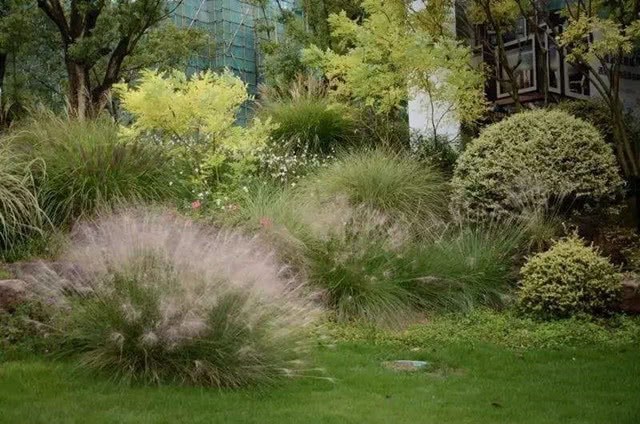
As people's demands for their living environment grow higher and higher, plants occupy an important position in the environment. Plant landscaping refers to the use of artificial design, planting, maintenance and other means to make plant communities or individual plants bring people a feeling or association of beauty in form, color, lines and shapes, that is, to create a specific landscape through activities such as reasonably matching and planting ornamental plants and shaping them. Plants also play a positive role in regulating human psychology and spirit, and serve to divide space and achieve a landscape effect in which the scenery changes with every step.
Elements of Plant Configuration
I. Plant Color
Color can change the three-dimensional visual size of a real object, guide people's line of sight, and increase the depth of the landscape. Bright tones such as red, yellow and orange-red make objects appear more conspicuous and prominent, making objects visually approach. Cool tones such as green, blue and purple make objects visually recede. Gray and black are neutral colors, most suitable as the background base color for bright tones.
II. Plant Size
The most direct and most realistic spatial feature among plant element characteristics. (Trees, shrubs), the plant size element is an element with variable characteristics, and all plant design must be considered from two aspects: first, the size of the plant when mature, and second, the size of the plant when first planted.
III. Plant Shape and Form
Spherical, umbrella-shaped, weeping, spire-shaped, spindle-shaped, columnar, free-form. In principle, plants with extreme shapes should be planted as specimens rather than in groups, such as old tree stumps, weeping willows, Sophora japonica 'Pendula', and Salix matsudana 'Tortuosa'.
Lines and texture, geometric lines and shapes are an organizational technique for plant landscape configuration.
Straight lines express a strong sense of direction and movement, so people often use vertical or horizontal linear plant groups to guide people's line of sight.
Curves give the landscape more natural, gentle and elegant effects. Texture is the synthesis of the rough or fine external appearance and overall temperament of a plant; it is the comprehensive expression of plant size, surface vision, leaf and branch form, and so on.
Principles of Plant Configuration
I. The Principle of Diversity and Unity
Diversity and unity is also often called unified coordination. The greatest art is to turn the most complex diversity into the highest degree of unity. Diversity and unity is the basic landscaping principle of the formal beauty of plant landscapes. In plant landscape design, the shape, color, lines, texture and mutual combination of plants should all have a certain degree of variation to show differences, while at the same time maintaining consistency among them to achieve a sense of unity, seeking change within unity and unity within change.
II. The Principle of Rhythm and Cadence
In landscape design, regular changes in plants produce a sense of rhythm, which can avoid monotony. For example, if a long continuous ribbon-shaped flowerbed along a road has no variation at all, it will make people feel very monotonous, but if its form is continuously broken up, forming a situation in which large and small flowerbeds appear one after another, it will bring the visual sense a rhythm and cadence rich in variation.
III. The Principle of Proportion and Scale
Unlike hard landscape, the relevant spatial proportions of plant landscape configuration must consider not only three-dimensional spatial relationships, but also the three-dimensional changes of plants over time.
IV. The Principle of Symmetry and Balance
Symmetry is a form with strong regularity that easily achieves a sense of balance and stability. No creation can do without the principle of symmetry and balance.
V. The Principle of Contrast and Harmony
Contrast and harmony are a pair of contradictory elements; when applied appropriately they produce beauty, and when applied improperly they form ugliness. In plant landscaping, contrast through color, appearance, lines, texture, volume, composition and so on can create strong visual effects and inspire people's aesthetic experience.
VI. The Principle of Theme and Plot
The principle of theme and plot is not an indispensable component of plant landscape configuration, but a work with theme and plot can still be considered a good work; it can often add cultural elements to the work and bring more interest and a more compact structure.