Fish actually have this kind of death, and it's totally unexpected
On a bridge at the border between Kenya and Tanzania, Chris Dutton and Amanda Subalusky noticed that whenever the Mara River rose by a few dozen centimeters, dead fish would be washed ashore, sometimes in numbers reaching over a thousand, but they could never figure outwhy the fish kept dying。
Storks, vultures, crocodiles and hyenas quickly dispose of the dead fish, so if you don't witness the dead fish yourself, you'd have no idea the fish were dying. Local rangers knew about this phenomenon, but they attributed the cause to farmers spraying pesticides on fields upstream.
Hippo poop is killing the fish
In fact, the culprit was not the farmers. Dutton and Subalusky conducted a series of increasingly bold experiments, including remote-controlled boats, computer simulations, building temporary dams and large tanks containing excrement. In the end, they found the real cause -hippos。
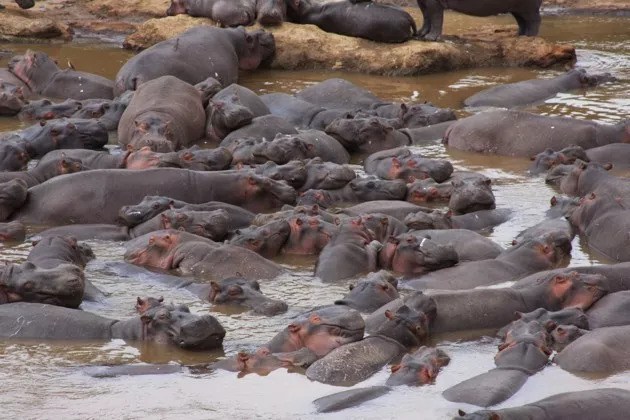
A hippo pool. Image: Chris Dutton
The couple published their findings, and the paper's title was quite polite: "Organic matter loading by hippopotami causes subsidy overload resulting in downstream hypoxia and fish kills," which in plain language means"Hippos sometimes poop so much that they smother the fish to death"。
Hippos generally enter grasslands at night to graze, then return to the river during the day to keep their bodies cool and prevent sunburn.When they roll around in the water, they frequently excrete urine and feces. This stretch of the Mara River is only 100 km long, yet it contains about 4,000 hippos and the 8.5 tonnes of waste they excrete each day. "If you put a net in the water downstream, within seconds the entire center of the net will be packed with hippo feces," Dutton said. "There's hippo dung everywhere on the rocks and the riverbed."
Beware of poop spray. Image: badarun / basenotes.net
Building a dam in the hippo pool
During the dry season, when the Mara River becomes narrow and shallow, hippos in some stretches become especially concentrated - and so does their feces. Hippos are aggressive, dangerous animals, and only the most reckless researchers would dare venture into the so-called "hippo pools." Dutton and Subalusky did not do so; instead, they deployed a remote-controlled boat equipped with sensors to probe the "hippo pools." They found that the mud and water at the bottom of these hippo gathering siteswere practically a mess, full of ammonia, methane, hydrogen sulfide and other bizarre chemicals. And because bacteria digesting the accumulated hippo feces consume almost all the oxygen in the water,these places are extremely low in oxygen。
Hippos are wary of the remote-controlled small boat. Image: Amanda Subalusky
When heavy rains come, large amounts of rainwater flow into the hippo pools, stirring up the rotting filth and flushing it downstream,just like flushing a toilet, a phenomenon known as a "flushing flow." To study flushing flows, Dutton and Subalusky used oxygen loggers, and the readings showed that flushing flows significantly reduced oxygen levels downstream, thereby suffocating the fish.
They designed experiments specifically to verify this idea. They added hippo feces to bottles of water, demonstrating that the dissolved oxygen content of the water in the bottles would decline. They also placed feces-containing water into "experimental streams" (long trays used to simulate rivers), but even so, they still longed for a more realistic experiment. "At the time we were discussing ways to create water flow using a pond, and some other researchers said'Why not build a small dam?'”
The small dam the two built. Image: Amanda Subalusky
Dutton and Subalusky were greatly inspired. They used sandbags to cut off the water supply to a nearby pond, a pond within hippo territory but not frequently visited by them. Their assistants helped them obtain a large truck, two 4,000-liter large tanks and a large wastewater pump. With these they transferred 16,000 liters of hippo feces water into the artificial pond. When they removed the sandbags, the data showed that oxygen levels downstream dropped significantly.
Transferring hippo feces water to the artificial pond. Image: Chris Dutton
This is the second published study on how hippo feces affects the river environment. Previously, Keenan Stears of the University of California, Santa Barbara conducted a similar study on the Great Ruaha River in Tanzania. Unlike the Mara River, the water of the Great Ruaha River is heavily consumed by farms upstream, and during the dry season the river completely stops flowing, and in that basin thehippos become confined to isolated small pools。
Stears found that ponds with concentrated hippos had less oxygen compared to ponds with fewer hippos, and thediversity of fish and invertebrates was half that of the latter, and the number of fish was only 4% of the latter. Only during the rainy season, when the river once again connects the various ponds, do the diversity and numbers of fish and invertebrates rise.
Examining dead fish. Image: Chris Dutton
Stears estimates that about 94% of Africa's hippos live in rivers like the Great Ruaha, rivers that have either already begun to dry up or are very likely to gradually dry up later with climate change. "Our findings reveal new problems relevant to all of Africa," he said.
What does an undisturbed river look like?
Dutton and Subalusky's research shows that even in a relatively undisturbed river like the Mara, hippos and the oxygen-depleting waste they produce can sometimes be a problem. And their research prompts us to rethink -what "undisturbed" really means。
They point out that large numbers of migrating wildebeest drown in the Mara River, bringing to this river each year1,100 tonnes of carcasses, thereby nourishing the Serengeti Plain. "The Mara River is truly a unique system," Subalusky said.Hippos and wildebeest act as a "conveyor belt", transporting terrestrial nutrients into the water in the form of excrement and carcasses, and the places these river waters flow through are full of herds of elephants, thousands of zebras and antelopes.
Wildebeest carcasses floating on the river surface. Image: Christian Beier / cbpictures.com
And so, the Mara River reflects what rivers around the world may originally have looked like, that is, what they looked like before humans recklessly slaughtered mammoths, bison and other megafauna: rivers were not babbling streams, butfull of carcasses and rotting feces; downstream, occasionally a group of unfortunate aquatic animalssuffocated to death. (Editors: Ent, lava)
This article is authorized for republication from I Am a Scientist iScientist.
I Am a Scientist
iScientist
id: IamaScientist
"I am a scientist, and I do science communication."
Calendar Girl's avatar of the day
Hippopotamidae, pygmy hippopotamus
This article was first published on Guokr.com's I Am a Scientist iScientist