What to do about citrus fruit splitting? Do these three things to prevent it effectively
Laodao's note: To learn agricultural techniques, ask experts, and check diseases, please download the Nongguanjia APP.
Citrus fruit splitting is very likely to occur before the citrus fruit matures and is harvested, and the fruit splitting rate can sometimes reach more than 40%, seriously affecting the economic income of farmers.
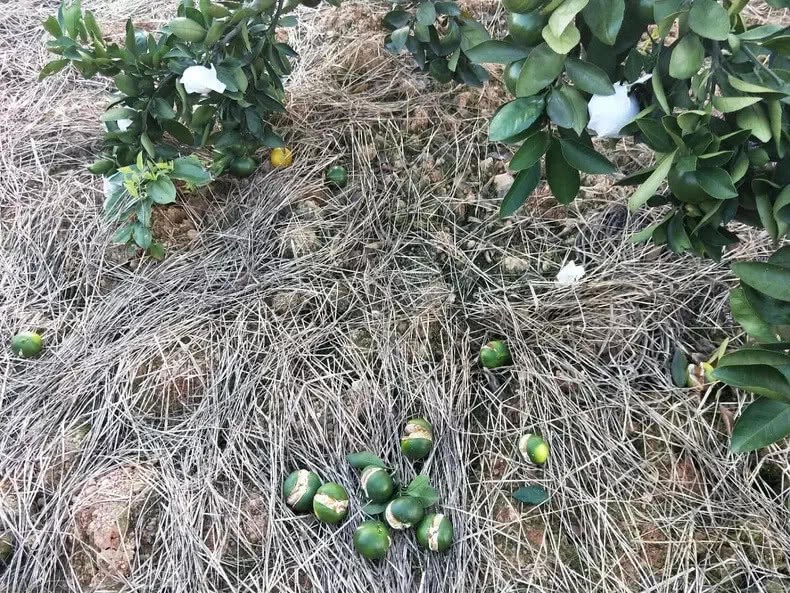
Not long ago, user Liu Xinfeng from Shangqiu City sent pictures of citrus problems on the Nongguanjia app platform, asking: What is wrong with the citrus fruit?
Image from: Nongguanjia user
Nongguanjia experts gave answers based on what the images showed:
Lu Pengyuan (Zhongyuan District, Zhengzhou City, Henan Province, specializes in plant protection technology)
Cracking is considered to be caused by uneven water and fertilizer, sudden heavy watering and heavy fertilizing, and fluctuating temperatures, as well as a lack of boron and calcium. Pay attention to rational fertilizer use, control nitrogen, and you can use monopotassium phosphate compounded with Sule boron and sugar alcohol calcium for spraying to alleviate it. Provide shade and cooling in time, and remove the cracked fruit.
Guo Xinhua (Guanxian County, Liaocheng City, Shandong Province, agronomist, head of the technical station)
Fruit splitting is related to insufficient phosphorus and potassium fertilizer, large temperature differences from fluctuating high and low temperatures, uneven water supply that alternates between too much and too little, and deficiencies of boron and calcium. During the growing period, spray sugar alcohol calcium or chelated calcium plus Sule boron, control the amount of nitrogen fertilizer, and balance fertilizer and water to prevent fruit splitting.
Li Hongyi (Zhengzhou City, Henan Province)
It may be caused by excessive nitrogen fertilizer, lack of phosphorus and potassium fertilizer, fluctuating high and low temperatures during the growth cycle, and water shortage in the early stage, leading to poor flower bud differentiation and unsuitable pollination temperatures, as well as a lack of boron and calcium. Supplement boron and calcium in advance.
Nongguanjia Lecture Hall - Recognize the disease state of citrus exocortis
Damage symptoms
1. Branches: twigs are slender, clustered, and the canopy is dwarfed.The bark at the rootstock part splits longitudinally.
2. Leaves:Leaves are small or the green mesophyll near the veins turns yellow, resembling zinc deficiency.
3. Flowers: deformed flowers, many flowers,severe flower drop.
4. Fruit: severe fruit drop.
5. Whole plant: diseased trees are weak and yield is very low.According to a survey in Guizhou. Among citrus varieties using citron as rootstock, the symptoms are longitudinal cracking of the phloem at the rootstock part, shortened shoots, and dwarfed plants reaching only one third of the height of normal plants. The canopy is small and yield is reduced.
Fruit symptoms of exocortis
Occurrence pattern
Exocortis shows symptoms relatively quickly on some plants and can be used as an indicator plant for identification. For example, on the leaves of Rangpur lime and citron, symptoms appear in 3 to 6 months. In the former, long yellow spots appear on new shoots and the bark splits longitudinally; in the latter, the leaves bend backward, and the midrib on the underside of the leaf becomes corky, necrotic, and cracked. On petunia, Java sanqi, and sanqi, symptoms appear in 6 to 8 weeks, with symptoms of midrib necrosis and cracking, upright and curled leaves, and inhibited growth.
Agricultural control
1. Use shoot-tip grafting virus elimination to cultivate disease-free seedlings.The mother tree is identified using the Arizona 861 strain of Etrog citron as an indicator plant, and only those proven disease-free may be used for cutting propagation. Virus-free plants can also be cultivated through shoot-tip grafting to eliminate the virus.
2. Strictly implement quarantine to prevent the spread and expansion of the disease.
3. Once individual diseased plants are found in the orchard, they should be dug out and burned in time.
Pesticide reference
24% mixed fatty acid copper sulfate aqueous emulsion (low toxicity) use 78-117 milliliters per mu by spraying
1.2% octylamine acetate aqueous solution (low toxicity) use 233-350 milliliters per mu by spraying
5.9% octylamine moroxydine aqueous solution (low toxicity) use 152.5-222.5 milliliters per mu by spraying
1% lentinan aqueous solution (slightly toxic) use 83-125 milliliters per mu by spraying
8% ningnanmycin aqueous solution (low toxicity) use 75-104 milliliters per mu by spraying
13.7% sophora flavescens sulfur aqueous solution (low toxicity) use 133-200 milliliters per mu by spraying
6% oligosaccharin aqueous solution (low toxicity) use 62-83 milliliters per mu by spraying
3% amino-oligosaccharin aqueous solution (low toxicity) use 20-30 milliliters per mu by spraying
Hello, friends