Christmas cactus grows like crazy and blooms profusely, and can be grafted onto a rare new material
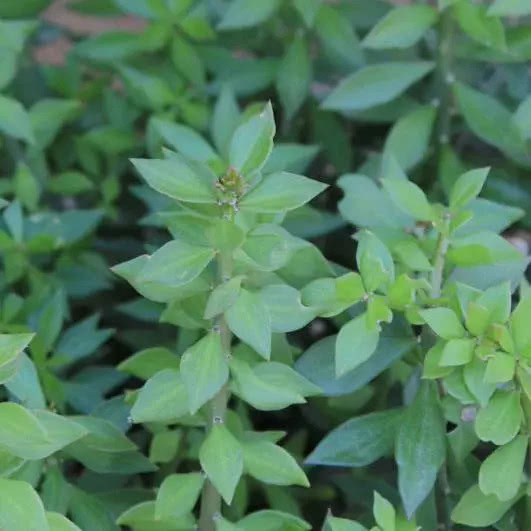
Today I want to tell you about this new thing used for grafting, and this is Pereskiopsis. That is, Pereskiopsis spathulata.
Pereskiopsis is divided into large-leaf Pereskiopsis, hairy Pereskiopsis, and small-leaf Pereskiopsis. Hairy Pereskiopsis has a layer of white hairs between the leaf axils. Small-leaf Pereskiopsis has relatively small leaves. This is large-leaf Pereskiopsis, which has relatively large leaves. Their functions are all about the same.
Pereskiopsis is mainly used to graft plants in the cactus family. Its function is that its early growth momentum is very strong. Graft a small cactus ball onto it, and the growth rate will be very fast. A cactus ball that originally needed one or two years to bloom can, after being grafted onto Pereskiopsis spathulata, grow quickly, expand quickly, and bloom quickly. If it is a new variety of cactus ball that we are propagating,
we can quickly force it to bloom and see the flowers. If the variety is good, directly cut it off and plant it in the ground, and this is a finished cactus ball, and then let the cactus ball grow in the ground, so it can quickly produce offsets, then bloom, and be sold quickly. This is the function of Pereskiopsis spathulata.
It can make plants in the cactus family grow quickly, but its later growth rate will become slow. After one or two years, if we do not cut off its scion, its growth rate will noticeably slow down.
Using it to graft Christmas cactus, its growth rate is also very fast. When it grows many new leaf segments, we directly cut off the leaf segments and graft them onto Pereskiopsis or onto cactus, and they can be propagated quickly.
Later I will teach everyone how to use Pereskiopsis spathulata to graft Christmas cactus and cactus balls. Today I am only talking about the function of Pereskiopsis spathulata. Below are Christmas cactus grafted onto Pereskiopsis and Christmas cactus grafted onto cactus,