Seventy percent of Hsinchu County's domestic water supply may be at risk of heavy metal contamination, with conductivity in the Touqian River exceeding standards
Seventy percent of Hsinchu County's drinking water comes from the Touqian River watershed, but along its banks there are not only garbage landfills but also wafer and packaging plants, whose industrial wastewater is discharged into the river, making public health a growing concern. Even though the Hsinchu County government claims that all discharge water tests meet standards, environmental groups' independent testing found that conductivity exceeds the standard value, "this is not water fit for human consumption at all." They are demanding that candidates for Hsinchu County magistrate and mayor propose concrete measures to separate irrigation and drinking water channels from discharge channels within four years.
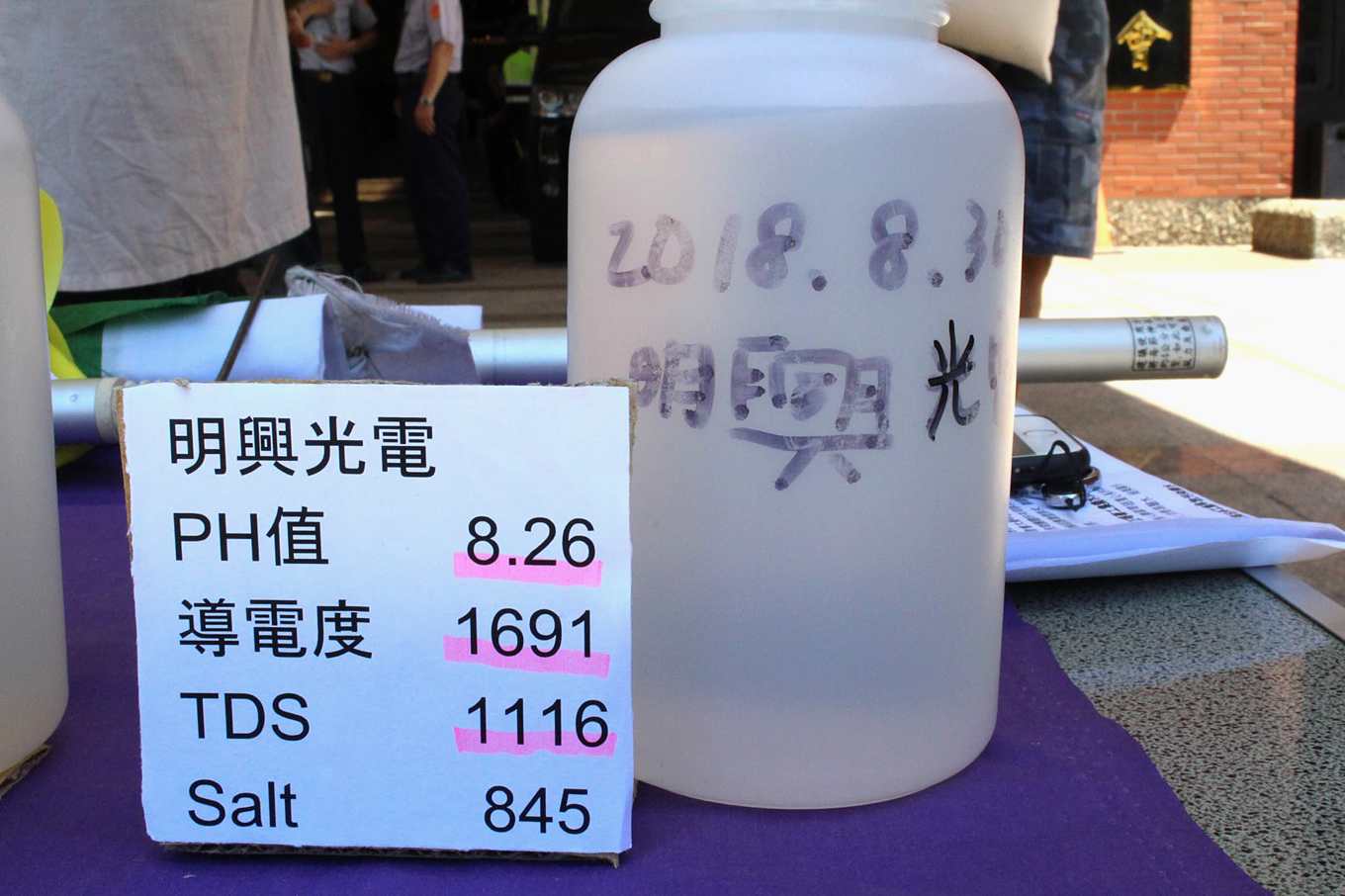
Environmental groups actually tested nine locations. At sites not polluted by factories, conductivity (EC) was only 122.9 μS/cm; after passing through factory pollution, conductivity rose to 150 μS/cm. The standard for irrigation water conductivity is 750 μS/cm, but measured conductivity at Siliconware reached 1166 μS/cm, at Taisic reached 821 μS/cm, and at Ming Hsin Optoelectronics conductivity exceeded 1000 μS/cm every time it was measured.
Chen Tsui-chin, convener of the "We Want to Drink Clean Water" alliance, said this water may contain hexavalent chromium, arsenic, lead and other heavy metals, causing conductivity to be too high. "Wastewater that is not even suitable as irrigation water is the source of Hsinchu residents' drinking water and irrigation water. This water flows into the Touqian River and becomes the water we mix with milk for our children to drink, and the water we use to irrigate our rice."