Millions of bees in central Taiwan, China poisoned by banned fipronil; BAPHIQ urges public to report
The pesticide fipronil has been banned for three years (4.95% suspension concentrate), yet it continues to circulate on the market. After affecting a million eggs across Taiwan, China last year and causing mass bee deaths in Puli, this year it has again caused acute poisoning deaths among bees in central Taiwan. Beekeepers roughly estimate the number affected at several hundred hives, resulting in millions of bees dying from acute poisoning.
Feng Haidong, Director-General of the Bureau of Animal and Plant Health Inspection and Quarantine (BAPHIQ) under the Council of Agriculture, stated that fipronil is indeed still being circulated illegally, and is even being newly smuggled into Taiwan, China. Regarding the bee poisoning cases in central Taiwan, clear reports have been received. BAPHIQ encourages the public to report violations, with high cash rewards available.
Fipronil facts: It is simultaneously a pesticide, an animal drug and an environmental chemical, acting as a neurotoxin with immediate effects on insects. It has three uses and scopes of application, including the broad-spectrum insecticidal 4.95% suspension concentrate (now banned), granules used for pest control in rice and corn (0.3% fipronil granules), and spot-on drops for flea treatment in dogs and cats (such as the product "Frontline").
Miaoli District Agricultural Research and Extension Station: Acute fipronil poisoning is the cause of death
Wu Zixian, head of the Sericulture and Apiculture Section at the Miaoli District Agricultural Research and Extension Station, said that in mid-August this year beekeepers reported that bees were showing symptoms of acute poisoning. On-site sampling revealed large numbers of bee carcasses, while bees still barely alive exhibited trembling and other signs of poisoning. Samples were sent to the Tea Research and Extension Station for testing, which confirmed that the pesticide fipronil was responsible.
Wu Zixian explained that fipronil is acutely toxic to bees; even extremely small residue amounts can affect bees. The fipronil residue levels detected this time were many times over the limit, thus causing heavy bee casualties.
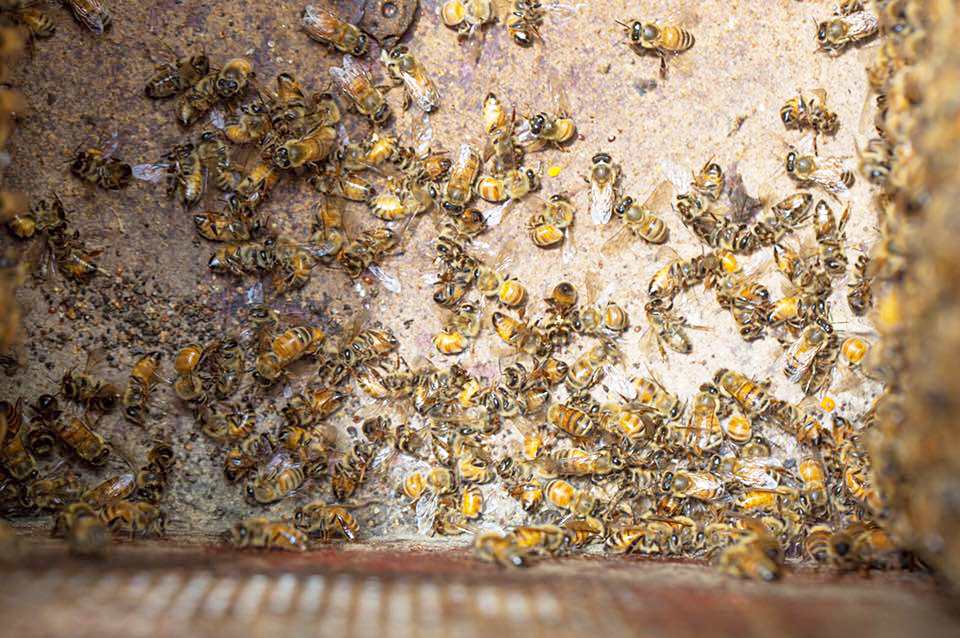
Some beekeepers: Nine pesticide residues detected, fipronil at the highest level
The affected bees this time were mainly distributed in the Puli and Caotun areas, but a beekeeper who wished to remain anonymous said that bees from Nantou to Chiayi have been affected. However, beekeepers have kept a low profile, worried that if the news gets out consumers will worry that honey is unsafe, and also afraid of offending nearby farming friends if they speak up. Therefore, few beekeepers are willing to report and submit samples. It is roughly estimated that millions of bees have died, and beekeepers who could not move their hives in time have suffered severe losses.
Some beekeepers who reported and submitted samples said that after receiving the test reports, they found that in addition to fipronil showing the highest level, eight other pesticides were also detected, including chlorpyrifos, imidacloprid and benomyl. Beekeepers speculate that besides pesticide use during the recent areca palm flowering season, nearby cucurbit crops were also sprayed after consecutive days of heavy rain, and neither can be ruled out as a cause of the bee deaths.
The anonymous beekeeper said that in the past bees were less likely to die after rain, but this year it was the opposite: "Pesticides are being sprayed more heavily than last year; the bees can't take it, they just keep dying and dying." He keeps 300 hives, and half of the hives had all their bees die. A single hive originally held nearly 10,000 bees, and some were reduced to only 100 bees left. The losses are severe: "Bees are expensive; one hive costs 4,000 to 5,000 yuan. How much would it cost to buy another 100 hives?"
BAPHIQ: Fipronil still circulating on the market; information already gathered
BAPHIQ Director-General Feng Haidong said that fipronil is indeed still circulating on the market. In addition to stockpiles accumulated before the ban, newly smuggled quantities are also arriving in Taiwan, China. The main sales channel is pesticide retail stores in various localities. Regarding this bee poisoning incident in central Taiwan, BAPHIQ has received reports and gathered specific intelligence, but the details cannot be disclosed.
Feng said that completely eliminating fipronil will take some time, and encouraged the public to report violations, as high cash rewards are available.
Puli Farmers' Association: Cause of bee deaths not yet clear; confirmation expected this week
Gu Weizhou, an agricultural extension officer in the Extension Section of the Puli Township Farmers' Association, said that reports of bee casualties have so far been received from three apiaries in Puli Township, in the Wugong, Guangcheng and Qilin neighborhoods, but the exact number of bee deaths is still being determined.
As for the Miaoli Station pointing to fipronil as the cause of poisoning, the Farmers' Association simply said: "It's not clear yet; further investigation is needed." Test results are expected this week, which should determine the cause of the bee deaths.