Plants suitable for making beaded bracelets all have to withstand a lot of wear and tear
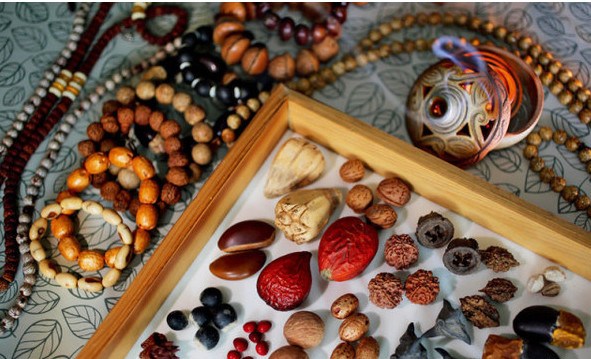
There are all kinds of bodhi beads on the market - the classic three bodhi types, thousand-thread bodhi, white jade bodhi - basically any bead string is likely to be tagged with a "bodhi" suffix.
With so many kinds of bodhi, don't you get suspicious! Are they all seeds from the bodhi tree? The answer is they have absolutely no relationship at all. The bodhi tree is actually a plant in the Moraceae family, and its fruit looks extremely like the figs we eat. It simply cannot grow any kind of bodhi all over its body.
Speaking of these bodhi beads, they are actually a general term for the seeds of nut-type plants used in wenwan bead strings. Currently there are more than 300 kinds on the market, processed from the fruits of different plants, and the bodhi made from the fruits of different plants is naturally given various different bodhi names.
The plant origins of various bodhi beads
Star and moon bodhi is the drupe of the rattan palm Calamus jenkinsianus, a plant in the Arecaceae family. The most memorable thing about the Calamus jenkinsianus plant is probably its thorns - short straight thorns densely cover the leaf rachis and petioles, and even the involucre outside the inflorescence has thorns.
Vajra bodhi is probably the bodhi seed with the most varieties on the market. The reason is simple: the number of segments differs, ranging from two or three segments to more than a dozen. Vajra bodhi is the seed of Elaeocarpus robustus, a plant in the Elaeocarpaceae family.
Phoenix eye bodhi is the drupe of a plant in the genus Ziziphus, Rhamnaceae family. The seeds are harvested at the end of August to early September each year. The so-called "eye" is the seed's bicarpellary, bilocular structure. Occasionally mutated seeds can show three, four or five carpels.
White jade bodhi is the drupe of the oil palm. It gets its name because it feels and looks like white jade - smooth and warm. The oil palm drupe is oval-shaped, and each fruit bunch can bear 1000 to 3000 fruits.
Thousand-eye bodhi is the hard endosperm of the raffia palm drupe, solid in form. The raffia palm is not the bottle palm - the two belong to different genera. Thousand-eye bodhi is mostly white with patterns on the surface; red and green ones are relatively more precious.
Thousand-thread bodhi is the drupe of the foxtail palm. In the south it is used as a street tree; the fruit is sour and astringent, mostly used as decoration. Because the yield is large, the price is not high. The exocarp of the foxtail palm drupe is bright red, becoming redder with age.
Bodhi root is not actually a root, but the hard endosperm of the drupe of Corypha umbraculifera, a plant in the Arecaceae family. After being handled and played with for a long time it changes color and forms irregular lines, commonly known as "elephant skin".
Myanmar padauk bodhi: the Myanmar padauk tree produces fist-sized, lentil-shaped pods. Open the pod and the seed inside is what we call Myanmar padauk bodhi. The upper part is a golden-yellow leathery aril called the wax pedicel, which is highly malleable; the lower kernel is pitch-black and shiny, like a black bean.
Golden bell bodhi is the capsule of a plant in the genus Eucalyptus, Myrtaceae family, called "one-mouth cup" in Chinese medicine. The fruit is top-shaped, mostly tea-green, like a small lotus pod, with a unique herbal smell. The fruits of Eucalyptus dealbata, Eucalyptus tereticornis and Eucalyptus urophylla are all top-shaped, and all are original seeds of golden bell bodhi.
Ghost face bodhi is the drupe of Dracontomelon duperreanum, an evergreen large tree in the Anacardiaceae family. It bulges irregularly toward the center on all sides, is black-brown in color, and the fruit splits into five segments, each forming a "ghost face" of its own.
At the end of this article, Squirrel Jun wants to state that this article is only a popular science piece about plant fruits and seeds, and does not involve any commercial elements! Right - no buying bracelets, no buying bracelets, no buying bracelets! I only hope that you, the reader, will see more of the beauty of plants in nature~
Welcome to follow Plant Fanatic - Squirrel Jun and you together become obsessed with flowers, plants and nature!