These 5 flowers should not be kept even if they are free; all of them are toxic, and you will regret it too late once you keep them
Surely quite a few flower lovers had a batch of their plants and flowers die off after failing to survive the summer heat, and in the blink of an eye autumn is about to arrive, with temperatures getting lower day by day, which is also the best time for the care of potted flowers, so add a few new pots of flowers to your home; those who love growing flowers have already begun to think about the flowers of the new season. But faced with the wide variety of potted flowers on the flower market, how should one choose?
When choosing flowers, you cannot just buy whatever looks pretty. Some flowers bloom beautifully but are not suitable to keep at home. For example: some flower plants purify the air very well, and some bloom brilliantly in autumn, yet they are toxic. Below, let me share these 5 common flowers with you; even if they are free, they should not be kept indoors, and when you come across them, it is too late to even avoid them!
The first flower: Crown of Thorns
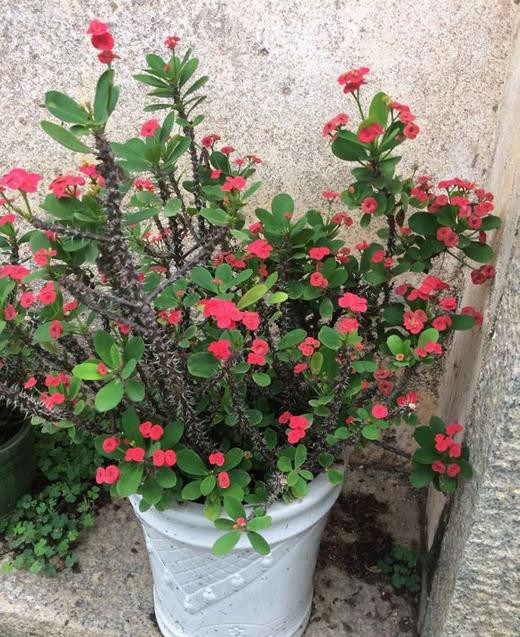
The Crown of Thorns has small, bright red flowers and can be seen blooming all year round; it is also known as the iron begonia, and because its flowering period is long, it is deeply loved by flower lovers.
When keeping Crown of Thorns indoors, harm mainly occurs in these two ways. First, when the branches of Crown of Thorns are damaged, they secrete a white sap containing "alkaloids", which must never touch the skin, especially the eyes. In fact, Crown of Thorns has many small thorns that easily prick the skin. When keeping it indoors, try to place it in relatively high places such as on top of a refrigerator or cabinet, and absolutely do not place it in the bedroom.
The second flower: Alocasia
The leaves of Alocasia are evergreen all year round. Placed indoors, it is not only beautiful but also has a strong air-purifying ability, improving the home environment. Even in the hot summer, it can give people a refreshing feeling. Precisely because of this, many flower lovers know it is toxic but still want to keep a pot at home. Then you must be careful: apart from the water dripping from the leaves being non-toxic, the entire plant of Alocasia is toxic. If you really want to keep it, there is no problem as long as it is not eaten by mistake. Especially for flower lovers with babies at home, do not keep it; safety is still the most important thing.
The third flower: Garden Balsam
When I was little, the flower most often planted in the yard was Garden Balsam. Besides being tenacious in vitality and relatively easy to grow, many girls used it for the fun of dyeing their nails. In fact, Garden Balsam is toxic, but its toxicity is relatively low, and as long as it is not eaten raw, it will not cause any harm. However, for families with pregnant women, when choosing flowers at the flower market, even if a pot is cheaper, do not keep it. Garden Balsam is dispersing in nature and softens hardness, and should not be used during pregnancy, so families with pregnant women had best not keep Garden Balsam. It is also suggested that flower lovers not keep it; if they do, then do not place it indoors and can plant it in the yard.
The fourth flower: Poinsettia
When it comes to the flower Poinsettia, it would not be an exaggeration to call it the best-looking; its bright red bracts open like a ball of flame, looking very festive. Precisely because of this, it is deeply loved by flower lovers, who all want to keep it indoors to add festivity and enliven the atmosphere.
Here I advise flower lovers not to place Poinsettia indoors, because its entire plant is toxic. If you accidentally touch the white sap it secretes, it will cause numbness, redness, swelling and heat, and the flowers also release toxins, causing symptoms of respiratory allergies. Many flower lovers feel that such a beautiful flower must be toxic; in fact, this experience makes sense; after all, roses also have thorns, and that is not false at all.
The fifth flower: Oleander
The Oleander plant grows relatively large and is generally not used as an indoor potted plant. Some flower lovers plant it in the open ground in their yards; under the lush green leaves grow flowers, and its blooms are especially gorgeous. It is just that the toxicity of Oleander is very strong, whether indoors or outdoors, so do not keep it unless it is very necessary. Many flower lovers will wonder: Oleander is so toxic, yet it is still widely planted in urban green belts. That is because the most commendable thing about Oleander compared with other greening trees is that its effect in absorbing toxic gases is very good; even if the leaves are covered with dust, it still grows vigorously.
So which flowers are best to grow in autumn?
1. The orchid series
Although the weather turns cool, Clivia and Phalaenopsis are truly the best flowers to grow in autumn. When not in bloom, their leaves are lush green and can be kept as foliage plants. When winter comes and most flowers wither, their flowers bloom on the branches, red and yellow, in butterfly shapes, all appearing very joyful. Moreover, keeping orchids indoors can also cultivate the mind and character, wash away fatigue, and cultivate elegant interests. Caring for them is very simple: use leaf mold and pine needles as the substrate, water by the principle of see dry see wet, change the potting soil twice a year, use fried hemp seeds as base fertilizer, and usually even fertilizing is saved; just water them.
2. Cyclamen
In autumn, most flowers are in vigorous growth, and of course, Cyclamen is no exception. At this time, having survived the hot summer, as autumn arrives and the weather becomes cooler day by day, Cyclamen will recover from its semi-dormant state. This is a suitable time to repot, prune away the roots damaged in summer and old roots, replace the soil and replant, and gradually apply phosphorus and potassium fertilizer to encourage more and brighter flower buds. Cyclamen has very lush leaves and high ornamental value, suitable for placing on one side of an indoor coffee table or TV cabinet; its winter blooms are festive and have a good meaning.
3. Chinese Rose
After the summer heat, Chinese Rose welcomes a peak flowering period in autumn. At this time, Chinese Rose is no longer as non-standard and unbearably ugly as its summer flowers. To grow flowers, first grow the roots, and Chinese Rose is no exception; this is a truth most flower lovers understand. Especially when propagating Chinese Rose by cuttings in autumn, rooting is particularly important. You can use the vermiculite semi-hydroponic method for cuttings, and transplant after rooting.
Chinese Rose is suitable for both open-ground planting and balconies, but cannot be placed indoors, because it needs an environment with relatively good ventilation and light. For example, Canary, El Paso, and Snowflake Fatty Beef are all suitable for balconies, and they also bloom very frequently.
That is all for sharing the knowledge about growing flowers in autumn. Thank you for reading!
If it has been helpful to you, remember to like and share it~
?