An Analysis of Dialectical Thought and Aesthetic Viewpoints in Bonsai Making
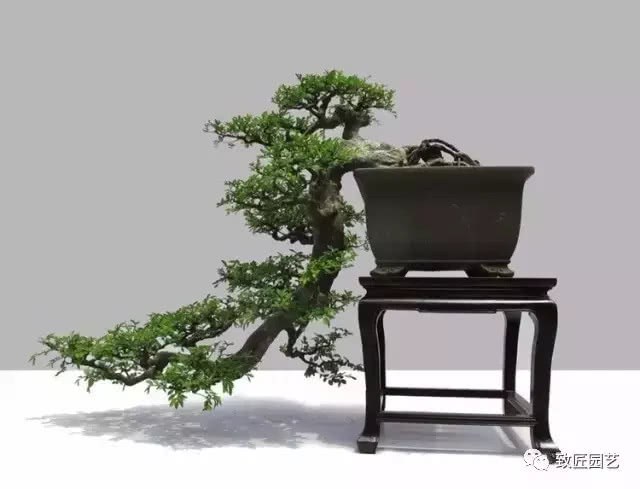
Everything contains contradiction, and contradiction is the unity of opposites; under certain conditions, the two sides depend on each other, serve as each other's premise, and coexist in a unified whole. This is also the ideological principle of bonsai making.
1. Empty and solid: if the relationship between empty and solid is handled properly, it will make the artistic conception of the bonsai more beautiful and more lofty. It is mentioned that at the expert's position, if it is dense without emptiness, then the emotional appeal is especially reduced; if it is treated with startling clouds and falling mist, binding the ridges and enclosing the trees, then there is vitality. It says that when painting, if there is no variation between empty and solid, then it cannot be considered a successful work; too solid means no emotional appeal, while if empty and solid are handled properly, then the flexibility of the painting greatly increases, and it has interest and charm. The same is true in bonsai making: solid is the foundation and basis of empty, and empty is the lingering meaning and expansion of solid, but empty gives people the effect of association. Therefore, when making a bonsai, the branches and leaves must have variations of empty and solid. When it should be empty but is not empty, then the realm is blocked and not stretched out; when it should be solid but is not solid, then the realm is broad but has no content. But empty and solid must have measure and proportion; too much emptiness causes the form to scatter. Empty and solid must be skillfully combined to bring out the best in each other, using emptiness to contain presence and using absence to surpass presence. This is a traditional Chinese expressive technique, and it is even more important in forest-style bonsai. Therefore, empty and solid are an important artistic handling method in managing position. It gives people the artistic effect of "the words end but the meaning is endless," and it is of great significance to the generation of the bonsai's artistic conception. For example, if one side has many layered branches and the other side is an exaggerated large branch, then the gap is relatively large, with only one branch; this is a treatment of emptiness, and it is precisely this side that gives people the feeling that beneath the tree there is a great mountain valley, and in the distance a vast landscape of good rivers and mountains that cannot be seen to the edge. This fully proves its role in managing position and expanding the artistic conception.
2. Sparse and dense: empty and solid affect the meaning, while sparse and dense are extremely important aspects in determining the layout of the bonsai's branches and trunk. Generally, a stump bonsai should be dense at the top and sparse at the bottom, and the distribution of branches on the trunk should also be both sparse and dense, and must not be all the same, so that one knows the end by looking at the beginning. In painting theory there is the idea that density need not fear closeness and blockage, and sparseness need not fear emptiness and looseness; this can make the entire work rich in formal variation and give a feeling of loftiness and verdant distance. For example, in the towering embrace of green, the lower branches and trunk are larger than the upper ones and their spatial intervals are also larger and relatively sparse, while on the opposite side of the extended distant large branch and above it, the branches are many and dense. In this way, the arrangement is irregularly ordered, making the entire form relaxed and tense to an appropriate degree, and the image tall.
3. Primary and secondary: primary and secondary are very important in determining momentum in bonsai. In the combination of images, there must be a distinction between primary and secondary. Generally, the primary is handled in a prominent position in the scene, and it may also exceptionally be placed at the side, but in terms of momentum it must be concentrated on the main scene. It can make the viewer's vision concentrate on the wonderful main scene. How to handle primary and secondary well mainly depends on coordination: the primary must not bully the secondary, and the secondary must yield to the primary. In the double-trunk style, the issue of primary and secondary must be handled well. For example, in Seven-Step Poetic Meaning, the main trunk is thicker and taller than the secondary trunk, and its trunk momentum is more generous, fierce, and unrestrained, while the secondary trunk is thinner, and when echoing the main trunk it stretches out to one side, making concessions according to the development of the main trunk, yet supplementing the space left by the main trunk. The two do not interfere with each other in the growth of branches and side branches. In addition, single-trunk bonsai also have a primary-secondary relationship. For example, the subsidiary built branch in "Hidden Dragon in the Clouds" grows only in the gaps left by the growth of the main trunk, and it echoes the main trunk, seeming to be part of the main scene's extended large branch, ultimately making the entire form complete in momentum on its own.
4. Concealment and exposure: The great Song dynasty painter Guo Xi said in his work that if a mountain wants to be high, showing it all does not make it high; if mist and clouds lock its waist, then it is high; if a river wants to be distant, showing it all does not make it distant; if it is obscured and its veins are broken, then it is distant. What this says is that to make the painted mountain very high, one should paint a patch of cloud at the mountainside to block part of the mountain, and then the mountain looks higher; to paint a long river, let it appear and disappear intermittently, and it appears more distant. In bonsai making, concealment can store up momentum, strengthen suspense, stimulate the viewer's imagination, and produce a lofty and distant artistic conception. Therefore, in creation, there are often places where concealment is better than exposure, expressing content that is more, deeper, and farther. Without concealment, there is a lack of charm, and it is difficult to induce deep thought. Hence there is a common saying: if the water is too clear, there will be no fish. Therefore, the organic combination of concealment and exposure can deepen the theme, strengthen the artistic conception, and produce the artistic effect of "still holding the pipa half hiding her face." For example, if the trunk divides into three trunks less than one chi from the ground, and in the end two trunks must be removed, leaving saw marks, and the trunk here suddenly becomes thin, it appears very unnatural. In handling this problem, more edges were kept here and it was treated a bit more solidly, so that the thinner trunk above is connected with the lower root and trunk through this cover, making a stump bonsai less than two chi high appear towering into the clouds, so that one looks up and sees the top, achieving a relatively good artistic effect.
5. Curve and straightness: curve and straightness are the most basic forms of variation in bonsai modeling. Curves contain more content and variation, making branches and trunks stretched, smooth, and dynamic, with the artistic effect of a path turning as the peak winds around. The Chinese totem is the dragon, and this thing with an S-shaped body makes people feel noble and unfathomably mysterious. In old times, there was a saying in bonsai that curved is beautiful and straight has no posture. In fact, under certain conditions curve and straightness are each other's premise and depend on each other, so curve and straightness cannot exist independently. The mutual transformation of curve and straightness constitutes the rhythm in bonsai. On the other hand, curve is soft and straightness is firm, just like calligraphy: when it should be straight, be straight; when it should bend, bend, only then does it appear strong and forceful; otherwise it has no spirit and no strength, lacking a sense of aged vigor. Beginners often bend every branch they encounter, and the result is chaos without order, appearing as a group of snakes hanging from a tree. That is morbid and has no beauty to speak of. Therefore, correctly handling the relationship between curve and straightness will produce an artistic effect in the work that is both reasonable and unexpected.
6. Movement and stillness: in bonsai, this pair of contradictions mainly manifests as momentum. Only with both movement and stillness does it appear lively. Stillness serves as a foil to movement, so that movement has measure and will not cause the center of gravity to become unstable because of movement. Movement depends on stillness; without stillness, movement loses order. With movement but no stillness, it is chaotic; with stillness but no movement, it is stiff. Therefore, only when movement and stillness are handled properly can the work be lively in momentum without losing composure. For example, in "I Want to Ride the Wind and Return," a large branch stretching out increases the bonsai's dynamism, but the other branches near the main trunk increase the stability of the center of gravity; this is stillness. Thus the entire bonsai has dynamic momentum without losing balance, and therefore appears dignified, steady, and aged and forceful.
In short, a successful bonsai work should possess a certain ideological and artistic quality. It is not without reason that old bonsai artisans said bonsai comes from the hands of literati. Therefore, bonsai makers must all continuously improve their literary cultivation. In the aesthetic aspects of bonsai art, although different places differ somewhat, they must all naturally provide materials, follow the basic growth habits of plants and the postures formed in their struggle with nature, and conform to nature. Romain Rolland said it well: "Nature is beautiful." For example, among bonsai forms, the waterside style and cliff-hanging style are both appearances of plants adapting to nature, while certain deformities, strange shapes, or certain animal images forcibly shaped by human consciousness, with noses and eyes, are extremely unnatural. Even if in nature some tree shapes resemble certain animals, that is also between likeness and unlikeness. The words of the great art master, old man Qi Baishi, are classic artistic language. If it is too alike, the viewer has no room for imagination; if it is not alike at all, the viewer has no basis for imagination. Neither will deliver beauty to the appreciator. The viewpoints in the process of bonsai making are subjective, but they are the summary of people's long-term observation and understanding of nature, and of the act of endowing nature with emotion. Therefore, bonsai makers should give themselves to nature, give beauty to the viewer, and keep the skill for themselves, constantly improving their craftsmanship.
Highlights