How should the height of a bonsai trunk chop be determined?
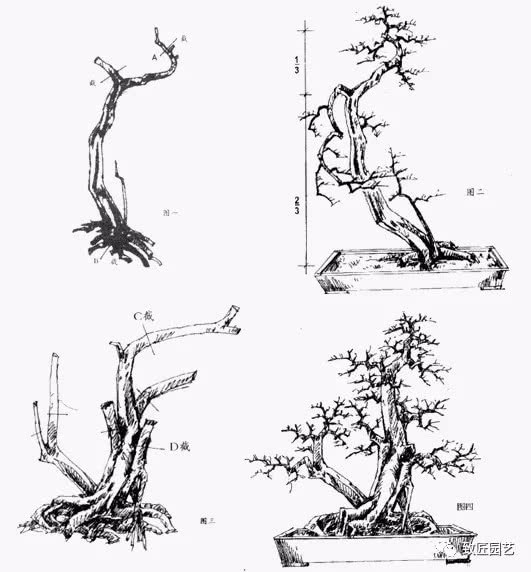
Most bonsai raw material comes from wild-collected stumps. If you want to pick, from among a great many tree stumps, the material that suits bonsai styling, you have to master a certain amount of stump-selection knowledge:
1. It must be a tree species suited to bonsai styling.
2. The stump material must have good roots and a good base, and especially must have small-to-medium roots and fibrous roots.
3. The trunk must have a certain degree of curvature (except for the straight-trunk style), the transitions must be natural, and the apex trunk must taper step by step to a point.
4. The trunk must have accompanying branch stubs suitable for styling. Once we have chosen the stump material, we must determine the future creative theme, assign it to a certain styling form, design the finished height of the work, and thereby determine the height of the trunk chop.
The height of the trunk chop should generally be considered from the best viewing face of the trunk and the existing bottom branch stub. The position of the tree stump's bottom branch stub should ideally conform to the golden ratio of 1:0.618, that is, 1/3 of the stump height. On a tall, towering stump the bottom branch stub is rather high, with the upper part making up 1/3 and the lower part making up 2/3. On a short stump of the large-tree type the bottom branch stub is rather low, with the lower part making up 1/3 and the upper part making up 2/3. This is the basic rule, but there are also exceptions, which are a separate matter.
How to determine the height of the trunk chop from a given bottom branch stub. The position of the tree stump's bottom branch stub (the original accompanying branch stub) cannot be changed. To make the height of the bottom branch stub suit a given styling form, there are only two methods:
1. Cut the apex trunk shorter, so as to conform to the proportion of a short lower part and a long upper part; this is subtraction.
2. Raise the roots appropriately (exposing the roots), so that the height from the low branch stub to the pot surface increases and conforms to the given proportion; this is addition. Of these two methods, sometimes one can be used when making the trunk chop, and sometimes both can be used together. This is decided according to the specific circumstances of the tree stump.
(Figure 1) is a mountain mandarin (Atalantia buxifolia) stump, with a trunk diameter of 7CM. The original bottom branch stub is rather thick and is at 80CM. At the root base there is a secondary branch, with a trunk diameter of 1CM. It can be seen that this is a tall, towering double-slanting-trunk stump, one large and one small, one S-shaped and one straight. The creative theme can be described as "Grandfather and Grandson Enjoying the View." From the height of the bottom branch stub, the designed finished height of the work should be around 120CM. The newly trained apex branch is about 10CM, so the trunk chop point should be at A. A side branch is used as the apex trunk, with a thickness of 1CM, and the whole stump tapers to a point with natural transitions. The main root is cut short to point B to facilitate repotting into a shallow pot in the future. Figure 2 is the finished design rendering. The key styling point of this stump is to cultivate a high-position cascading branch, styled as a reverse-3-shaped branch, to serve the effect of protecting the "grandson." The rather thick base of the original bottom branch stub can be solved by splitting it thin on one half. As can be seen from the figure, it conforms fairly well to the original creative theme.
(Figure 3 is) a large mountain mandarin (Atalantia buxifolia) stump, with the main trunk diameter 10CM and the secondary trunk diameter 6CM. The main trunk's bottom branch stub is rather low, at a height of 20CM. It is 4CM thick. Four forked roots arch and are exposed, 15CM high. From the figure it can be seen that this is a typical short-stump large-tree-type stump. To make good use of all the original stump's accompanying branch stubs and the main trunk's existing curvature, the main trunk's chop position is best at C, about 80cm high. With a finished height of 100CM, this makes the bottom branch stub obviously rather low. To solve this problem, one only needs to raise the root part appropriately to 5CM from the pot surface; the bottom branch stub chop point D is 5CM high, which gives the starting point of the original branch stub a height of 30CM, conforming to the proportional requirements of the styling. Figure 4 is the designed finished rendering. The tree's appearance is majestic and imposing, with the spirit of a strongman lifting a tripod.
Highlights