In Defense of Dead Branches: The Cultural Value Behind Dead Branches
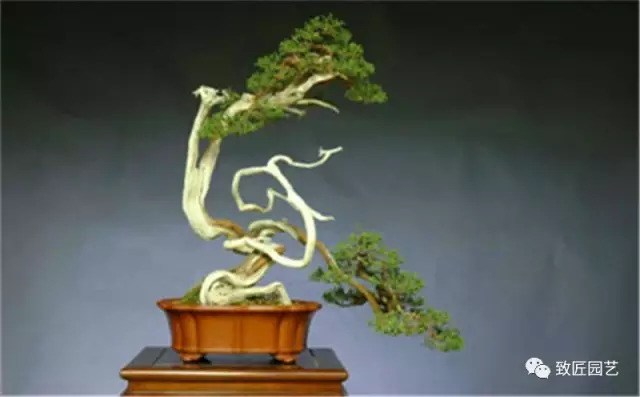
In the bonsai world today, a certain artistic expression is very popular, commonly seen in pines and cypresses: the trunk is only partially wrapped in bark, with a thin water line sustaining the plant's growth, and the crown is also half dead and half alive. The entire work expresses the plant's state of growth under adversity, highlighting the resilience and tenacity of life. After this description, many readers may already be able to name it. Some call it divine branch or sari trunk bonsai, while I call it dead branch or dead trunk bonsai.
A few years ago, some people in the Japanese bonsai world brought this kind of half-dead, half-alive bonsai to our country for exhibition or sold them as commodities. Some of this kind of bonsai from Taiwan, China also entered the mainland of the motherland and were welcomed. After the bonsai were, chiseled, bark-torn and so on with dozens of tools they invented, the dead parts were subjected to "aging" treatment. As a result, the withered parts of the plant set off the living parts as full of vitality, and the gray-white of the withered parts made the green branches and tender leaves appear even more spirited. The entire bonsai work, under the contrast of age and vitality, gives people a strong visual impact.
This kind of bonsai is beautiful, but what is even more admirable is their advanced technology. Our bonsai people love to learn, so they took this technology. Within a few years, at various bonsai exhibitions, bonsai made by our bonsai people using this technology appeared one after another, and the craftsmanship was exquisite and the performance impressive. Along with the "taking" of this technique, the names divine branch and sari trunk gradually became popular, and almost everyone was about to forget its original name.
In fact, the terms dead branch and dead trunk are not my invention. This form of expression already appeared in ancient bonsai works in our country. At that time, our ancestors called it dead branch and dead trunk, and this name is in harmony with the profound culture embodied by bonsai. So why do more and more people now call it divine branch and sari trunk? I believe the emergence of this situation is a manifestation of our impetuousness and lack of calm in the learning process, suffering from the habit of following what others say without deep thought about its name. Little do they know that the terms divine branch and sari trunk also have their own special cultural background. This term originating in Japan precisely embodies a spirit of the Japanese nation, is closely related to the history and circumstances of the Japanese nation, and also has profound cultural connotations behind it.
In the process of learning, bonsai practitioners should be selective about what they learn. In recent years, our bonsai industry has developed rapidly, and bonsai practitioners have also been constantly innovating in technology and artistic expression. They are working hard to learn and draw lessons from others, showing an unprecedented capacity for absorption, and embodying "taking-ism" to the fullest. There is nothing wrong with learning. Good technology should be learned to improve the artistic expressiveness of our bonsai works. But when taking, if there are some useful things that others have and we do not, we can take them, and indeed should take them; if others have them and we also have them, then do not take them. Just carry forward our own, and this is also inheriting tradition; as for things useless to us, even if others offer "buy one, get one free," we must not take them.
Therefore, I believe that this kind of half-dead, half-alive bonsai should still be called dead branch or dead trunk bonsai. Moreover, in the future, when our bonsai practitioners take from others, they should first settle their impetuous mood, look through their own "pockets" to see whether they already have it, and then carefully think about whether what is taken is useful to them.
Reprinted from Bonsai China
Wonderful content