A detailed guide to bonsai bending techniques, easily master the shaping methods
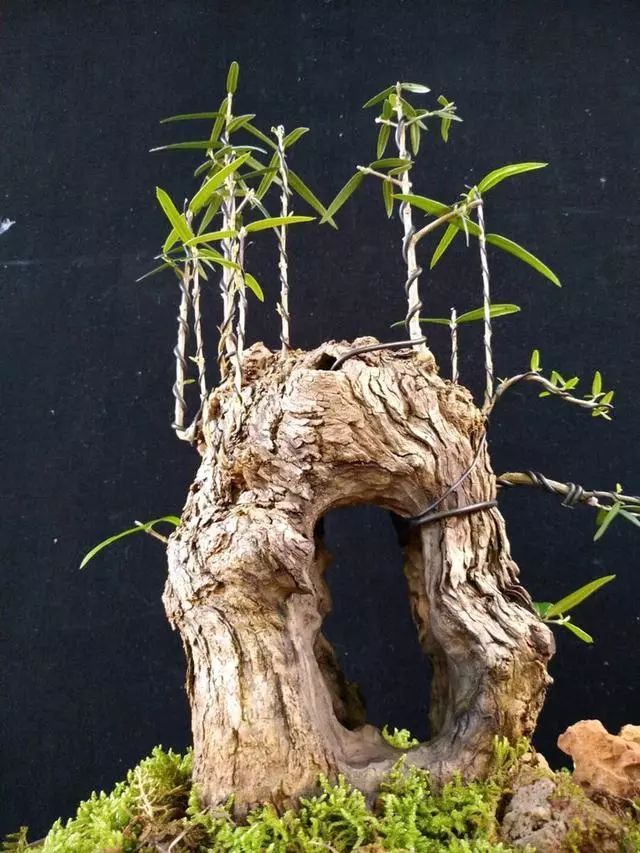
Bending includes bending straight trunks and adding curves to curved trunks, as well as straightening curved trunks. For bending, you can use soft palm fiber and cloth strips, hard copper wire and aluminum wire, and you can also rely on pruning. Of course, nowadays it is basically a combination of several methods.
First, and the step most easily overlooked, bend the branch that needs bending moderately back and forth up and down and left and right, so that the bark layer separates from the wood and becomes more flexible.
An imperfect analogy: if you bend a wire back and forth, does it not temporarily become softer?
Whether the analogy is perfect or not does not matter, as long as everyone understands. Many bonsai enthusiasts do not do this step, and as a result the bend is either not enough, or the branch breaks.
Then, if the branch is relatively thin and soft, you can directly wrap it with aluminum wire to bend it, or use palm fiber to pull it into a curve. Bending is not directly folding, but twisting clockwise.
If the branch is relatively thick and hard, you need to coil palm fiber around the entire bending position and wrap aluminum wire (traditional techniques make a distinction, but today's bonsai growers all use them in combination), to increase the branch's ability to bear force and prevent it from breaking because the bend is too sharp or too abrupt. When necessary, you can operate in multiple layers: first coil palm fiber, then add aluminum wire, then coil again, then wrap aluminum wire again.
If it still cannot be bent, you can also use techniques such as splitting the trunk, cutting, and grooving to help with bending. Likewise, pay attention to increasing the branch's ability to bear force, and apply medication and wrap with film to prevent infection and rot caused by damage to the branch.
At the same time, you can use other objects or tools to help with bending, such as branch benders, iron pieces, heavy objects, etc. When using these tools, you must likewise pay attention to increasing the branch's ability to bear force and protecting the bark from damage.
If conditions allow, you can also wrap the bonsai material around bamboo, wood, or other easily decaying objects, referencing how vines wrap around trees, to create natural curves; you can also twist steel bars and other hard objects into the desired shape, then tie the bonsai material onto them.
Another thing to note when bending is that you should adjust the degree of bending according to the size and flexibility of the tree. Do not rush. For bonsai material that cannot be brought into place in one go, you should proceed step by step and gradually bring it into place.
Friends who like it, welcome to like and share
The Nature Planet
Everything plant-related in one place