Current State, Problems and Improvement Suggestions for the Production and Marketing Structure of Agricultural Products in China (Part 1)
In the social and political news of the first two months, considerable space was devoted to reports on the collapse of farm-gate prices for fruits such as bananas, pineapples, papayas and dragon fruit, leaving farmers with nothing to show for their efforts. These reports included helpless, sorrowful appeals and protests from farmers in various regions, defenses and explanations by Council of Agriculture officials of their policies and response measures, and even incidents in which farm-gate buyers were ostracized and attacked by peers for offering purchase prices that were too high, among countless other examples.
The phenomena of sharp rises and sharp falls in the market prices of agricultural products in China actually occur regularly and unpredictably. Whenever such incidents occur, ordinary people usually feel the impact of price increases keenly, because retail market prices become too high to afford; when a bumper harvest drives farm-gate prices down, consumers often feel nothing at the retail end, at most seeing prices return to normal or become slightly cheaper than usual.
But for farmers, the common response is that when market prices rise, the farm-gate price they can obtain does not rise as much as the wholesale market price; yet when a bumper harvest causes wholesale market prices to fall, that is when the pain begins, often with no outlet for sales or a total loss.
With this problem of sharp rises and sharp falls in agricultural product market prices, government agencies often become the target of criticism. It would not be entirely fair to say the government has done nothing about this problem, because very early on the government used various subsidy measures (such as removing surplus products or substandard goods from the market) to compensate farmers for their losses, or launched special overseas agricultural procurement and other adjustment measures to stabilize price fluctuations and quell public discontent.
If the government can respond immediately to such incidents, the controversy will be much smaller; but if it responds too slowly, it becomes social and political news that is hyped extensively. Regardless of the outcome, however, once the incident subsides it usually leaves no trace, and all one can do is wait for the next occurrence to respond again. The problem seems never to be solved.
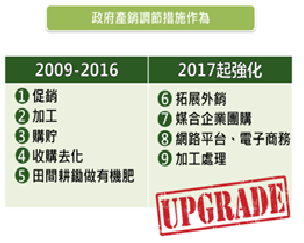
Whenever there is a major phenomenon of sharp price rises or falls, the Council of Agriculture will present policy explanations and response measures to deal with it; for example, during this recent turmoil, Council of Agriculture Chairman Lin, at the July 3 press conference on refined measures for fruit production and marketing adjustment, released a briefing slide (as shown below) explaining what measures the government had taken in the past to deal with overproduction and price collapses; but after so many years the problem remains, so clearly these measures have not been effective in truly solving it.
In the figure above, shaded boxes circle three types of agricultural producers, including individual farmers, production and marketing groups, and production cooperatives; producers' production methods include open-field cultivation, greenhouse/net-house cultivation, and plant factories, among other types. Basically, apart from the plant factory production type, farmers' associations play a certain role in production guidance and marketing coordination among these producers.
Under the regulations of the Agricultural Products Market Transaction Act, farmers basically have the three channels for selling agricultural products shown in the figure: self-production and self-sales, contract production, and independent production delivered to wholesale markets or specific trading markets for sale. With different sales channels, farmers' practices in agricultural production management differ in order to meet the special requirements of that channel, and their ability to set and negotiate product prices also differs; the production and marketing environment and problems they face naturally differ as well, explained separately as follows:
Self-production and self-sales:
As shown in the figure, the sales channels for self-production and self-sales include four types: markets, farmers' association storefronts/sales outlets, self-built official websites/e-commerce websites, and health-oriented (self-operated) specialty restaurants. (Other practices, such as farmers loading products into vehicles themselves and selling at markets or roadside, are ignored here.)
For agricultural products sold through this channel, whether fresh products or simply processed products such as jam or pickles, farmers can sell them as commodities, and farmers have the leading role in selling, setting and negotiating prices. However, this direct/indirect consumer-facing sales method requires a certain amount of sales (including product packaging), promotion, and non-agricultural production manpower and expenses, with which farming friends are not familiar; therefore only some farmers sell products through this channel, and many of those who do will not stake all of their agricultural products on this channel, usually operating this sales channel with the mindset of a side business.
The proportion of farming friends who purely take the self-production and self-sales route - that is, selling all or most of their agricultural products through this channel - is even smaller (note). Usually such farming friends focus on producing specific agricultural products, manage their own brands, build product quality reputations, and also have their own websites (official sites) or join e-commerce marketplace sites focused on agricultural product sales.
Note: Terms such as "proportion" used in this article are only conceptual statements because specific statistical figures are lacking as supporting evidence. If government departments also lack relevant statistical figures, they could be collected in the future as a basis for decision-making and management.
If marketing through the internet, such farming friends usually rely on the assistance of professional website operators (such as OwlTing Market) to shape brand image, expand online customer groups, and cultivate a fixed customer base. More ambitious farming friends will simultaneously join or operate multiple websites to expand the reach of online customers, thereby increasing product sales volume and sales speed.
Overall, the proportion of agricultural products and processed agricultural products sold through this channel in the total national sales of agricultural products is very low, so it does not affect changes in national agricultural product prices. If farmers thereby establish their own brands and quality reputations, they are relatively less affected by market price fluctuations and can sell products at prices better than wholesale/retail markets.
Although online shopping has become a trend, agricultural authorities also encourage farmers and farmers' groups (such as farmers' associations) through guidance and subsidies to set up websites for agricultural product sales; there are also various private commercial website operators focused on selling agricultural products. But this type of sales channel is only suitable for specific consumption patterns, specific types of agricultural products, and specific types of consumer groups, and cannot be promoted as a sales channel that satisfies the consumption needs and habits of the general public. Even if successfully developed, because the market scale is small, only farmers who invest early in a niche and continue operating can benefit. Therefore, the prices of agricultural products sold through this channel cannot affect the large daily trading quotations of agricultural products, nor can they improve the risk problem faced by most farmers of drastic fluctuations in agricultural product trading prices each production period.
Contract production:
"Contract production" is a production model similar to "contract farming" or "guaranteed purchase." For the buyer, because he must satisfy the market demand of existing channels or develop the commercial interests of channels, he must find trustworthy agricultural product producers and obtain a stable supply of agricultural products to meet his business and service operation needs. Conversely, for agricultural producers, because they do not need to worry about the future dilemma of having no outlet for their produced agricultural products or suffering losses from a disastrous price drop, they can reduce agricultural production risks and focus on agricultural production operations; therefore adopting contract production is a relatively guaranteed production and sales model for farmers.
The (farm-gate) price of agricultural products under contract production is basically agreed in advance by both parties. The buyer calculates commercial costs and profits and proposes an acceptable purchase price; the producer estimates production costs and expected returns and proposes a desired selling price, after which both parties negotiate. The ideal result of the price agreement will be a purchase price range set on the basis of a certain product quality; that is, a flexible pricing plan will be adopted depending on the quality of the harvested agricultural products and the wholesale market price at the time; but the maximum will not exceed a certain number of yuan, and the minimum will not fall below a certain number of yuan. As for whether this price is better for farmers, the leading role in negotiation is mostly held by the buyer.
Because the terminal market demand operated by the buyer involves a considerable volume, the partners with whom he contracts production are usually mainly production and marketing groups and production cooperatives, and he rarely signs contracts with individual farmers. However, because some buyers still take profit as their main consideration, and farmers may also be attracted by occasionally high profits from other farmers, a stable and widespread contract production relationship still needs further cultivation, and government departments can certainly play a certain guidance role in this.
Although the quantity of agricultural products released through contract production is clearly much higher than that of self-production and self-sales, and because there is a certain sales model and production-marketing order, the price fluctuations of agricultural products sold through this channel are clearly lower. As shown in the figure above, because its sales channels have low overlap with wholesale market channels and still cannot compete with wholesale markets in quantity and variety; in most cases its product attributes also differ from those of wholesale markets, and unit prices are mostly higher than average wholesale market prices; therefore the product prices in this channel also cannot clearly affect wholesale market prices and price changes. At most, when retail market prices of agricultural products rise unreasonably, agricultural authorities will use a mix of persuasion and pressure to urge hypermarket operators to increase shipments from their contract production sources to slightly balance the soaring agricultural product prices.
From the above analysis, it can be seen that contract production is a production model that offers farmers relatively more guarantees and can produce good production-marketing relationships. Agricultural authorities should consider how to effectively expand the development of the contract production model and guide wholesale markets to open up a trading environment for such products or induce wholesale market purchasers (jobbers) to switch to buying agricultural products from contract production suppliers. The policy promoted by the Council of Agriculture, the Ministry of Health and Welfare and the Ministry of Education in early last year (2017) based on food safety needs, requiring school lunch ingredients to comply with the "Four Labels and One Q" policy, is an excellent policy that mutually reinforces improvements in the agricultural production and sales procurement environment. Agricultural authorities can further track and compile statistics on the changes this policy produces in the contract production environment and understand whether the two sides thereby establish a healthy contract production cooperation model.
Independent production delivered to wholesale markets for sale
Whenever people talk about incidents of sharp rises and falls in agricultural product prices, the source of the incident is in fact the transaction prices in this wholesale market; in particular, the daily wholesale prices of the Taipei Agricultural Products Marketing Corporation's First and Second Fruit and Vegetable Markets have a clear effect in guiding changes in retail market prices.
In the 1960s and 1970s of the Republic of China era, the Agricultural Products Market Transaction Act was passed and agricultural product wholesale markets were established. Their original purpose was to build a unified, open national agricultural product trading environment and order, to avoid uneven regional arrival distribution and unfair trading phenomena caused by factors such as artificial monopoly or information gaps, which would lead to unreasonable agricultural product prices and allow farm-gate purchase prices to be exploited by middlemen.
This system has been in place for many years, and with the help of information technology, the transparency of trading information has become fast and detailed, but the frequency of large fluctuations in agricultural product prices and the severity of changes show no sign of easing. In addition, farmers are still often heard complaining that when wholesale market prices rise they do not receive corresponding benefits, while when prices plummet it is the time of total loss and heavy damage. The role of government departments here also appears unusually passive and awkward: they have no coercive power to restrain changes in agricultural product prices, yet must bear criticism from both farmer producers and end consumers when agricultural product prices sharply rise or fall, and spend huge amounts of public funds and effort cleaning up the mess, repeating endlessly in a seemingly endless cycle.
In exploring the causes of sharp rises and falls in agricultural product prices in wholesale markets, one can certainly attribute them to supply-demand imbalances caused by seasonal and climatic factors (bumper harvests or disaster-related shortages). But reviewing relevant materials and information, it is not hard to find that there are also issues worth discussing throughout China's entire agricultural production and marketing transaction chain.
Mr. Lin Yu-hung, who has long paid attention to China's agricultural production and marketing issues and is both a farming friend and columnist, and Mr. Jiao Chun, another columnist for "Agriculture 2-3 Things," have pointed out some problems in many articles; for example: the operational methods by which suppliers/jobbers and consignees in wholesale markets may influence wholesale prices, the behavior of market jobbers in compressing purchase prices for farmers at production sites, the phenomenon that the production and marketing mechanism of wholesale markets cannot effectively link purchase prices with market prices, and calls for continuous review and improvement of China's transportation and marketing system and structure.
In addition, from the news incident in June this year in which a banana jobber was beaten, it can also be seen that in the field of agricultural product purchasing jobbers there are so-called hidden industry rules. When someone does not follow these rules and affects the interests of others, they will be ostracized or even attacked; and these hidden rules are not conducive to producers (farmers) obtaining the production profits they deserve.
Therefore, if agricultural authorities want to change this role of being passive and vulnerable everywhere, they need to actively face the problems, come up with effective measures to gradually improve China's production and marketing structure and overall condition, reduce the amplitude of agricultural product price fluctuations, and increase the returns farmers deserve.
How should this be done? It will be explained clearly in the next section.