How to Make and Care for a Plum Blossom Bonsai
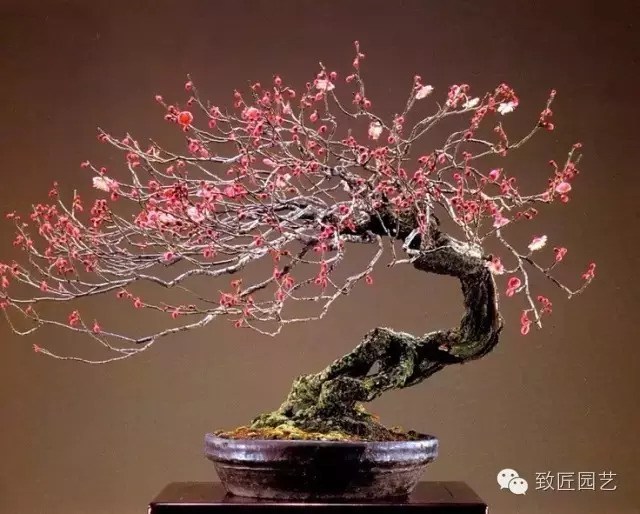
Plum blossom (Japanese apricot, Prunus mume) is a deciduous small tree or shrub in the genus Prunus of the rose family (Rosaceae), with a height of 4 m to 10 m. The trunk is grayish brown or purplish brown, and the new branches are mostly green. Besides normal straight branches, its branches also show variations such as weeping and dragon-coiling forms. The leaves are alternate, simple, with short petioles; the leaf blade is broadly ovate or ovate, pointed at the tip, 4 cm to 10 cm long, with fine, sharp serrations along the margin, and downy hairs on both sides. Flowers are borne 1 to 2 together in the leaf axils of the branches, with short stalks. Flower colors include white, pale green, pink, red, purple, and others; some cultivars also have colored blotches or stripes on the petals. Each flower has many stamens, whose length equals or is slightly shorter than the petals, and the flowers are fragrant. Depending on the cultivar, the shape of the calyx and petals varies greatly, and there are single-flowered and double-flowered forms. Depending on the climate of each region, they bloom successively from January to March each year, generally flowering before the leaves emerge.
For propagation of plum blossom, seedlings of peach, apricot, or plum blossom can be used as rootstock, and grafting is carried out by cleft grafting or bud grafting. After the graft takes, pinch out the growing tips to control plant height; after 3 to 4 years, when the trunk has grown to a suitable thickness, it can be used to make a bonsai. Old plum stumps that have grown for many years, are short in stature, and have an antique form can also be used to make bonsai. They can be transplanted after the flowers fade in spring; when digging, cut off the main root, keep more lateral roots, reshape the old trunk, and prune away some branches. First plant them in the ground or in a clay pot to "nurse the raw material." After they survive and the root system develops well and new branches sprout, use pruning and wiring methods to create bonsai of various forms.
Plum Blossom BonsaiTraditional styles include the Hui school's roaming dragon style, three-tier style, and basket-carrying style; the Yang school's knot style, wind-following style, and weeping style; and the Su school's split-trunk style, among others. In addition, there are different forms such as cascade style, waterside style, straight-trunk style, slanted-trunk style, curved-trunk style, deadwood style, and root-over-rock style. Pine, bamboo, and plum can also be planted together in one pot, which is called the "Three Friends of Winter." When planting, pay attention to the size combination of the three so that they are orderly in height and well-arranged, and place ornamental stones on the pot surface as needed to make it fresh and elegant, with high artistic quality. Traditional plum blossom bonsai values an old, antique-looking trunk, sparse branches, and a delicate, graceful plant, so when styling, the trunk should be slanted and curved, and the branches should not be too dense. Scars can also be made on the branches and trunk by hammering, tapping, or chopping with an axe to add a sense of antiquity. With the great development of the times, free-spirited natural-style plum blossom bonsai with varied forms are more favored by people, and some even make plum blossom bonsai with dense branches, so that at flowering time dense flowers cover the branches, giving a feeling of vitality and vigorous upward growth. When making this type of bonsai, the branches should be numerous but not messy, and the branches and trunk, as well as the branches and flowers, should be harmonious and unified.
The styling of plum blossom bonsai is mostly carried out after the flowers fade in spring. The method is mainly pruning, supplemented by wiring. When pruning, straight branches without grace can be cut off, while branches with beautiful form and attractive curves should be retained. For young trees or straight branches that need to be kept, wiring can be used to bend them, so as to achieve the artistic effect of "sparse shadows slanting across, antique and elegantly strange".
Plum blossom likes a warm, humid environment with plenty of sunlight and good ventilation. It is tolerant of cold and drought, but fears waterlogging. Usually it can be placed outdoors in a place with ample light and circulating air; if sunlight is insufficient, flowering will be affected. During the growing season, water by the rule of "do not water until dry, and when watering, water thoroughly," avoiding water accumulation in the pot soil, otherwise root rot will occur. From late May to late June is the early stage of physiological flower bud differentiation in plum blossom, so watering should be properly controlled. Wait until the tips of new branches show slight wilting before watering again. You can also pinch the tips of new shoots until they wilt by hand; repeating this several times can damage the growing points, thereby controlling the growth rate of branches and favoring flower bud differentiation. From July onward, normal watering can be resumed to meet the water requirements for growth; if rain occurs, pay attention to drainage to prevent waterlogging. During the growing season, apply a fully decomposed, dilute liquid fertilizer about once every 15 days. In May and June, additionally apply a phosphorus and potassium fertilizer such as 0.2% potassium dihydrogen phosphate or superphosphate once each month to promote flower bud formation. In northern regions, move it indoors in early winter to a sunny place for care, maintain a room temperature of 0°C to 6°C, and spray the plant with some clean water about every 2 days to increase air humidity and prevent branch tips from withering, but the soil does not need to be too wet. In December, flower buds begin to swell, and 0.2% potassium dihydrogen phosphate solution can be applied 2 more times along with an appropriate amount of nitrogen fertilizer to promote larger, more fragrant flowers. After the flowers fade, carry out one pruning, cutting off diseased and insect-damaged branches, overly dense branches, and other branches not needed for the design, and shorten old branches, leaving only 2 to 3 buds on each branch to stimulate new branches. When new branches grow to 20 cm, pinch them once. Young trees should be repotted once every 1 to 2 years, and old trees once every 2 to 3 years, which can be done after the flowers fade in spring. The potting soil should be loose, fertile, well-drained sandy soil, mixed with a small amount of bone meal, or place a few pieces of animal hoof and nail in the lower part of the pot as base fertilizer. Newly potted plants should be placed in a shady place to recover for about a week, then moved to a sunny place for care.
Featured Content
Click below
To watch more content, please click:Bonsai article summary and compilation!