Well-meaning rescue of abandoned small animals may actually harm them
Wildlife rescue is not a simple matter. This article probably cannot answer all your questions. If you want to learn more about wildlife rescue knowledge & stories, you are welcome to sign upfor this Friday's online lecture. Calendar Girl has invited wildlife conservation worker@Wild Youth Chen Laoshito talk about the ins and outs of wildlife conservation, and you can also ask him your questions then~
Body text divider
We often see posts online saying that someone found a small leopard cat, a small badger, a small masked palm civet or the like somewhere, has already taken it home, and is asking how to feed it. But the problem is, their mothers were feeding these babies just fine, so how did they end up being carried home by humans?
What should you do if you come across a small animal?
Actually, most people mean well. They say they saw the cub there with no one looking after it, and they were afraid it would freeze, starve, or get rained on. But in reality, this is overthinking it. If wild animals did not have the normal ability to reproduce and raise their young, they would have gone extinct long ago. So please rest assured,your worries are very likely unnecessary:
The parent animal knows how many times a day to feed its young to ensure they grow up safely; the parent animal also needs to go out foraging itself, and may even bring some food back for the young; their den can shelter them from wind and rain, keep them warm, and be comfortable enough to ensure the young grow up healthy.
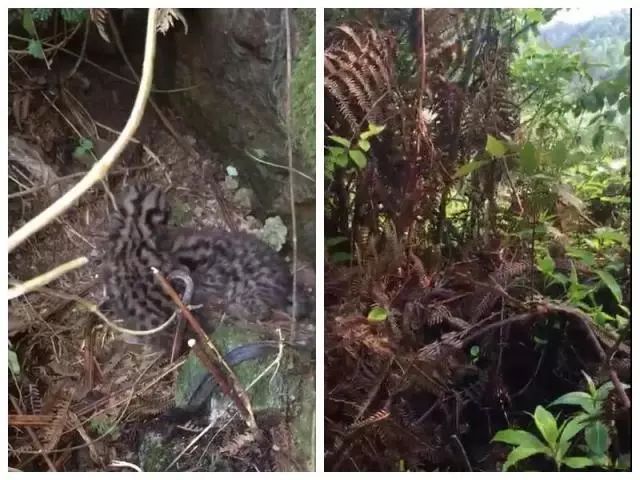
In an environment like this, if you find two small leopard cats, that is their den. Just leave it alone.
In addition, some "rescuers'" accounts themselves may be questionable, such as saying they found some kind of small carnivore cub in the middle of the road that had not even opened its eyes yet. Thesecubs are so small that it is not even realistic for them to crawl out of the den, so how could they get to the middle of the road?There are also cases where people find carnivore cubs in mountain crevices or in dense grass. While we envy their sharp eyes and good luck, we need to remind them:these places are exactly the kinds of places they like to choose for their dens, so do not make a fuss。
Take leopard cats and masked palm civets, for example. Although both have strong tree-climbing abilities, they both choose hidden spots on the ground to make their dens. Badgers choose to breed in burrows, so badgers that are rescued while still too smallI suspect were all originally dug out of burrows。
For a hog badger as small as this, saying it was picked up is also very hard to believe.
If you find a cub outside the den that can already walk normally, it is very likely following its parent out to move around, or the den is nearby. At this time, please be sure not to disturb them. Disturbance may cause the mother and young to become separated, and may also get you attacked by a parent animal that runs out from who knows where.
What you can do at this time is not approach. You can observe quietly from far away. Of course, it is even better to avoid it altogether without even looking. If you have already accidentally disturbed the animals, you should also withdraw immediately. The mother and young will try to find each other again, which is much better than having people still there getting in the way.
A hog badger of this size may have been "rescued" by someone who, for who knows what reason, did it just as it was coming out of the burrow to move around.
If you come across an animal's den, the correct thing to do is leave as soon as possible. Not disturbing it is the best protection. Staying there too long may be noticed by the parent animal and affect their normal family life.
If the location where you found the cub really is suspicious and you truly feel worried, the correct approach (though actually I do not recommend most people do this, because I thinkit is very likely to either cause trouble for yourself, cause trouble for the animals, or cause trouble for both sides) is to check the cub's body condition. If it is in good spirits and has a plump body, then that is enough. Leave with peace of mind, and you can come back to check tomorrow. What should you look at the next day? If you find a parent animal there, then there is no question, leave with peace of mind; if the parent animal is still absent, but the cub is still in good spirits and has a plump body, that proves they have their mother feeding them, and you can also leave with peace of mind.
A leopard cat rescued to Guangzhou Zoo. Do not even think about keeping one, as keeping one is illegal. Image: Gao Linfeng
What needs to be emphasized is that during all checking, do not touch the animal, do not touch the den. Wild animals are very sensitive to scent,if a human touches the cub, the possibility cannot be ruled out that the parent animal will come back and kill the cub or abandon feeding it. So, you must not use your hands. In fact, a person standing beside the den has already left a lot of information for the animal, and the parent animal is also very likely to move the cub because of this. By the time you go again, it may already be empty, which actually shows that you have already caused trouble.
If you take the cub home...
What happens after a cub is taken home by humans?
It may die because the individual does not know how to care for it.
It may die after being sent to a rescue department because they do not know how to care for it.
It may meet someone who knows how to raise them to adulthood, and then that person takes a weekend off, and the colleague on duty does not know how to care for them, and the cub dies.
It may die from diarrhea after drinking cow's milk.
It may die from cold after being forgotten and not kept warm. After all, no one can give them warmth every day with an embrace the way their mother can.
……
In short, under human care, these wild animals have all kinds of ways to die; even if they grow up, they may still be too close to humans to be released, making nature lose these wild animals forever.
A leopard cat picked up because it was cute, fortunately later rescued by forest police with the assistance of Cat Alliance volunteers
Even if they are eventually released back into the wild, what will happen?
It may starve or freeze to death in the wild because under captive conditions no parent animal taught them survival skills such as finding food.
It may die after being attacked in the wild by natural enemies because it never learned how to avoid them or how to interact with members of its own species, or it may be attacked for not being accepted by its peers, and eventually die.
……
I will not list their ten thousand ways to die one by one. In short,when they are taken home, it is almost equivalent to already being dead. Even if they survive, the possibility of returning to the wild is extremely low.
If at the time they were a litter of well-fed, well-clothed babies that just happened to be seen by someone, then the decision to take them home is a bolt from the blue for their fate.
This is absolutely not alarmism. For the national treasure, the panda, enormous manpower and material resources have been invested in artificial breeding, but pandas raised under captive conditions still struggle falteringly today when it comes to rewilding and release. Losing the rearing of their parent animals and growing up in captive environments makes it extremely difficult for wild animals to return to the wild.
A leopard cat rescued in Taiwan, China. Compared with the mainland, Taiwan, China is much more advanced in wildlife rescue. Even though various efforts have been made, their attempts to rescue and rewild released leopard cats still cannot be considered successful.
So, what can we do?
The cubs picked up by people are usually small carnivorans such as badgers, raccoon dogs, masked palm civets, leopard cats, and yellow weasels, as well as small hedgehogs. The reason is probably thatthe areas where these animals are active are often close to areas where humans are active; moreover, human houses or farmland surroundings are also very likely to provide them with warmth and food sources (such as rodents or insects, etc.).
A leopard cat in Beijing, China. It lives right beside us
As people's awareness of wildlife protection increases, many people want to help cubs. Since it has been said all along that taking cubs home is wrong, then what is the right thing to do?
Leaving protection to wildlife protection organizations, institutions, and research universities is of course far from enough.Protection should be something everyone can do. If you want to help wild animals near your home, you can become their spokesperson and tell more people about them; you can also try to improve their habitat--
for example, stop poaching activities from happening here; for example, go tell nearby people about the knowledge of protecting wild animals and the harms of eating wild animals; for example, reduce the use of pesticides that may affect wild animals; for example, try to restore the ecological environment of shallow mountain areas through scientific methods; and so on.
When people everywhere begin to protect the ecological environment of their own place, that is the greatest help to those wild animals and to us humans ourselves.
Summary
Rescuing animals is something that requires time, energy, professional ability, and financial investment. Low-investment, high-output animal rescue does not exist. So, what should you do if you come across a carnivore cub?
Leave it alone, walk away quickly.
This article may not answer all your questions
This Friday at 19:30Come listen to the online salon!
Resolve your questions about rescuing wild animals
Calendar Girl has invited the author of this article,
wildlife conservation worker@Wild Youth Chen Laoshi
to answer everyone's questions and share stories
What will Chen Laoshi talk about?
Whyshould we rescuewild animals?
What kind of wild animalsdo not need you to rescue them?
To rescue wild animals, whatdo you need to give up?
Rescuing less commonly seen animals,
such asroe deer、batswhat is that experience like?
Of course, there are also some off-topic complaints
How will wildlife rescue destroy you?
Forget it, maybe you should just not rescue wild animals
This super exciting online salon
is this Friday, do not miss it!
You can also ask Chen Laoshi your questions on site~