When love means getting shot in the head, this kind of romance is hard to bear
The animal world never lacks bizarre sexual behaviors. Many animals injure the female during mating (in hermaphroditic animals, it is both partners, or the one receiving sperm), and the methods vary. These ferocious mating methods are collectively known astraumatic mating(Traumatic Mating)。
The love life of sea slugs: one shot to the head!
In 2014, Rolanda Lange of the University of Tubingen in Germany, along with her research partners Werminghausen and Anthes, published a startling discovery.
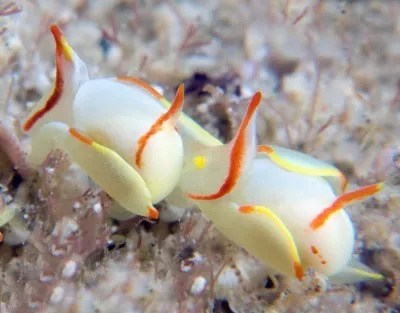
The researchers caught some sea slugs from the Great Barrier Reef and kept them in the laboratory. They belong to the genus Siphopteron, and currently have no formal species name. These little creatures are extremely cute, with a body length of only 2 to 4 mm, a white body paired with bright red and yellow trim, as radiant as candy.
They look soft and adorable on the outside, but inside they are @#¥%&*... Image: seaslugforum.net
In contrast to their cute appearance, the sex lives of sea slugs are extremely wild. The sea slug family is already famous far and wide for its sex life, and sea slugs of the genus Siphopteron are an especially wild member among their kind. It is, as far as we know,the only animal known to pierce its partner's head during mating。
Schematic diagram of the mating process of a sea slug of the genus Siphopteron. Image: DOI: 10.1098 / rspb.2013.2424
The sexual relationship between two sea slugs begins with intimacy. They position themselves head to tail, curled into a ball, like two shoes in a shoebox. Because sea slugs are hermaphroditic, both partnersinseminate each other. The two sea slugs extend the slender male reproductive organ located at the front of the body. This thing is forked, and both forks have pointed "heads," one thick and blunt, the other thin and sharp.
The thick blunt tip inserts into the entrance of the female reproductive organ to deliver sperm. Because sea slugs mate head to tail, the male reproductive organ at the front is aimed right at the "back door" at the rear of the partner. This path is not long. Butthe thin sharp tip will curve around to the front and insert into the partner's head, at a position just slightly above the eyes. The reproductive organ of the sea slug can extend very far, almost as long as the body itself.
Who would have thought it was such a little cutie. Image: In-Depth Images Kwajalein
During insertion, the reproductive organ injects some fluid. We still do not understand the composition and source of this fluid, but based on inferences from sea slugs of the same genus, the injected substance is very likely prostate fluid. The entire insertion process lasts more than 40 minutes. As mating nears its end, the sea slugs change position from being curled into a ring to a head-to-tail "train car" arrangement. On one occasion, Lange and her colleagues observed three sea slugs together, inseminating one another.The function of the sea slug's "head shot" remains unclear. But stabbing the head is not easy; it requires an exceptionally flexible reproductive organ and precise maneuvering, so doing this must carry some benefit in terms of natural selection.
Go to the Big Iron Rod Hospital and ask for Director Stab
The most ordinary household pest, the bed bug (Cimex lectularius), has males thatdirectly use their sharp external genitalia to pierce the female's abdominal wall and inject sperm into the female's circulatory system, letting them swim to the destination on their own.
Mating bed bugs. The smaller male bed bug below thrusts its genitalia directly into the female's abdomen. Image: Rickard Ignell / Wikipedia
At least nine families of snails, during mating, stab a hard "arrow" made of calcium salts into the partner's body, called a "love dart" (Love Dart). In different snail species, this "arrow" also comes in different shapes such as needle-like, arrowhead, and blade-like, just like a ninja's hidden weapon pack.
Afterward, the snail on the right has a love dart stuck in its body. Image: Eynar / Wikipedia
Some flatworms belonging to the order Polyclad look like brightly colored handkerchiefs, and their mating method is so bold and unrestrained that it stands unchallenged in the animal kingdom. Flatworms are hermaphroditic; as long asone can stab the partner's body and inject sperm into it, fertilization can be completed. During mating, both partners extend their male reproductive organs, dodging and thrusting at each other like a fencing match.The one that gets stabbed acts as the "female", receiving the sperm.
Two flatworms raise their bodies, attempting to pierce each other with their external genitalia. Image: Leslie Newman / Wikipedia
Why do animals harm their own partners? The reasons are bizarre and varied, but it is certainly not to spice things up.
The snail's "Cupid's arrow"
Let us give one example, a type of animal that has been studied quite thoroughly: snails. The reason for their love-hate relationship is very likely thatsnail romance is extremely hostile to sperm. More than 99% of the sperm that enters a snail's body loses its life. Inside the snail there is a small organ called the bursa copulatrix,whose secreted enzymes dissolve the sperm. The reason snails "hate" sperm may beto give the sperm-receiving party the power of choice: it can destroy the sperm it does not like and choose the snail with the best genes to serve as the "father" (snails are hermaphroditic, so either one can be the father).
Mating snails. Image: David Fox / gettyimages.com
As we said earlier, mating snails use the love dart to stab each other. The end of the love dart is connected to a pair of glands, which secrete mucus that coats this "arrow." Ronald Chase and Katrina Blanchard of McGill University also conducted an experiment to understand the "medicinal effect" of the mucus on snails.
They caught some garden snails (Cantareus aspersus) and surgically removed the glands of the snails' love darts, then let them mate. After one group of snails mated, the sperm-receiving snails were injected with an extract from the glands; after the other group mated, they were injected with saline. After the sperm-receiving snails laid eggs, the genes of these eggs were examined. The results showed that the "mucus snails" could fertilize at most 44.1% of the eggs, while the "saline snails" could fertilize at most only 20.4% of the eggs (inside the sperm-receiving snails, some sperm from previous matings had been stored, so the credit for fertilization was not entirely divided between these two), which is to say,the mucus more than doubled the chance of fertilization。
As the snails say, no "dart," no gain. Image: kiokuima / YouTube
The components in the mucus can make the snail control the muscle contractions of the "duct" of the bursa copulatrix, making it difficult for the enzymes to flow out. A snail that fires off "Cupid's arrow" may use this method to increase the survival rate of its own sperm and fertilize more eggs. Some snails use "drugs" to control their own kind that are very dangerous. The snail with the scientific name Bradybaena pellucida,after being stabbed, lays fewer eggs and has a shorter lifespan. Although the total number of eggs is reduced, the snail that uses this "weapon of mass destruction"can greatly increase its own fertilization rate, so on the whole, compared with snails that do not use the love dart, it still has more offspring. The snail takes a larger share from a smaller cake.
Come and see what other facts about snail mating you do not know. The video is about 3 minutes long; please watch it on wifi. Source: PBS Digital Studio
The arms race behind marital harmony
Mating looks like marital harmony and perfect union, but in fact it is not. Females and males, or in hermaphroditic animals,the egg provider and the sperm provider, frequently come into conflict. For example, the best choice for a female may be to mate with multiple males and choose the best sperm, but the best choice for a male is to fertilize as many eggs as possible. After he mates with one female, he is certainly not happy about other males coming to grab this "cake."
So males may evolve methods to manipulate females. For example, the laboratory regular Drosophila melanogaster,some proteins in its seminal fluid suppress the female's "desire", making the "refractory period" of the female fruit fly after mating longer and reducing the chance of "rival" invasion.
Mating fruit flies. Image: FRANCISCO ROMERO FERRERO
But while males evolve methods of manipulation,females also evolve new methods to counter them, for example, using enzymes to break down the proteins that the male deposits into her body. Genetic research has found that in the genus Drosophila (Drosophila.spp), whether female or male, the proteins related to reproduction evolve very quickly. After this evolutionary "arms race" develops to a certain degree, the female's external genitalia become a tightly guarded "pass,"and "drugs" and sperm traveling this route together are easily wiped out completely. So another path must be found, like the snail's love dart, choosing a weakly defended place to break through. Some animals, like bed bugs, even change the "route" that sperm takes.
Perhaps the sea slug's "head shot" mating method is also meant to "inject drugs" into the partner to control it. They chose the tactic of attacking the head, aiming directly for a soul-piercing hit at the partner's central nervous system.
This article is a special contribution to Species Calendar, from Species Calendar author @Red Queen.
If you like her, you can also follow
The Mantis Shrimp's Squirrel Nest
id: gh_6422b69589c2
Strange species and interesting knowledge