Container-garden master Dennis creates vivid works with stunning plant combinations
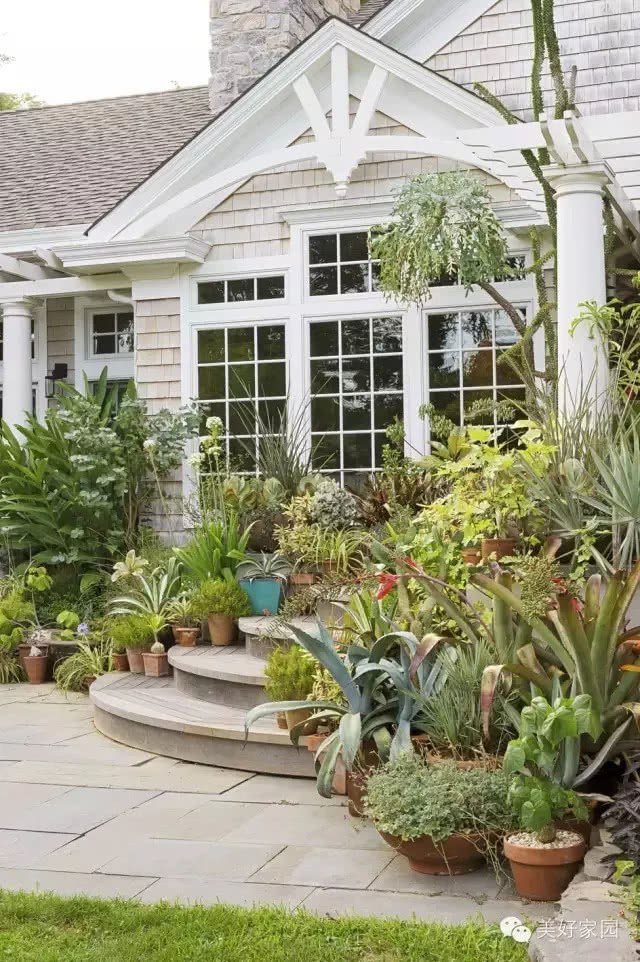
At first, his only wish was for the garden to hold all his potted plants,but he never imagined this "tropical storm" would eventually sweep through his entire soul.
It turns out plant sellers are just as crazy as buyers, addicted to collecting plants. Look at the nearly 40 plants flanking the steps: agaves, bromeliads, bulbous plants, pitcher plants and other odd and curious varieties.
When I first met Dennis Schrader, he was trying to put in a good word for mixed-style container plantings. As a master of container combinations, he doesn't mean to offend other ways of grouping plants. The principle of "a main plant, supporting plants and spillover plants" may be a bit too dogmatic; instead, Dennis likes to use more striking plant combinations to create more vivid container works. Dennis, who fell hopelessly in love with tropical plants, says it took him only a very short time to develop his interest.
An Ornithogalum arabicum is the main plant on the steps, backed behind it by kangaroo paws and many varieties of agave.
In 1982, Dennis went into the landscape design business with partners, interpreting the beauty of tropical plants with his own personalized style. They longed to develop as many tropical plant resources as possible, but the gap between ideals and reality eventually forced them to wake up. Ten years later, they adjusted their business strategy and moved to Mattituck on Long Island, founding Landcraft Environments Ltd., a nursery focused on cultivating and wholesaling rare perennial varieties. From then on, Dennis joined the ranks of world-class plant collectors, and their private garden next to the nursery naturally became the front line where a motley collection of plants from around the world gathers.
Simple yet powerful, Sansevieria cylindrica sends out round leaf spears from a mat of gray-green Pilea glauca 'Aquamarine', while the trailing snapdragons beside it keep blooming.
How should this spiritual wealth of plants be put to good use? Container plantings are clearly the best way to show off. Dennis focuses on container combinations of a single plant type, but the vast majority of containers in this style are not solo performances; they usually feature one main plant paired with other plants to jointly star in the container display. Usually Dennis finds a plant with strong vertical lines to dominate the container, then surrounds it with a ring of groundcover plants, mostly tiny, trailing types. It might be a combination of tall, upright sansevieria with clustering pilea, or an Ornithogalum arabicum combined with creeping snapdragons. Although each container has only one showy highlight, Dennis habitually uses plants of the same type to accent the main plant, matching traditional mixed-style containers in quantity but with a clearer hierarchy of main and secondary elements.
Golden creeping Jenny (moneywort) spills over the edge of the pot, with Caladium 'King Arthur's Sword' and Farfugium japonicum 'Ukigumo' flanking the cup-shaped taro planting on either side.
Dennis's method suits plants whose main plant has strong vertical lines but not much visual interest in its lower half, so in a way it solves tricky problems remarkably well. Dennis's container plantings cleverly cover the bare ground around the house and in the garden while precisely capturing the most beautiful side of the plants. Compared with mixed-style container combinations, the single-plant-type approach has more distinctive characteristics.
The main container draws its gray inspiration from stone, along with silver-leaved sun-loving Mertensia maritima and tree-form lavender cotton (Santolina chamaecyparissus). Sansevieria and the fiber-optic grass dotted along the steps form a striking contrast with them.
Of course, plant selection also has some influence. The color of the container is also closely tied to the color of the plant's stems; for example, black-stemmed Alocasia macrorrhizos paired with tiny gray-green Pilea glauca 'Aquamarine' and a deep blue container; tall, slender containers can set off a slim main plant. Either way, choose the container carefully, since after all it is a component of the work.
The "three cobblers" are a Billbergia as the main plant, clumping Kalanchoe thyrsiflora of the Crassulaceae family, and Tradescantia 'Pink Stripe' of the Commelinaceae family trailing out of the pot.
The key to grouping plants is to bring together plants with the same needs and growth habits, taking into account not only their light requirements but even their preferences for soil moisture. In each container Dennis carefully arranges, both partners in the combination have similar or shared growth habits. Because the plants used in the groupings have low light requirements, as long as they are moved indoors in winter, they can live year after year. Compared with the grouping principle of "a main plant, supporting plants and spillover plants," Dennis's overall container is simply a living "main plant."
Beneath the pergola leading to the vegetable garden, Begonia 'Madame Queen' takes root in a tall stone urn, edged around with variegated creeping fig.
Container combinations of a single plant type
Using the straight, nearly arrow-shaped black-stemmed Alocasia macrorrhizos as an example, Dennis demonstrates how to master the essentials of single-plant-type container combinations. Paired with the main plant is Pilea glauca 'Aquamarine' - dark stems and tiny silver leaves forming a cushion like meerschaum around the rim of the container. For the container, Dennis chose a deep blue glazed pot, striking enough to catch the eye.
Materials to prepare:
A 35 cm diameter pot (with enough depth),
potting soil,
one black-stemmed Alocasia macrorrhizos,
six Pilea glauca 'Aquamarine'.
Fill with quality potting soil to a depth a few centimeters below the rim of the pot.
Take the black-stemmed Alocasia macrorrhizos out of its original pot and loosen its roots.
Dig a hole and place the black-stemmed Alocasia macrorrhizos in the new pot, making sure the root ball sits above the soil surface.
Backfill soil around the root ball of the black-stemmed Alocasia macrorrhizos, leaving a 5 cm wide trench band for the pilea.
Firm the soil around the root ball.
Squeeze the plastic pot of the pilea to help the plant slip out easily.
Loosen the soil and untangle the pilea roots.
Plant the six pilea side by side, press firm, and add potting soil to fill all the gaps.
Find a suitable spot for the newly made container combination. The black-stemmed Alocasia macrorrhizos and Pilea glauca 'Aquamarine' have similar growth habits and both like partial shade. Water the new container arrangement, then sit back and enjoy its beauty.
-END-
Beautiful Home New Media
Presenting every home that you and I can touch!
Classic home decor case studies | Authoritative professional gardening guidance
Refined lifestyle concepts | Sharp and trendy art information