A 4.5 by 1.2 m aquascaped tank, 4 aquascapers, 4 days and 4 nights to complete - stunning
Attention!
Tomorrow, tomorrow! We are holding a friendship contest for aquatic plant hobbyists' first tank setup, and you get to decide the winner! Everyone please join in, thank you all! (After the contest, voters screenshot and join the group to get a red packet! See you tomorrow, be there or be square!)
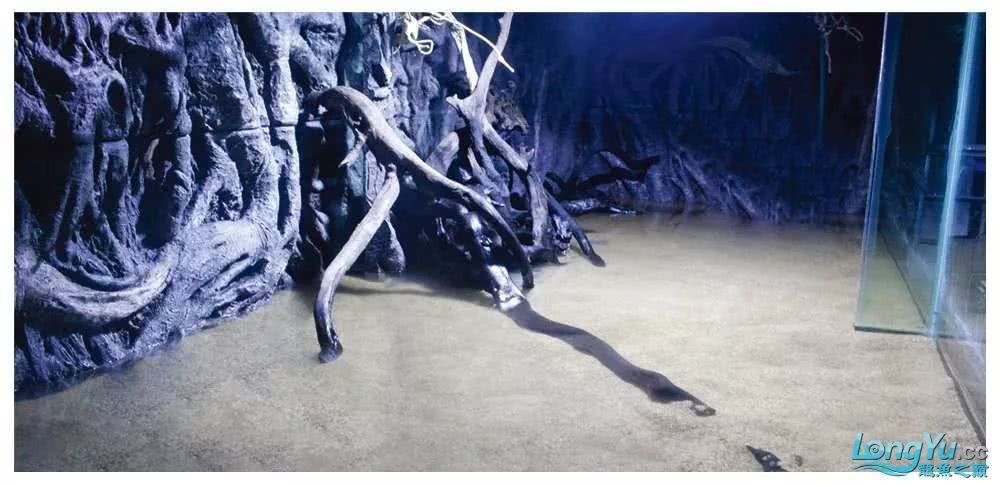
After more than three months of design, a 4.5 m long, 1.2 m wide biotope aquascape, through the efforts of four workers putting in more than 12 hours a day, was finally completed after four days and four nights.
[Design concept]
The front of the fish tank uses double 15 ultra-clear laminated glass, while the other parts use double 15 float laminated glass, with three layers of bracing. Because the fish tank is located in the basement, a single full pane of glass could not be manufactured, so the middle position uses a glass butt-joint method. The one shortcoming is that to make the fish tank safer and more secure, two pillars 7 cm thick, 16 cm wide and 1.2 m high were used for support, which affects the appearance somewhat, but with such a large tank and so many tons of water, a leak is no joke. Between appearance and safety, safety was chosen.
Bottom filtration:1.2 m X 1.5 m, with two filter chambers in total, plus an added 1.5 m X 0.8 m water trough, which can be connected to the bottom filtration or used independently.
[Outstanding features]
24-hour overflow water change. The advantage of this design is: for 12 tons of water, if a quarter were changed weekly, that would be three tons of water, a huge undertaking, and changing water like an ordinary fish tank would be impossible. So 24-hour overflow was chosen; a large water volume combined with 24-hour overflow keeps water quality very stable. At the time of setup the pH was 8.4, and now, one year after setup, the pH has remained stable at pH 8.4. This greatly reduces routine work; you only need to change the white filter pads once every 2 to 3 weeks to keep the fish tank well maintained.
In the middle of the bottom filtration there is a 1.5 m X 0.8 m water trough, connected to the bottom filtration, which can be used to raise fry and as a treatment tank; now two sets of upper filtration have also been added.
I. Design and installation
1. The fish tank is located in the basement; the workers are carrying one set of bottom filter tanks down to the basement for overall installation.
2. On the basement floor, 2 cm wooden boards were laid; the picture shows one of the two bottom filter sets.
3. While the workers were busy, I took a photo of the glass thickness. You can all see the thickness of this glass, double 15 glass. Because the fish tank is very large, the glass is thick enough, the silicone sealant has a relatively large bonding area, and the safety factor is also relatively high.
4. The glass fish tank in the middle is used to isolate and raise juvenile fish, and can be connected to the main tank or used independently.
5. What supports the fish tank is H-beam steel, 8 mm thick. H-beam steel is much taller than square steel and has the strongest load-bearing capacity.
6. Starting to tinker with the filtration system, various pipes and filter media. The filter media were raised up with PVC pipes and partitions, which can enhance water flow, and debris can settle.
7. For the safety and stability of the fish tank, pillars were added at all four corners. The wide black positions are the pillars, and the middle is like this, as shown in the picture above. The pillars are 6 cm thick, with three layers of bracing, and the bracing is 3 cm thick.
II. Aquascaping part
1. The ultimate weapon for treating driftwood - a high-pressure high-temperature water gun borrowed from a friend's hotel, originally used to clean central air conditioners and stoves, which can instantly heat up to 140 degrees.
2. The two main pumps used are 22T units of a certain Singapore brand.
3. The background board uses a certain brand's Qianlonggen series; one set is 3.6 m long, and nearly three sets were used in total.
4. Starting to lay the sand. The sand thickness is 2 cm. Sand can play a major role in cultivating nitrifying bacteria; the drawback is that NO3 and NO2 will accumulate in large amounts. This problem can be solved by keeping some sand-sifting fish. For example
Related Articles
- How to prevent and control pests and diseases on desert rose? Ventilation and dryness are the key to prevention
- The three main causes of cotton diseases: climate, seeds and cultivation
- How to Grow Bird's Nest Fern in Water? Master Temperature, Light, and Water Change Techniques
- A Complete Guide to Identifying and Controlling Common Potted Flower Pests
- Do Carnivorous Plants Need Watering? Pot Watering and Wet/Dry Assessment Methods
- How to manage cotton during the flowering and boll-setting stage? Apply flowering and boll fertilizer heavily, use chemical regulation and pruning to prevent premature senescence
- How to Grow Chinese Hibiscus? Master These 5 Key Points for Blooms All Year Round
- How to Grow Tulips in Water? The Complete Process from Bulb Preparation to Blooming