Growing flowers starts with growing roots, but roots that grow too vigorously can also cause trouble, so don't ignore it
Growing flowers starts with growing roots, and I believe many flower lovers know this principle. If a potted flowering plant has yellowing leaves or drops its flowers, a considerable part of the reason is that the roots have rotted. If the plant's root system grows very lush, will the flower then grow very well? Actually, not necessarily! Because if the root system of a potted flowering plant grows too lush, it will also affect its healthy growth. After all, the flower pot is only so big, and the nutrient soil is only so much; when there are more roots, the potting soil is easily absorbed completely, and if you do not repot for a long time, there is probably no soil left in the pot at all! A flower with no soil, no matter how you grow it, will not grow well!
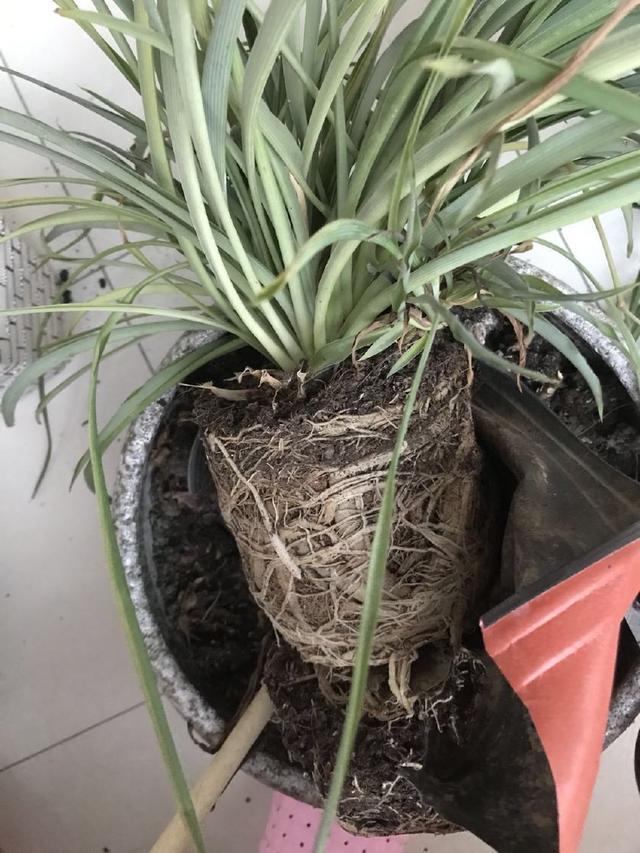
First take a look at my spider plant in the picture below
That's right, this is a spider plant that has not been repotted or given fresh soil for several months. To be honest, I am not surprised at all, because I already knew that spider plants have a very vigorous root system; it is just that I usually take care of too many flowers and plants, and when I got busy I forgot to repot it. By the way, do you know how I dug it out? You may not believe it if I tell you: I directly used scissors to cut a big opening in the flower pot before I could pry it out. As you can see, the spider plant's leaves are no longer so glossy green, with not a bit of shine, and are even a little yellow. If I do not repot it again, the trouble will probably be big!
Not only spider plants; if Clivia is not repotted for a long time, its root system is also a problem
Just looking at the picture of the Clivia above makes it hard to keep looking, after all, this root system has grown way too vigorously. It looks like it has not been repotted for at least a year, and there is not a trace of soil left in the flower pot, all gone. Grown this way, within two months, the leaves will surely turn yellow, let alone bloom; even if it blooms, the flower will be trapped by the arrow. Clivia is a typical fleshy-rooted flower, with thick and strong roots; as long as there is a little nutrients and a suitable soil environment, it grows very fast. So if flower lovers grow Clivia, be sure to remember to repot it often. Generally, repot at least once a year; I suggest flower lovers can change the potting soil once every 6 months. After all, over time, the nutrient soil will become poor.
When repotting flowers and plants, what details need attention
First is the timing of repotting and changing soil. Generally, spring and autumn each year are good times for repotting; at this time the weather and temperature are suitable, and the survival rate after repotting is high. And most flowers are now propagated by cuttings in spring and autumn, also because the climate is suitable. Second, when repotting, check the condition of the root system. If the root system is too lush, it is recommended to use scissors to cut off part of the old roots or the rotten roots inside. Then soak them in carbendazim and potassium permanganate solution for 10 minutes, let them dry, and then transplant them into a new flower pot. Third, after repotting, do not water immediately; wait at least 5-6 hours before watering, or simply water the next day, which helps survival.
The above are the issues to pay attention to regarding growing flowers; the root system must be taken seriously.
Thank you for reading, remember to like and share~