Rose bushes growing leaves but not blooming? Find the internal and external causes and solve it easily
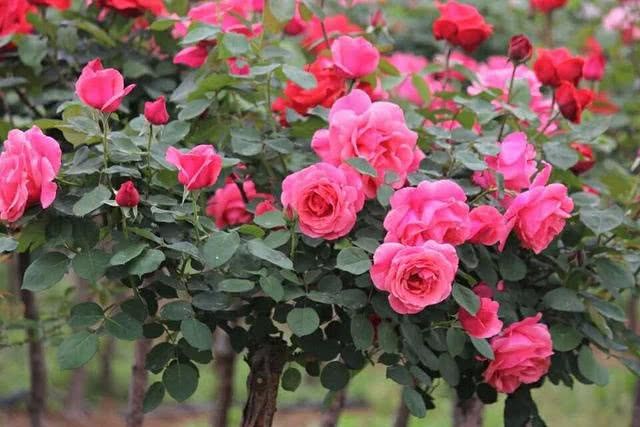
If you were to pick the most beautiful part of a rose bush, the flower would undoubtedly be the absolute champion. After all, we grow roses just to see them bloom, but although roses are beautiful, growing them is not simple. Many gardeners often see their roses standing tall with lush green leaves looking perfectly healthy, but the problem is they bloom little or not at all. So what exactly should be done about this phenomenon of excessive vegetative growth? In fact, there are only six ways to deal with it...
1. Internal causes:
First, the internal cause of excessive vegetative growth in roses is the intake of excessive nutrients, mainly referring to fertilizer and water. Let's talk about fertilizer first. Although autumn has already arrived, due to the "autumn tiger" (late-summer heat), temperatures are still very high. At this time, roses themselves are still in a semi-dormant state just as they are during the hot summer temperatures, so nutrient intake is not high either. If fertilizer is applied indiscriminately, it can easily cause eutrophication of the rose. Especially if we apply large amounts of nitrogen fertilizer without experience, the excessive growth will become even more severe. Of course, this is still a relatively mild situation; more seriously, it may cause fertilizer burn, leading to the death of the plant.
Watering also deserves attention. Although temperatures are high and water evaporates quickly, roses themselves have a good regulatory capacity, so there is no need to worry too much about a period without watering. However, some gardeners are afraid their roses will be "thirsty" and water them many times a day. This leads to excessive water absorption, which is not good for plant growth. Following the principle of "water when dry, stop when wet" and using the actual condition of the soil as the basis for whether to water is most appropriate.
2. External causes:
1. Lack of necessary pruning
Autumn is a period of rapid growth for roses, so during this time they will grow many branches and leaves. Once a plant has too many branches and leaves, nutrients become dispersed, and it also has a certain impact on air circulation, ventilation and light. So to prevent excessive vegetative growth, you must use the pruning shears on your roses in autumn. The purpose of pruning is to cut off excess side branches, including of course dead branches, diseased branches, leggy branches, etc. After pruning, the remaining branches can absorb nutrients better, and air circulation is also improved, so the chances of blooming are greatly increased.
2. Insufficient light
For roses to bloom, a certain amount of light is essential, because only by receiving sunlight can normal photosynthesis take place. Of course, we also know that many gardeners worry about the harshness of the sun and fear their roses will get sunburned. In fact, there are two solutions here: one is to set up a shade net at home and protect the plants with the shade net during the period when the sun is harshest; the other is to choose to give roses sunlight in the early morning or evening. The benefit of doing this is that it also avoids bacterial growth caused by high temperatures.
3. Notes:
1. Roses should ideally be placed in a well-ventilated spot to avoid bacterial growth. You can install an exhaust fan in the greenhouse or simply use an electric fan to blow air directly on them.
2. In addition to nitrogen fertilizer, phosphorus and potassium fertilizers can also be appropriately added during the rose blooming period. Of course, all fertilizers need to be diluted before application.
Prevent pests and diseases. During the spring and autumn rainy seasons, leaves are prone to black spot disease and powdery mildew. Once discovered, you can spray with a 1000-times dilution of 70% wettable thiophanate-methyl powder for treatment, or use a cotton ball dipped in alcohol to wipe both sides of the leaves and the petioles for treatment. The main pests are aphids and red spider mites, both of which can be treated by spraying with 40% dimethoate emulsifiable concentrate diluted 1500 times with water.