Failing to promptly clean up dried leaves on succulents is highly harmful, so stop ignoring it
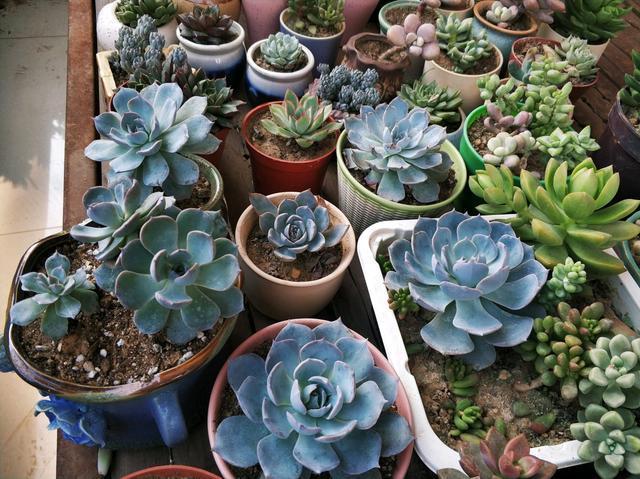
Playful and cute succulents are the top choice for many flower lovers to grow at home. On the one hand, this is because of their extremely high visual appeal, and on the other hand, because succulents are relatively easy to care for. But perhaps all friends who have grown succulents have encountered this situation: succulents develop dead leaves and leaf drop. Many people think this is a natural phenomenon, and of course many tender-hearted friends say it makes them feel distressed. So how exactly should these dead leaves and fallen leaves be handled, and is there any way to prevent them? The article below gives you plenty of practical tips.
What should be done about dead leaves on succulents? Clean them up quickly!
As we introduced before, many people regard dead leaves on succulents as a natural phenomenon, so they just let them fall into the pot. This approach is completely wrong. In fact, when dealing with dead leaves on succulents, we must pay attention to two words: "fast" and "ruthless." Fast means quick action: remove dead leaves as soon as you see them. Ruthless refers to the intensity: never let dead leaves stay in the succulent pot for too long. The reason for doing this is that if dead leaves accumulate, under the current relatively high temperatures they can easily breed bacteria and cause the succulent to suffer pests and diseases. If handled improperly, then the cute succulent may just up and die!
Be alert! These causes lead to dead leaves on succulents
Dead leaves on succulents are highly harmful, so how exactly do they arise? In fact, there are mainly 2 reasons:
The first is the natural phenomenon we just mentioned. This situation mainly appears during the period right after bringing the succulent home, because a newly potted succulent needs a process of adapting to the pot. At this time it consumes old leaves, but new leaves will grow afterward, and the succulent will also enter normal growth. In addition, sometimes we also encounter the situation where the outer leaves turn to water. At this time we need to remove the water-rotted leaves, then place the succulent in a well-ventilated spot to dry, and the potting soil must absolutely not be damp. Because keeping water-rotted leaves only increases the probability of bacteria and pests.
The second is the issue of watering, mainly caused by long-term water shortage in succulents. Although we need to reduce watering in summer, it is definitely not a complete cutoff of water, because succulent growth still needs water supplementation. If this aspect is not in place, then the water in the leaves of the succulent naturally cannot keep up, and drying out will occur. This is not only a blow to its appearance, but may also affect the normal growth of the succulent.
Master these three points to easily deal with dead leaves!
So what exactly should we do? In fact, the methods can mainly be divided into three points:
1. Supplement water appropriately. At present we are still in a high-temperature stage, and succulent growth is in a slowed or semi-dormant state. At this time the demand for water is reduced, and we can wait until the potting soil is completely dry and cracked before watering. However, watering here requires mastering two key points. First, watering must be thorough to avoid the appearance of uneven watering. Second, for succulents, it is best not to let water splash onto the leaves, so as to avoid leaf burn caused by sunlight refraction.
2. Pay attention to the role of top dressing stones. If there are top dressing stones on the surface of the succulent potting soil, then after watering, there is still top dressing separating the dead leaves at the bottom from the moist soil. Air permeability is good, and the leaves will not be rotted by damp water vapor, so they will not dry out so quickly.
If dead leaves continue to appear, then there may be a problem with the roots of the succulent, and the roots need to be taken out for observation and treatment. If the root system is not healthy enough and absorption is poor, the plant's condition will deteriorate. At this time, too much watering can easily cause rot, while too little watering will cause water shortage, so grasping the amount of water is very important.