Plants that bloom in all four seasons even with rough, minimal care - you'd feel shortchanged if you kept even one fewer
Not all flowers need careful tending; some will grow well with just simple, basic care. These flowers are highly adaptable and need little management. Apart from the necessary fertilizing and watering, they don't need much attention the rest of the time. Just "tough-love" them, and they'll bloom for you in all four seasons. With flowers like these, you'd feel shortchanged if you kept even one pot fewer!
“
Tough love, and they still bloom
”
- Madagascar periwinkle -
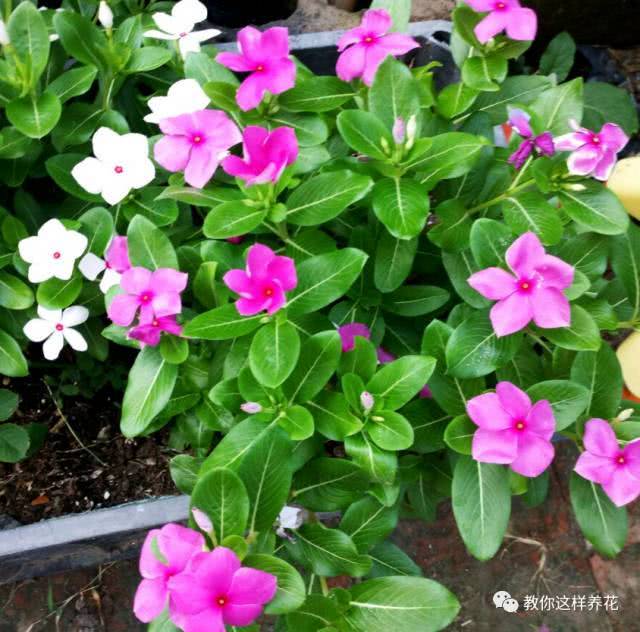
Madagascar periwinkle, also called "daily spring," has an especially long blooming period and can bloom from the start of the year to the end. It also produces many flowers and belongs to the group of plants that can burst into a mass of blooms without much management.
Madagascar periwinkle has relatively high light requirements. During the growing period it needs ample light, which keeps the leaves verdant and glossy and the flower colors bright. If it lacks light, the leaves will turn yellow and may even drop.
For Madagascar periwinkle care, give it no less than 4 hours of sunlight per day. If you have a spot with full sun, even better - the flower colors will be more vivid and the flower shapes more compact.
Madagascar periwinkle hates wet conditions and fears waterlogging. Do not water the potting soil too much; excessive moisture affects growth and development. You can fertilize once every half month, which will give you a much larger flower display and a longer blooming period.
To make Madagascar periwinkle bloom more, be sure to pinch the tips often so it grows more side branches! Starting when the seedling has 4-6 leaves, you can begin pinching, keeping three or four nodes and cutting off the branches above. When the new shoots grow 4-6 leaves, pinch once more. Three times in total; more than 3 times will affect bloom quality.
Some flower enthusiasts have even used grafting to achieve the goal of one Madagascar periwinkle plant bearing flowers of multiple colors, which is especially beautiful.
- Moss rose -
Moss rose is a plant many people have grown since childhood, and in many rural areas it grows like a weed around old houses. Moss rose comes in a wide range of flower colors and has a faint fragrance. It is very easy to grow and keep alive, and it easily fills a pot to overflowing. Its self-seeding ability is also strong, so basically you'll have flowers to see every year.
Moss rose also has many varieties - single-petaled, double-petaled, color-splashed, purple rice-grain, Chonglou, and so on - with colors including imperial red, crop red, bright red, deep red, purple-red, white, snow blue, pale yellow, deep yellow, and more.
Moss rose care is very simple. It can be planted in most soils, with loose, breathable potting soil being best. Water only when the soil is dry; when you water, water thoroughly, and do not let water accumulate, otherwise the roots will rot. During the rainy season, take care to shelter it from rain and ensure drainage to prevent root rot. Normally keep it in a spot with ample sunlight; sufficient light will keep the stems, branches, and leaves compact, give it a beautiful shape, and produce more flowers.
Although moss rose is fairly tolerant of poor soil and needs little management, if you apply a little fertilizer appropriately, it will bloom even more vigorously! Normally fertilize once a month, and before blooming you can also apply a supplementary dose of monopotassium phosphate - the moss rose flowers will be bigger and the colors more brilliant!
Little flowers like these, with hardly any care, can still show you their beauty.
- Crown of thorns -
Crown of thorns basically blooms all year round, and after resting for a month or so it blooms nonstop again. Crown of thorns is covered in thorns, combining the fortitude of a tiger's thorn with the charm of plum blossoms when it flowers. When it blooms, a faint, lingering fragrance drifts out, delighting anyone who smells it. Among crown of thorns, the large-flowered crown of thorns has larger leaves and flowers and bright, vivid flower colors.
Crown of thorns is drought-tolerant and has low requirements for potting soil; generally, loose sandy soil is enough. When watering, make sure the soil has dried out completely before watering thoroughly, and you don't need to water often. Fertilizing once a month will give you more flowers and more vivid colors.
Crown of thorns likes sunny and warm environments. Normally keep it in a spot with ample light; the more sunlight, the more vivid the flower colors and the longer the blooming period. In winter, if the temperature does not drop below 15°C, the flowers will not stop and will keep blooming!
- Geranium -
Geranium is a flower that is easy to grow, has a long blooming period, and blooms superbly beautifully. Geranium flowers bloom in clusters like hydrangeas, with vivid colors, and they are easy to propagate, making them very suitable for growing at home. They are welcomed by many flower enthusiasts.
Geranium is best kept in loose, breathable potting soil. Geranium is drought-tolerant, so normally you can wait until the potting soil is slightly dry before watering. Usually take care to keep it in a spot with ample light; combined with pinching, the plant's shape will be more perfect and it will bloom more.
The suitable growing temperature for geranium is 15-25°C. In winter, overwintering is relatively safe above 10°C; below 3°C it is prone to cold damage, though some varieties can tolerate low temperatures of 0°C. In summer, take care to shade it and cool it down during high temperatures. You can spray water toward the flowerpot to cool it, and place it in a ventilated spot, which helps the flowers get through summer.
Geranium blooms a lot and blooms frequently, so it has relatively high fertilizer needs. In spring and autumn, fertilize once every 7-10 days. In summer and winter, stop fertilizing. Before buds appear, use mainly nitrogen fertilizer; after buds appear, use mainly phosphorus and potassium fertilizer.
Geranium is good-looking and easy to grow, and even beginners can easily get them into good condition, making them very suitable flowers to start with. Among them, large-flowered geranium is slightly harder to get through summer, while ivy and zonal geraniums, when temperatures are suitable, bloom in all four seasons and are especially beautiful.
- Wax begonia -
Wax begonia has a graceful posture, delicate, glossy leaves, and flowers in clusters. Under suitable conditions it can bloom in all four seasons, with a very long blooming period. Wax begonia care is very simple, and it has a long history of cultivation in many places, mostly used as a landscaping flower. Now there are also many double-flowered varieties that are very beautiful. Because of its strong adaptability, in some places in the south it has escaped cultivation and become a wild plant.
Wax begonia care is relatively simple. Wax begonia likes a mild, moist climate and is generally kept in loose, breathable potting soil such as leaf mold. Water only when dry; when you water, water thoroughly. During the growing period it can be kept slightly moist, but during high summer temperatures and low winter temperatures you should restrict water and keep the potting soil on the drier side, otherwise the stems may rot.
The suitable growing temperature is 18-20°C. In summer it needs shading, and in winter overwintering is relatively safe above 5°C; above 10°C it can bloom normally.
When watering, take care to water from the edge of the pot, not from the top, otherwise the leaf center and stem are prone to rotting. When fertilizing, do not splash it onto the leaf surface, to avoid burning the leaves.
Wax begonia seeds mature in May-June, and can be harvested once the seed coat turns brown. You can sow in spring in April-May, or in autumn in August-September. Simply scatter the seeds directly into the pot without covering them with soil. Use the soaking method to moisten the sowing soil, cover with a piece of glass, and place in a semi-shaded spot; they will sprout in about 10 [days].
Double-flowered varieties are very popular among flower enthusiasts
They can bloom in all four seasons with hardly any care
Every single one is beautiful!
If you like them, grow a pot!
Share this with flower enthusiasts who need it!