The river lotus sways like white feathers, the heavenly thorn vines spread like green threads
During the 29th year of the Kaiyuan era (741), Du Fu (712-770), already approaching thirty, traveled through Qi and Zhao, seeking out famous mountains and scenic sites. Moved by the serene and secluded atmosphere of Master Si's dwelling, he wrote this poem "Thatched Study of the Monk Si":
Beneath Master Si's thatched hut, one may compose new poems.
Pillow and mat placed deep in the woods, tea and melon keep the guest lingering.
The river lotus sways like white feathers, the heavenly thorn spreads like green threads.
Vainly I am unworthy of Xu Xun's company, hard to match Zhidun's words.
Who Master Si was is no longer known today, but he was at least a monk well-versed in Buddhist learning. [1] The parallel couplet "The river lotus sways like white feathers, the heavenly thorn spreads like green threads" describes the scenery around Master Si's thatched hut, mentioning two plants. "River lotus" refers to the lotus flower, and "sways like white feathers" describes the swaying of the river lotus. But at first I thought "river lotus" referred to a freshwater fish, the silver carp, and so the scene of silver carp leaping from the river surface in my hometown, stirring up splashes of spray, came to mind.
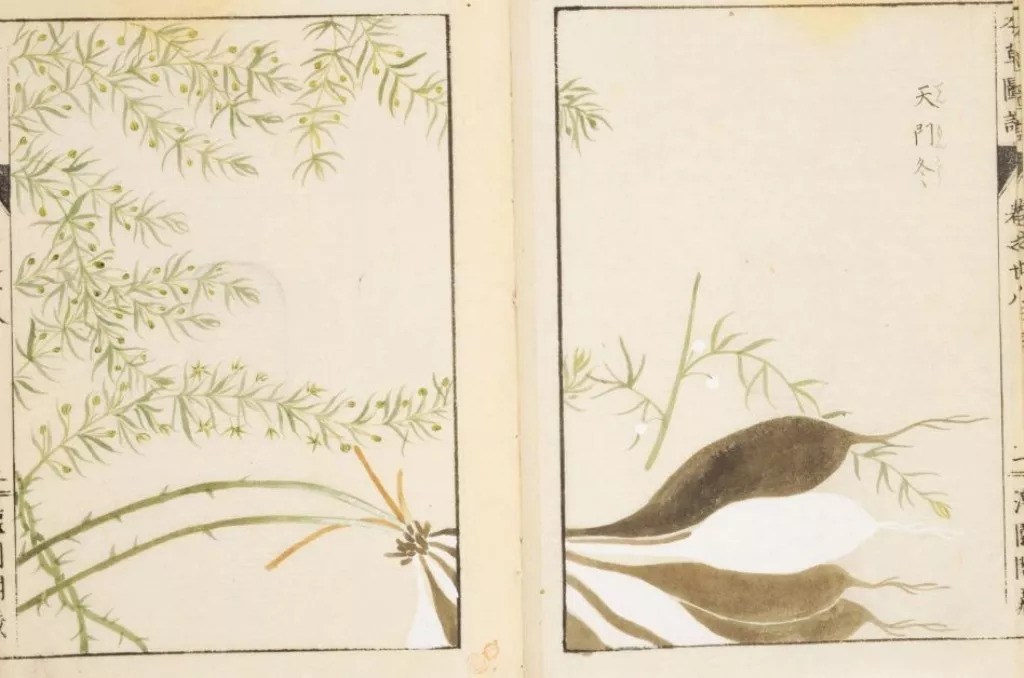
"Heavenly thorn" is Asparagus cochinchinensis. What kind of plant is Asparagus cochinchinensis?
Asparagus cochinchinensis - Materia Medica Illustrated. By Iwasaki Kanen
1
Asparagus cochinchinensis, often also referred to simply as tiandong, is a climbing plant in the Liliaceae family, genus Asparagus. It is a famous traditional Chinese medicine, and the medicinal part is its swollen root tubers.
How did Asparagus cochinchinensis get its name? According to "Notes on the Explanation of Plant Names," the character "tian" (heaven) in plant names often carries the meaning of "natural," "men" (gate) carries the meaning of "reddish," describing the dark reddish-brown outer skin of the swollen part of its root, and "dong" (winter) is a pictograph of eaves icicles, just like the spindle-shaped roots of Asparagus cochinchinensis. Therefore, Asparagus cochinchinensis means "speaking of its medicinal use as naturally occurring and bearing reddish ice-winter." [2]
Asparagus cochinchinensis leaves and spindle-shaped roots
"Compendium of Materia Medica" says: "The luxuriant among grasses is called men, commonly written as men (gate)." "Erya: Explaining Grasses" states: "Mi, men-dong." Guo Pu's commentary says: "Men-dong, also called man-dong." The Song dynasty scholar Xing Bing believed that "men" and "men (gate)" differ in writing but are the same in sound. [3] And men refers to "red millet," a type of millet, which itself carries the meaning of red.
From this it can be inferred that the character "men" (gate), used to describe the red color of its root's outer skin, is a borrowed form of "men" (red millet), because the character men is truly too complex to write.
"Dong" (winter)
The name Asparagus cochinchinensis sounds rather fierce and overbearing.
During the Jiaqing reign of the Qing dynasty, someone wrote a very interesting novel called "Romance of Herbs and Trees Through the Ages," combining plants with historical romance. It contains over three hundred kinds of Chinese herbal medicines, with over one hundred having plot roles. Some characters' appearances basically match the external forms of the herbs, and the division of enemy and friendly camps is also related to whether they are inherently toxic. [4]
In the twenty-fourth chapter of the novel, Asparagus cochinchinensis is set as the bandit leader of Shujiao Mountain in Xuanzhou of the Great Han Kingdom, who "robs houses and plunders people's wealth on the mountain, kills and burns, and gathers over a thousand followers," wanting to overthrow the court and proclaim himself ruler. In the twenty-fifth chapter, he is defeated in battle against the court's army and cuts his own throat. That is to say, if "Romance of Herbs and Trees Through the Ages" were made into a TV series, Asparagus cochinchinensis would not survive more than two episodes.
Setting Asparagus cochinchinensis as an insignificant villain - does this match its medicinal properties? At least, Asparagus cochinchinensis is non-toxic, unlike the bandit monk Datura under Asparagus cochinchinensis's command in the novel.
2
The river lotus sways like white feathers, the heavenly thorn spreads like green threads. - Why is Asparagus cochinchinensis also called heavenly thorn?
Historically, there has indeed been debate over the interpretation of "heavenly thorn" in this poem. The Southern Song scholar Zheng Qiao (1104-1162) in his "Comprehensive Records" believed that heavenly thorn was another name for willow, as evidenced by Yu Xin's poem "Bank willows draped in green threads." But the Ming dynasty literatus Yang Shen (1288-1559) refuted this view in "Sheng'an Poetry Talks":
Willow can be described as threads only in early spring. If it is the day of keeping guests with tea and melon, the season of river lotus and white feathers, it must be deep summer, when the willow has already grown old leaves and thick shade, and cannot be described as threads. As for what is described as spreading, one could speak of dodder or Chinese cucumber, but not willow. That heavenly thorn is not willow is clear. According to "Supplementary Explanations of Materia Medica": "Asparagus cochinchinensis is called yinyanghuo on the Eastern Marchmount, baibu on the Southern Marchmount, guansong on the Western Marchmount, and dianji on the Northern Marchmount." Dian and tian are close in sound and are alternate names. This explanation is closer. [5]
In addition, many documents record that Asparagus cochinchinensis is also called "dianji" (inverted thorn), so the name "heavenly thorn" came about because "tian" (heaven) and "dian" (inverted) are close in sound. The original meaning of "ji" (thorn) is the wild jujube tree with many thorns on its stem, and the base of the scale-like leaves of Asparagus cochinchinensis indeed has hard spines about 2.5-3.5 mm long [6], so calling it "thorn" has its rationale. It is a thorny climbing vine plant.
Yu Shiling's "Du Fu's Poem 'The River Lotus Sways Like White Feathers, the Heavenly Thorn Spreads Like Green Threads'" analyzed the difference between willow and vine as imagery in Chinese poetry history, to explain that the vine plant Asparagus cochinchinensis - "heavenly thorn" - belongs to "vine," and is absolutely not "willow": "Willow became a symbol of home, marketplace, (sic) complexity, and human habitation... On the contrary, the image of 'vine' is often used to express and set off the seclusion of the environment and the leisurely, unrestrained nature of the inhabitants." [7]
Asparagus cochinchinensis, this kind of "vine," indeed grows in secluded environments, like a hermit. In fact, there are not many poems that use "heavenly thorn" as imagery. Du Fu wrote Asparagus cochinchinensis into his poem, probably also because Asparagus cochinchinensis was an actual scene in Master Si's thatched study.
Yu Shiling's article also mentions that Du Fu and many poets of his time, when describing Buddhas, temples, and monks, also often mentioned vines and creeping plants, such as Wang Wei's "Passing by Zen Master Fu's Aranya": "Beyond the bamboo, the peak is especially bright at dawn; in the vine's shade, the water is even cooler." Wang Changling's "Officials Visit Xiangyin Temple": "The mountain lodge's people are already gone; green creeping plants replace wind and rain." Cen Shen's "Leaving the Pass, Passing Huayue Temple, Visiting Master Huayun": "The bamboo path is thick with green moss; the pine gate is coiled with purple wisteria." Li Bai's "About to Travel to Mount Heng, Passing Hanyang Twin Pine Pavilion, Keeping My Clansman the Monk Tanhao": "Extending creepers to form a secluded dwelling, cutting bamboo to surround fragrant clumps." Meng Haoran's "Summer Day at Dharma Master Bianyu's Thatched Study": "The bamboo grove is deep with dense shoots; the vine trellis draws out long tips." And "Staying in Master Li's Cell": "The mossy stream is full of spring water; the creeper window is interspersed with the night moon." [8] Whether Asparagus cochinchinensis is among the many "vine and creeper" images above, we cannot determine.
Master Si was a monk, and later poems that feature "heavenly thorn" are also mostly related to Buddhas, monks, and temples. For example, the Ming dynasty Zhang He's "Visiting Zen Master Xiao'an, Who Offered Dongting Tangerines": "The evening rain before the eaves moistens the heavenly thorn; the spring breeze beyond the mat stirs the photinia."
Feng Menglong (1574-1646) compiled a collection called "Oleander Thimble Thousand Poet Poems Mountain Songs," among which there is one titled "Threads of Heavenly Thorn":
Turning my head I saw this affectionate young man, I have not burned this stick of incense today in vain. His clothes are neat, his age and looks are at their prime, eyebrows exchange glances, both hearts are entangled. The sister says: Oh young man! If you are willing to visit me, I am not without a mark - threads of heavenly thorn outside the gate and wall.
"Oleander Thimble Thousand Poet Poems Mountain Songs" is a collection of Wu-region mountain songs set to the "oleander" tune, using the thimble rhetorical device (the last character of each mountain song is the first character of the next), with a line from "Thousand Poet Poems" as the ending. Most sing of love between men and women, and it was relatively popular in the late Ming dynasty.
The little song "Threads of Heavenly Thorn" is quite similar to the scene in "Romance of the Western Chamber" where Cui Yingying and Zhang Sheng first meet at Pujiu Temple, "How could she bear that glance of autumn waves as she left." The last line of the little song comes from the Southern Song poet Wang Qi's seven-character quatrain "Spring Evening Stroll in the Small Garden": "A clump of plum powder fades its residual makeup, smeared with new red on the crabapple. When the roseleaf raspberry blooms, spring's affairs are done; threads of heavenly thorn emerge from the mossy wall." Originally it was a lament on the passing of time, but adapted into the mountain song, those "threads of heavenly thorn" climbing over the wall became a self-portrait of a young woman boldly pursuing love.
Because this scene also takes place in a temple, it is the "heavenly thorn" that climbs over the wall, not the "red apricot."
Asparagus cochinchinensis flower
3
As a medicinal material, Asparagus cochinchinensis is listed as a top-grade drug in the medical text "Supplementary Records of Famous Physicians," completed in the late Han dynasty, with effects such as "removing cold and heat, nourishing skin and flesh, and boosting strength." However, in biographies of immortals, Asparagus cochinchinensis is given mythological color, enabling people to regain youth and prolong life.
"Biographies of Immortals," probably completed in the Western Han dynasty, says: "Chi Dingzi ate Asparagus cochinchinensis, and his teeth grew again after falling out, and fine hair grew back." The Daoist text "Baopuzi" by Ge Hong of the Eastern Jin says: "Du Ziwei took Asparagus cochinchinensis, kept eighteen concubines, had one hundred and forty children, and could walk three hundred li a day." His "Biographies of Divine Immortals" says: "Gan Shi, a man of Taiyuan, took Asparagus cochinchinensis and lived in the world for over three hundred years." These records of immortality techniques are of course not credible, but placed in Du Fu's poem, they have a different flavor: the heavenly thorn in the eminent monk's thatched study turns out to be a medicinal herb with various legendary magical functions.
Dwarf lilyturf - Materia Medica Illustrated. By Iwasaki Kanen
Besides Asparagus cochinchinensis, there is another plant with a similar name, called maidong (dwarf lilyturf), whose official Chinese name is Ophiopogon japonicus. It is in the same family but a different genus from Asparagus cochinchinensis, being a herbaceous plant in the Liliaceae family, genus Ophiopogon. Maidong is also a traditional Chinese medicine, and its medicinal part is also the root, which is oval or spindle-shaped, smaller than the root tubers of Asparagus cochinchinensis, with leaves basal and clustered, grass-like. According to "Notes on the Explanation of Plant Names," maidong got its name because its leaves are shaped like wheat. [9]
Dwarf lilyturf fruit
Dwarf lilyturf is evergreen, shade-tolerant, cold-tolerant, drought-tolerant, and resistant to pests and diseases, and is often used in landscaping. Universities with hills like Wuhan University and Huazhong University of Science and Technology often plant this species on slopes. In this season, Luojia Mountain and Guizi Mountain should be "every tree in autumn colors, every mountain only in setting sunlight." The patch of dwarf lilyturf on the slope under the tree shade should have borne fruit, sky-blue, like the water of South Lake.
2018-8-26
[1] "Mahaprajnaparamita Sutra": "What is an superior person? The Buddha said: A bodhisattva who single-mindedly practices anuttara-samyak-sambodhi, whose mind is not scattered, is called a superior person." In the closing couplet, the author compares himself to Xu Xun and compares the Eastern Jin eminent monk Zhidun to Master Si. "A New Account of Tales of the World": "Zhidun and Xu Xun were both at the court of the Prince of Kuaiji; Zhi was the Dharma Master, Xu was the chief lecturer." "Biographies of Eminent Monks": "When Zhidun lectured on the Vimalakirti Sutra, when Dun penetrated one meaning, Xun had no way to raise a challenge. When Xun posed one challenge, Dun also could not penetrate further." See (Qing) Qiu Zhao'ao, "Detailed Annotations to Du Fu's Poems," Zhonghua Book Company, October 1979 first edition, Volume One, p. 17. Xu Xun was a Eastern Jin metaphysical poet; although Zhidun was a monk, he was also well-versed in the learning of Laozi and Zhuangzi, and influenced by the prevailing trend of pure conversation, he widely befriended famous scholars and participated in pure conversation.
[2] Xia Weiying: "Notes on the Explanation of Plant Names," Agriculture Press, December 1990 first edition, pp. 304-305.
[3] (Jin) Guo Pu, annotated, (Song) Xing Bing, sub-commentary: "Sub-commentary to the Erya," Peking University Press, 1999 edition, p. 276.
[4] Huang Ting: "Research," Nanjing Normal University, 2016 master's thesis.
[5] (Qing) Qiu Zhao'ao: "Detailed Annotations to Du Fu's Poems," Zhonghua Book Company, October 1979 first edition, Volume One, p. 17.
Upon verification, baibu, yinyanghuo, and others are indeed alternate names for Asparagus cochinchinensis here. The ancients confused them, possibly because the forms of the medicinal parts are relatively similar, and among them, baibu and Asparagus cochinchinensis were most often confused in use.
[6] Chinese Academy of Sciences, China Flora Editorial Committee: "Flora of China," Science Press, 2004 edition, Volume 15, p. 106.
[7] Yu Shiling: "Journal of Du Fu Studies," 1995, Issue 3.
[8] Yu Shiling: "Journal of Du Fu Studies," 1995, Issue 3.
[9] Xia Weiying: "Notes on the Explanation of Plant Names," Agriculture Press, December 1990 first edition, p. 305.
About the author: Jianghan Tangtang, corporate employee / art museum public education volunteer / freelance writer, currently residing in Beijing.
Text and image editing: Jiang Mouren
This work is licensed under the (CC BY-NC-ND 4.0) license agreement
Please retain the above statement when reposting