Desert rose does not need frequent watering; only with ample sunlight will it flower and set seed.
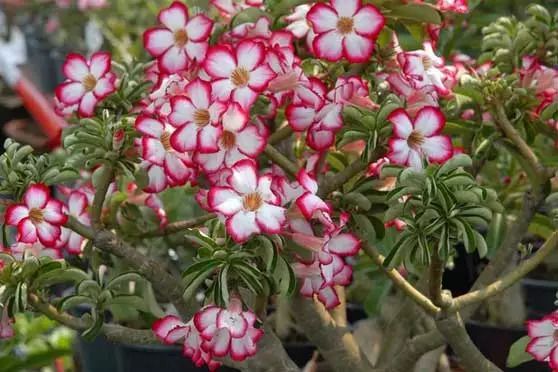
The desert rose is a very striking succulent, because it has a swollen rootstock and can also produce large flowers in different colors, larger than rose blooms, with the common dark red, white, yellow and other flowers; it drops its leaves when temperatures are low, and when warmth returns in spring it grows new leaves again.
The desert rose is a tropical desert plant; its swollen base stores a very large amount of water, and its water requirements are very low, so during growth you must avoid watering too frequently. It likes a warm, dry environment all year round, and excess water easily causes root rot.
If you want your desert rose to bloom more, you must give it as much light as possible. Apart from providing some shade in summer when temperatures are too high, keep it in direct sunlight for more than eight hours a day in the other seasons; only this is favorable for bud formation.
To care for a desert rose well, you must keep it in ample light every day, ideally on an east- or south-facing windowsill or balcony.
When growing a desert rose, you can water it regularly in spring and summer; water once the soil 3-5 cm below the surface is dry. By autumn and winter, you should control watering appropriately, as too much water easily causes root rot.
For caring for a desert rose, keeping the temperature above 10°C is most suitable, and in winter keeping it above 15°C is ideal, so its leaves do not drop easily; if the temperature falls below 7°C, it is prone to cold damage.
To grow a desert rose, you must choose a loose, airy, well-draining sandy soil, keep the soil pH at around 6.0, and be sure to use a slightly acidic soil, as this is favorable for bud formation.
You can fertilize a desert rose regularly in spring and summer; its fertilizer needs are not great, so you can give a slow-release organic liquid fertilizer once every one or two months.
The photo above shows the seed pods of the desert rose.
The desert rose can be propagated by stem cuttings or by sowing seeds; many friends have never seen the fruit of the desert rose.
After the desert rose flowers are successfully pollinated, they can form seed pods; once the pods mature, the seeds can be collected, and after the seeds have been sun-dried they can be used for sowing.
However, we generally propagate the desert rose from stem cuttings; the cut stems should be dried at the wound, then some rooting powder is dabbed on the base, and they are inserted into a loose, airy sandy soil. Water a few days later, and place them in a ventilated, brightly lit spot, and they will take root and sprout.