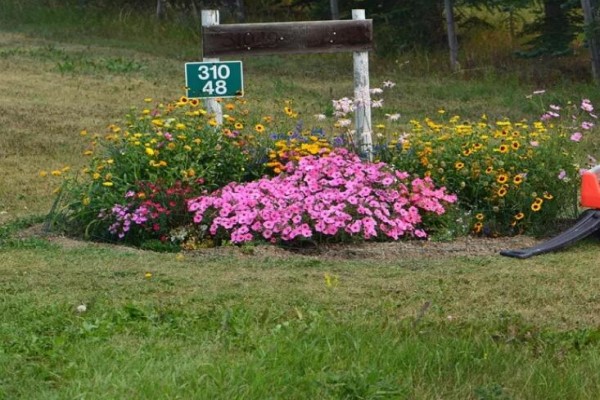
She grows 11 kinds of herbaceous flowers in a 6 sq m flower bed, as beautiful as a garden, drawing praise from passersby
Gypsophila (creeping baby's breath)
Gypsophila, also known as creeping baby's breath, this super cold-hardy carpet-like little flower, has never disappointed me and has always been the star of my flower bed. It is the first to sense spring, awakening from seemingly withered old branches and leaves, a circle larger than last year. Call it delicate, yet it is the first to wake from a -40°C winter; call it tough, yet how can such baby-soft flowers make one believe it has survived winter after winter. Just because I took one more glance at you in the crowd, I have never forgotten your face since, and that is you.
It awakens in late April, and by early June it is covered in buds, releasing without restraint the energy accumulated over a whole winter. The full bloom period lasts as long as a month, then it blooms sporadically until the end of August.
Campanula
Campanula is not to be outdone either, stretching boldly at the waist, a circle larger than last year, blooming merrily.
White ones, purple ones, vying in beauty.
Dianthus
Dianthus under the morning dew, crystal clear, too lovely to put down. In evenly textured soil, basking in even sunlight, it gradually grows into a standard ball shape.
Iceland poppy
Iceland poppy is not tolerant of intense heat, but it is indeed cold-hardy. This is perhaps a gift from nature to us. It emerges in early spring, and soon stretches out a long neck, tossing out meteor fireballs.
Erigeron annuus
Though called Erigeron annuus, it actually sprouts from perennial roots, blooming in late July, with a full bloom period as long as 2 weeks, a pale purple, waving in the wind.
Soapwort
By early July, the small flower bed is full of life. Perennials in full bloom, annual flowers and grasses growing vigorously.
However beautiful the perennials are, after their glorious bloom they gradually go dormant. The handful of wildflower seeds scattered in the empty spots in early spring gradually take root and sprout, and after the perennials make their exit, they make a shining entrance. At this point in the flower bed, the perennials are slowly leaving the stage. The flower bed is not lonely because of the perennials' exit; instead, it becomes even livelier.
Cut-flower baby's breath
Cut-flower baby's breath, swaying in the wind, cut a bunch for flower arranging. Always playing a supporting role, this time let it be the star. After cutting off the flowering branches, it will immediately send out side branches again, blooming from early June all the way to the end of August. A vase of cut flowers every week, and without leaving home, you can enjoy the flowers.
Cornflower
The summer garden never lacks the passion of red, and purple-toned flowers and grasses should count as something special. Pick the cornflower petals, brew them in hot water, and they have a unique fragrance.
Petunia
This year I arranged for the petunia to take the C position, and indeed it did not let me down. After taking root and adapting to the new soil, it came in a deluge. From an initial 15 cm diameter, it grew into today's 1 m large flower carpet. It was within my expectations, because I plant this petunia every year, and it has never disappointed me.
Every time I stop here, I am unwilling to leave; every grain of soil and every leaf has been touched by me, and passersby also slow down. Those who meet me tending it here all sincerely praise me and thank me, because the colorful flower bed makes this little path no longer lonely, and lets everyone, amid busy life, take out a little bit of time to feel the beauty and feel nature's gift.