Costco raw shrimp tested positive for carcinogens, avocados found with cadmium and strawberries and blueberries with pesticide levels exceeding limits
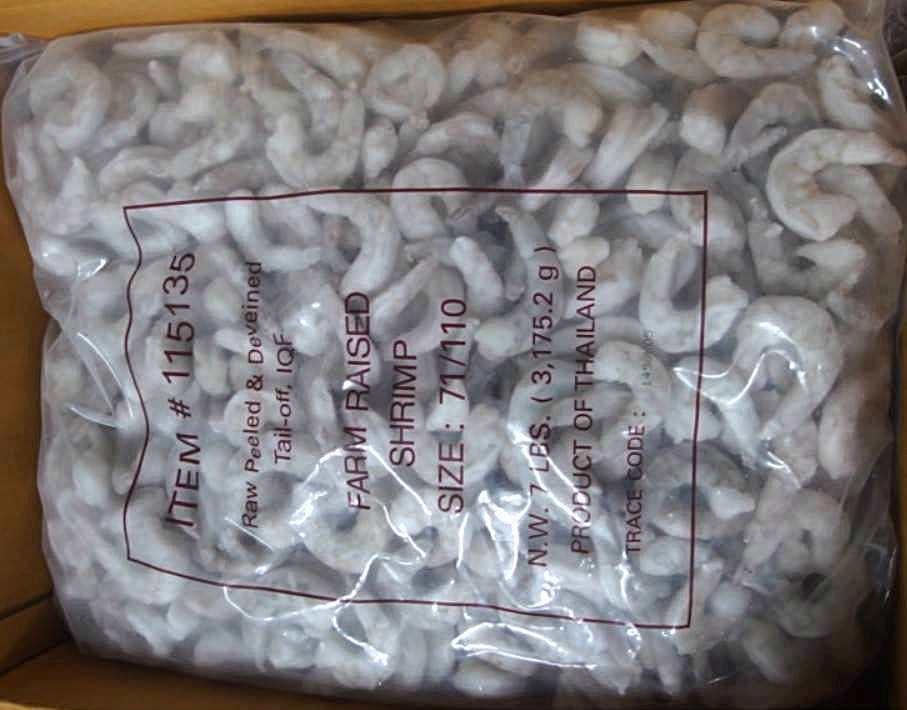
The Ministry of Health and Welfare's Food and Drug Administration today (the 28th) announced the list of border inspection non-compliance cases, among which several products from the well-known American warehouse store Costco were in violation. Imported avocados were found for two consecutive weeks to have cadmium levels exceeding the limit, and frozen raw shrimp imported from Thailand tested positive for nitrofuran metabolites banned in Taiwan. Meanwhile, Wellcome supermarket was found to have blueberries imported from the United States with malathion exceeding the limit, and bell peppers imported from Canada with fluazinam exceeding the limit.
Yen Tsung-hai, director of the Clinical Toxicology Center at Linkou Chang Gung Memorial Hospital, pointed out that cadmium is a Group 1 carcinogen announced by the World Health Organization, and long-term exposure increases the cancer rate. As for the nitrofuran metabolites detected in the frozen raw shrimp from Thailand, Yen stated that they are listed by the World Health Organization's International Agency for Research on Cancer as a Group 3 carcinogen, with some animal studies showing an increased cancer risk, and Taiwan banned them precisely because of health concerns.
Costco: Residue standards differ from country to country
Regarding the products that failed inspection this time, Wang Yu-mei, vice president of marketing planning at Costco, responded that the avocados failed inspection for two consecutive weeks because the same batch of goods was shipped in on two separate vessels. She said the non-compliance was mainly due to differing standards among countries, but that the products had already been removed from the shelves and the suppliers had been replaced, "everything on the shelves is compliant."
As for the frozen raw shrimp from Thailand, Wang stated that every batch of frozen shrimp imported into Taiwan is inspected locally and can only be imported into Taiwan if it passes. "This batch's inspection reports were all compliant too, and we don't know why the border inspection found it non-compliant. We will ask the supplier to look into the situation further."
Regarding Costco products repeatedly failing inspection, Wang explained that it is mainly because residue standards differ among countries, and the European Union, the United States, and Taiwan all have different regulations. "But of course we will still comply with each country's regulations. Any foreign supplier that wants to import into Taiwan must meet the requirements." When working with foreign suppliers, Costco has a standard operating procedure to confirm that suppliers can provide products that meet Taiwan's regulations. "We will confirm with the suppliers again, and not let products that were exported to other countries and do not meet Taiwan's regulations enter the country."
However, how will Costco itself strengthen food safety? Wang responded that Costco conducts regular inspections and unscheduled spot checks itself, "for example, every batch of frozen shrimp must be sent for third-party testing." As for the strawberries and blueberries previously found non-compliant, the suppliers have also been replaced. "We will make the suppliers understand the importance of the regulations. Not everything from other countries can be brought into Taiwan."
Wellcome supermarket and others also had multiple violations
In addition to Costco, Wellcome supermarket (Welcome Department Store Company) this time had "ESSENTIAL EVERYDAY blueberries" imported from the United States test positive for malathion residue of 0.2 ppm, not meeting Taiwan's 0.01 ppm standard, totaling 816 kg. "WINDSET FARMS fresh bell peppers" imported from Canada tested positive for fluazinam residue of 0.03 ppm, not meeting Taiwan's 0.01 ppm standard, totaling 463 kg.
"MYPROTEIN MYPROTEIN cocoa sandwich cookies" imported from the United Kingdom by Zhuanyuan Co., Ltd. were found to contain the sweetener cyclamate at 0.94 g/kg, a food additive not approved for use in the country.
The rest also included chili powder imported from China by Yufeng containing Sudan Red III at 10 ppb, which is not permitted for use under domestic regulations; mixed matcha powder imported from Japan by Deyiji found to have flusilazole residue of 0.12 ppm; and frozen grouper fillets exported from Indonesia by Xiangfengfu Industrial and Trade found to have methylmercury at 0.9 ppm, exceeding the domestic standard of 0.5 ppm.
Liao Tzu-ting stated that information on border inspection non-compliant products is released regularly every week, and the eighteen products announced today will all be returned or destroyed in accordance with relevant regulations and must not enter the country. Products still being sold on the market and on shelves will also be subject to market product inspections by local health authorities. As for whether fines will be imposed? Liao responded, "For importers, not being able to bring the products in and sell them is already a severe penalty."
Yen Tsung-hai: Cadmium is a Group 1 carcinogen, nitrofuran metabolites are a Group 3 carcinogen
When products have excessive residues of heavy metals and pesticides, the public's health is affected the most. Yen Tsung-hai pointed out that cadmium is a Group 1 carcinogen announced by the World Health Organization, and long-term exposure increases the cancer rate, such as lung cancer and prostate cancer. Japan's "itai-itai disease" in the 1950s occurred because industrial wastewater containing the heavy metal cadmium contaminated crops, and after people ate them, it led to bone lesions, osteomalacia, and spontaneous fractures.
However, the human body does not absorb it completely. Yen stated that the human body only absorbs 6%, and it is further excreted through the kidneys and urine. "Unless there is daily exposure, it is not easy for the human body to suffer cadmium poisoning. If people are concerned, they can get checked through blood tests and urine tests." In addition, malathion and fluazinam are both insecticides, with medium and low toxicity respectively. Current U.S. Environmental Protection Agency animal studies show an increased cancer risk, but there is not yet carcinogenic evidence in human studies.
As for the nitrofuran metabolites detected in the frozen raw shrimp from Thailand, Yen stated that they are listed by the World Health Organization's International Agency for Research on Cancer as a Group 3 carcinogen, with some animal studies showing an increased cancer risk, and Taiwan banned them precisely because of health concerns.