Fast propagation methods for Sempervivum tectorum (hens and chicks): it can flourish and fill your balcony even in summer
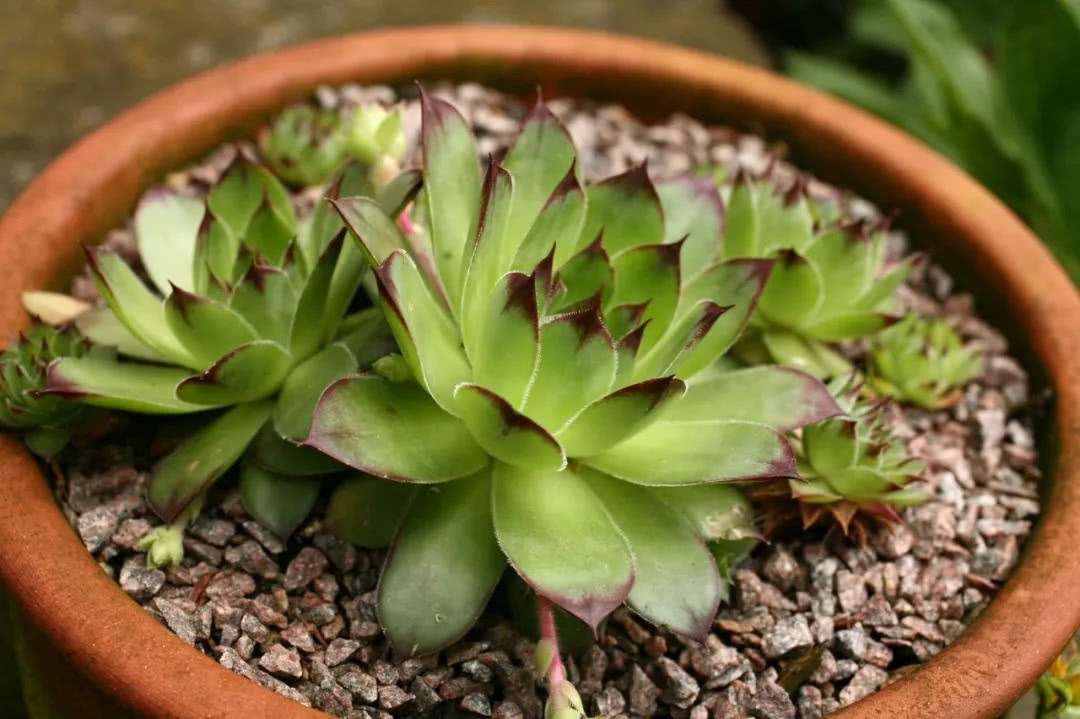
If you want to grow a beginner succulent that is especially easy to care for, then Sempervivum tectorum (hens and chicks) is a good choice. It has strong environmental adaptability and likes warm, dry environments, but its cold tolerance is also quite good. It can survive and reproduce even on tiled roofs, and it is also especially easy to propagate.
Sempervivum tectorum (hens and chicks) is originally a succulent that grows in western Europe. It grows on high mountains and can grow and reproduce in rock crevices and on rooftops. It can adapt to low-temperature environments and is afraid of excessively hot or humid environments.
Some friends say that their Sempervivum tectorum (hens and chicks) did not grow in summer, and when the roots were pulled up, none had grown out. If you are a beginner, I do not recommend buying Sempervivum tectorum (hens and chicks) in summer. It is afraid of excessively high temperatures. After the temperature exceeds 33°C, it basically enters dormancy, or at least its growth slows down. At this time, it is very difficult to promote rooting and sprouting in Sempervivum tectorum (hens and chicks).
Sempervivum tectorum (hens and chicks) is a succulent belonging to the genus Sempervivum. Its characteristic is that it is especially easy to grow side shoots. Many people fail to grow it well, usually because the soil mix is unsuitable, which can also easily cause weak root growth, and some even do not grow roots at all.
Sempervivum tectorum (hens and chicks) can also bloom, and the flowers are actually quite ornamental, but after the mother plant blooms, it will wither, leaving behind a great many side shoots.
Now, if you want to promote faster rooting and sprouting in Sempervivum tectorum (hens and chicks), first you need to choose the right time to plant it. It is a relatively cold-tolerant succulent that grows vigorously in autumn and winter; it does not like excessively hot nights or prolonged conditions, and does not like excessively hot or humid environments.
The best time to plant Sempervivum tectorum (hens and chicks) is in spring and autumn. In winter, keep the care temperature above 0°C. If it grows strong, it can also survive at low temperatures of a few degrees below zero. The form of Sempervivum tectorum (hens and chicks) is also very attractive. It has a rosette-like form, looking like one green lotus flower after another. It also continuously grows small side shoots, and once the side shoots grow to 2-3 cm, they can be transplanted.
In summer, Sempervivum tectorum (hens and chicks) will not grow vigorously. If it is planted when the weather is relatively hot, its roots will hardly grow at all, because in the stuffy, hot and humid conditions of summer, Sempervivum tectorum (hens and chicks) will go dormant and stop growing, or at least its growth will slow down.
To grow Sempervivum tectorum (hens and chicks) well, you also need to choose suitable soil, preferably loose, breathable, well-drained sandy soil. You can choose perlite mixed with peat soil at a ratio of 2:1, and you can appropriately mix akadama or pumice into the soil.
The environment for caring for Sempervivum tectorum (hens and chicks) should have sufficient light. Do not grow it in a completely dark environment. When the sunlight is relatively strong in summer, you can provide appropriate shade. Excessive exposure in summer or long periods of direct sunlight are also not good. In other seasons, you can give it more light.
It is very simple to propagate a great many Sempervivum tectorum (hens and chicks) on a balcony. As long as more side shoots grow, they can be cut off and used again for cuttings. The best time for cutting propagation is in spring and autumn. During care in autumn and winter, sufficient light needs to be provided, and appropriate temperatures should be maintained in the morning and evening. Its leaves can even turn a beautiful red color, and so on.