In "Ant-Man," is the ability to control ants an imitation of the queen ant?
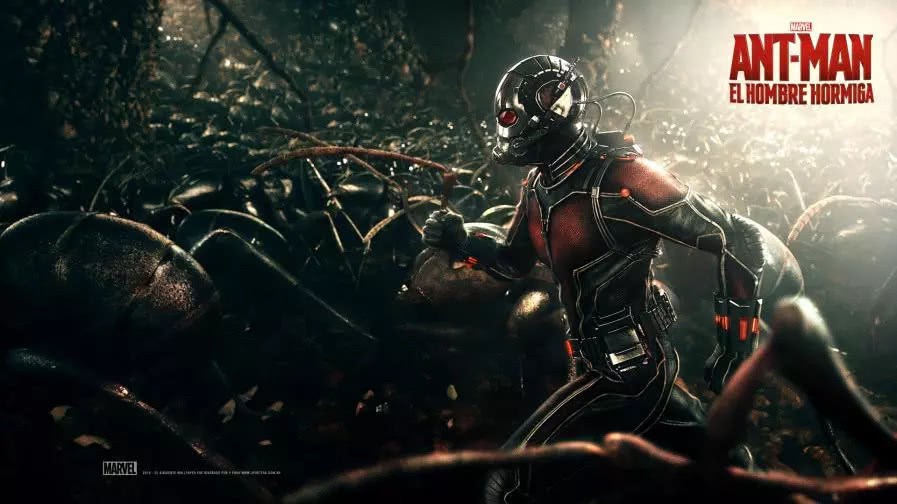
Over the weekend that just passed, was your social media feed flooded with the newly released little ants? As early as the first "Ant-Man" movie, the protagonist could shrink his body to the size of an ant andcontrol ants to fight alongside him. How do ants manage to be so organized? What is their real society actually like?
Ant-Man advances together with bullet ants (Paraponera clavata). Image: "Ant-Man"
"True" sociality
We often compare ant "society" with human "society," but in fact the two are very different. The social structure of ants, wasps, bees and termites is unique and is calledeusociality(eusociality). Eusocial animals have several characteristics:
1、Reproductive division of labor, the great task of reproducing offspring is undertaken by specific individuals (queen ants, queen bees, etc.).
2、Overlapping generations, individuals of different generations live together at the same time.
3、Cooperative brood care, caring for the offspring of other individuals in the same group.
Among animals with eusociality,individuals playing different roles belong to different castes, such as queen ants, worker ants, male ants, etc.; the English term is caste. Those familiar with the humanities and social sciences may notice that this word is also used to describethe human caste system. From the two points that individuals of different strata play different roles and that strata are difficult to switch between, the two really do have something in common.
Morphology of different castes in a leafcutter ant. Image: GameKeeper / wikipedia
So what interesting and special things happen in these societies that are different from ours?
She built her empire through her own abilities, so why still manage it?
In an ant colony,the queen is the center of the colony, but she does not monopolize power. This does not mean she is a"grassroots-style"approachable cadre, but rather that she simply does not manage the affairs of the other ants at all. Unlike societies commanded by a leader, such as wolf packs or human societies, the societies of ants and other eusocial animalsare in a state of self-organization. Ants have no leader, nor the ability to coordinate the overall situation and direct action, but the simple pheromone-based interactions among individual ants, stacked together, can accomplish complex behaviors.
Army ants build huge tents as camps at the base of large trees; each worker ant, with very poor eyesight, does nothing more than grab the companion next to it, yet in the end they build a great edifice made of countless ants. This is the self-organizing behavior of eusocial animals. Image: Geoff Gallice / wikimedia
Whether foraging, attacking or defending the home, it is all spontaneously completed by worker ants in a state of self-organization, and the queen does not manage it at all. Only when the ant nest is breached by enemies will she flee in the midst of chaos.
Ants of the genus Solenopsis build a bridge for Ant-Man. Image: "Ant-Man"
But the queen is not simply a reproductive machine either. Many ants are not monogynous but have multiple queens at the same time. These"palace struggles" among queens are no less intense than the TV dramas we watch. Higher-status queens have priority in reproduction and more offspring. In some species, high-ranking queens even have a whole set of special physical punishment rituals for lower-ranking queens. You could say they arehopeless at foreign wars but expert at civil wars。
Labor is infinitely good, who says they cannot reproduce
Contrary to what many people believe, worker ants among ants can actually lay eggs, and the eggs can grow up successfully. The sex determination mechanism of ants and eusocial bees is very special: anfertilized egg(diploid)formed by the union of an egg cell and sperm will develop into a female,unfertilized egg(haploid)will develop into a male. The queen stores the male's sperm in her spermatheca, and when laying eggs she controls the sex of the offspring by deciding whether the egg is fertilized or not. Worker ants, however, can only lay unfertilized eggs, so naturally these can only develop into males.
The queen's main task is to keep laying eggs. Image: Gary D. Alpert / wikipedia
If the queen dies, the workers who have lost the future often lay a large number of eggs and breed a large batch of males, as theirfinal act of stubbornness. As if to say, "This is my last chromosome, please take it!"
There are also some ants of the genus Diacamma that have no queen at all; their workers have full mating and reproductive ability. Workers have a pair of wing-bud-like structures on their thorax, and under the regulation of these structures they can mate and reproduce like queens. But only one worker in the nest plays the role of queen, and she bites off the wing buds of the other workers,manually "castrating"them, which could be said to be quite calculating.
A Diacamma ant; the pair of small black dots on the thorax are the wing-bud-like structures that hold reproductive power. Image: April Nobile / wikimedia
This is not how it was supposed to be!
Eggs, pupae and larvaeare the future of the ant colony. If danger occurs, the workers' first reaction is to move them to a safe place. But they also have another glorious identity:emergency food reserves。
A large portion of ant eggs are not meant to hatch but to be eaten. Such eggs are called trophic eggs. When a new queen starts from scratch to establish a colony, she has no material possessions, but she does have a body full of nutritional reserves; therefore, when there is no food, herparenting trick is to feed her own eggs to her own larvae。
And when famine comes and the colony has nothing to eat, eggs, pupae and larvae become precious food. Larvae and eggs are eaten first, because pupae do not consume resources, and if kept, they might emerge tomorrow as valuable labor.
When the nest is exposed, worker ants immediately begin moving the offspring. Image: Shenshan Chongyin
Society also has parasites
Some species of ants do not engage in production themselves and specialize in plundering the pupae and larvae of other ants as their own labor force. This"slave-holding" behaviorevolved independently many times among ants, and one of the most famous groups is the members of the genus Polyergus. Their mandibles are specialized intosickle shapes, used specifically to attack other ants. Because their mandibles are too specialized,they cannot take care of themselves; without the help of "slaves," they cannot even eat. Polyergus ants regularly raid other ants (generally Formica species of similar size), seizing larvae and pupae. Some are eaten as food, while others are kept until they emerge as workers and serve them.
Polyergus ants carrying out a large-scale raid. Image: James C. Trager / wikipedia
Although it sounds impressive, this "slave-holding" behavioris essentially parasitic behavior. Like other parasites, Polyergus ants cannot survive at all without a host. But this kind of parasitism is also very special: it is not one individual parasitizing another individual, but one insect society parasitizing another society, and therefore they have also gained a special title:social parasites。
Besides the high-profile and warlike Polyergus, there are other low-key groups of socially parasitic ants. Some sneak in under false pretenses and mooch food and drink from other ant colonies, and some have evenabandoned worker ants, evolving until only queens and males remain, making them and the aforementioned Diacamma two extremes on the road of evolution. The queens of such parasitic ants attach themselves to the host queen and lay their eggs together with the host's, and the deceived workers still think they have raised all their own family members.
The superorganism that combines zeros into a whole
For social insects such as ants and wasps, many behaviors and survival strategies may seem incomprehensible to us, but if the entire colony is regarded as a single organism, their behavior becomes very similar to that of other living things. Therefore they are often described assuperorganisms(Superorganism). In a superorganism, the individual is not important. Larvae can be reabsorbed likefat, soldiers sacrificed when encountering enemies are merely the superorganism'swhite blood cells, and the teams scavenging for food are the superorganism'soutstretched hands。
Army ants on the march (Eciton burchellii). Image: Geoff Gallice / wikipedia
When the queen dies, the superorganism called the ant colony also meets its death, butsome ant colonies can in theory exist forever. Some ants of the genera Formica and Monomorium not only have many queens, but also continuously have females internally allocated to become new queens,endless generations of descendants。
As for the genus Eciton, represented by army ants, although there is only one queen, every few years the colony holds a "general election," choosing a suitable crown prince from the queen's daughters to replace the old queen. So for these ants, theircolony history is as long as the age of the species. As long as there is still a place for them in Earth's ecosystems, these superorganisms can pass down the same bloodline forever.
This article is a special contribution to Species Calendar, from Species Calendar author @Shenshan Chongyin.