Two potted plants that can bloom even in low light on an office desktop
If you want to grow some easy-flowering plants indoors where there is not much light, that is very difficult; even the African violet, which has very low light requirements, still needs about 3 hours of diffused light per day to have a chance to grow and bloom. Plants all need light to have a chance to produce charming flowers.
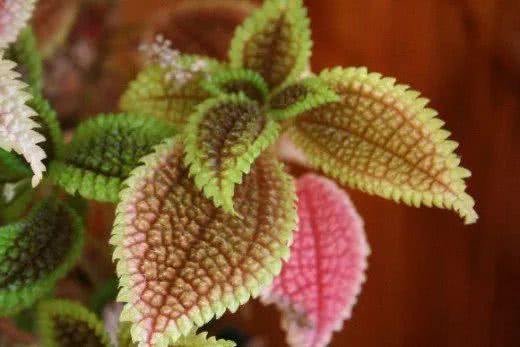
The one above is Pilea involucrata, and it can also grow and bloom in a low-light environment.
Many people have given up on growing flowering plants indoors, but below we will introduce two plants that can grow and bloom in a low-light environment.
Many shade-tolerant plants cannot bloom in a low-light environment, but some plants have colorful leaves that look even more beautiful than ordinary flowering plants, and they can also adapt to a low-light environment. If the intensity of sunlight is sufficient, they still have a chance to produce gorgeous flowers, such as the most common coleus below, also called painted nettle; these are all especially gorgeous plants.
One plant I really like is Pilea, which generally grows under tree shade and has very low light requirements. A little diffused light is enough for it to bloom, and with 3 to 4 hours of suitable diffused light each day it has a chance to produce delicate small flowers.
These plants that grow under tree shade can also be grown in flower pots and turned into gorgeous potted flowering plants. With proper care, not only will the leaves become very vivid, but they also have a chance to produce charming flowers.
The one above is Pilea, growing in cool tree shade. It likes very high humidity and high temperatures, and the growing environment should stay warm and humid all year round. Be sure to water it regularly, and when the air is dry you also need to mist water around it regularly; only this way can you effectively promote plant growth.
Of course, you also need to choose a larger container for growing it. The flower pot must have good drainage, and the pot must have relatively large drainage holes to avoid water accumulating in the soil.
You can place some pebbles on the saucer of the flower pot, then add some clean water, and finally set the potted plant on top; this will promote plant growth.
The one above is Pilea involucrata with colorful leaves. You can use it as a very good indoor ornamental plant; its leaves have vivid colors. You can place it in a bathroom or on a north-facing windowsill with no light. If you feel the indoor environment is dry, you need to mist it regularly to maintain relatively high air humidity.
Of course, you need to keep the temperature suitable. Keep the minimum care temperature above 5 degrees to avoid cold damage, and the optimal growing temperature is most suitable between 18 and 25 degrees.
Its flowers are especially delicate, small, and quietly colored. Their ornamental value is not very high, but they still look quite nice.
The plant above also likes a low-light environment. It is called peace lily, and people at flower markets like to call it "smooth sailing."
Peace lily does not need much light to grow and bloom, and it is also very suitable as an indoor potted plant. It can grow and bloom in many offices, hotels, office buildings and indoor environments.
Peace lily likes loose, well-drained soil. You can directly use peat soil mixed with perlite and appropriately add compost soil, so there will be sufficient fertility. The soil should be slightly acidic, and adding perlite and river sand can ensure the soil has good drainage.
Peace lily is also a plant that likes regular watering. During the spring and summer growing season, you can water it regularly to keep the soil moist and avoid long-term drought in the soil; otherwise the branches and leaves are prone to wilting and the leaves will droop.
Peace lily likes relatively high air humidity, so avoid excessively dry air. Especially when caring for peace lily indoors in winter, you can mist water around it.
When caring for peace lily, avoid long-term exposure of the leaves to harsh sun or excessive direct sunlight; otherwise the leaves are very easily sunburned, the leaves will turn brown, and the branches and leaves will gradually wither. At this time, you must move it indoors and keep it in a shaded, ventilated place for a period of time.
We must not grow plants in unsuitable locations. Plants such as coleus, peace lily and Pilea must not be grown in places with ample light; at most they can be given only about 3 to 6 hours of diffused light per day.
Plants also cannot be suddenly moved to a place with too great a difference in environment, and you also cannot grow these plants in excessively shaded places. If plants grown in excessively shaded places are suddenly given too much light through the soil, they are very easily sunburned.