Give your Christmas cactus this in autumn and it will bloom 100 flowers in a row with thick, glossy leaves
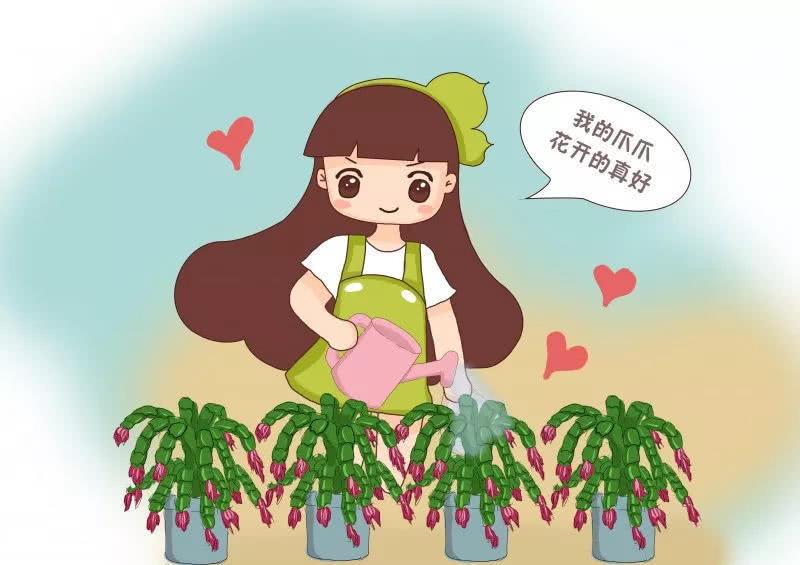
After a few heavy rains, the weather has gradually turned cool, and the dormant Christmas cactus has begun to resume growth. Today, Huahua will teach everyone what to do in early autumn so the Christmas cactus can burst into bloom!
Grown this way in early autumn, the Christmas cactus will burst into a pot full of blooms!
Most gardeners' Christmas cacti are grafted, and in summer they are usually kept with little water and no fertilizer to get through the season, so what needs to be done in early autumn is to let them slowly recover from dormancy.
1. Apply a dilute liquid fertilizer
In summer, the Christmas cactus gets almost no external nutrient supply, so its stems and leaves become rather thin. To lay a good foundation for blooming, you can first give the Christmas cactus a dilute slow-release fertilizer, preferably one fermented from fruit plants, applied about once every half month.
2. Spray less phosphorus and potassium fertilizer
The Christmas cactus is now in its recovery period. If you spray large amounts of phosphorus and potassium fertilizer to force blooming, it is not good for it to recover to a healthy growing state.
3. Control the amount of watering
Although autumn has arrived, you still cannot be careless when watering. The Christmas cactus's root system is still rather delicate now, and if you water heavily it is very easy to cause root rot, so it is best to water only after the potting soil has dried out completely.
4. Gradually provide light
In summer, gardeners usually keep Christmas cacti in a cool, ventilated place to avoid direct sunlight. Now you can first place the Christmas cactus by a bright window or on a balcony so it receives morning and evening light, then gradually increase the light exposure time later.
Take advantage of the cool weather and propagate quickly - turn 1 Christmas cactus into 10 pots!
Once the temperature drops, it is a good time for cuttings again, and the Christmas cactus is no exception. Friends who want more Christmas cacti can start taking cuttings!
1. Cut a few rather firm, robust leaves from the mother Christmas cactus. It is best if the leaves for cuttings have more than two segments, as such leaves have a high survival rate and also grow relatively fast.
2. Insert the leaves to be propagated into a comb, then soak the end that needs to go into the soil in rooting water. After soaking for about 30 minutes, place them in a ventilated spot to dry.
3. The soil used for cuttings must be loose and breathable. You can mix coconut coir and charcoal, add some sawdust, water thoroughly and mix evenly; the soil just needs to be slightly moist.
4. Insert the dried Christmas cactus leaves into the soil; the depth of insertion just needs to be enough to keep the leaves from falling over.
5. After taking the cuttings, keep them in a cool, ventilated place for care. Do not water frequently; just spray a little water when the soil dries. Christmas cacti propagated this way have a survival rate close to 100%!
Cut the Christmas cactus and marry it to a cactus!
1. For the scion to be grafted, it is best to choose one that is rather robust and a bit darker in color, and cut the lower end of the Christmas cactus scion into a duck-bill shape.
2. If you choose to use a cactus as the rootstock, be sure to choose one with rather thick leaves, and give priority to varieties that can overwinter. Then cut off about 1cm from the top of the cactus leaf.
3. Prepare a sharp small knife. After disinfecting it, make a horizontal cut on the cut surface of the cactus, with a depth of 0.5-1cm.
4. With the duck-bill end of the prepared scion facing down, insert it into the cut in the cactus. Then keep it in a cool, ventilated place for half a month, and afterward place it in a sunny spot for care.
5. To be safe, after inserting it you can use a toothpick or small clip to secure the scion and rootstock together.
6. After a period of careful care, the grafted Christmas cactus will bloom!
Huahua's tip: because temperatures vary from place to place, friends in areas with higher temperatures can, according to the actual situation, postpone the above operations by about half a month.
That is all for early autumn care of the Christmas cactus.
If you think the article is pretty good,
welcome to share it with friends!
The image comes from the internet, and the copyright belongs to the original author.
No unauthorized reproduction; if you need to reproduce, please contact us via the backend for authorization.