The dove tree's flowers are as white as snow, but that is far from the only thing that makes it so captivating.
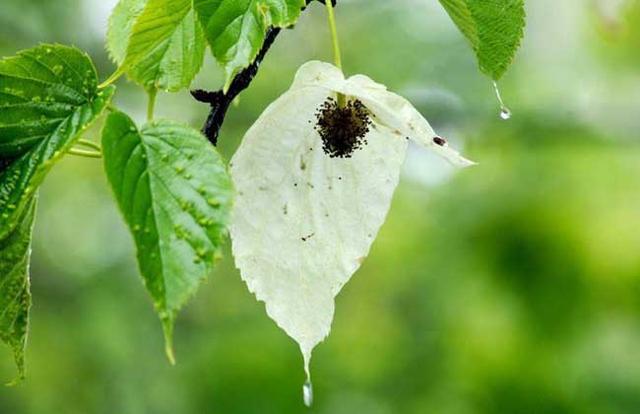
The dove tree (Davidia involucrata) is a deciduous tree belonging to the family Nyssaceae. It originally grew in regions such as Sichuan and Hubei in China, and it has also been rated as a national first-class key protected plant. In some places it is called the dove flower, dove tree, or water pear. Today let us take a look at what characteristics this nationally protected tree has. Let us get to know it together.
1. Growing habits
The dove tree generally grows at an altitude above 1,500, and it is a broadleaf deciduous tree. The air humidity of its growing environment is relatively high, and the sunlight it receives is not intense. From this it can be seen that it does not grow well in a dry environment with many days without rain and lots of wind. Most of the medium in the altitude regions where it grows is acidic, and it is thick, fertile soil, so the dove tree is not tolerant of drought, not tolerant of barren soil, and cannot grow in alkaline soil.
The growth of young dove tree plants is very slow, and they like cool, moist environments, so under tree shade is a very good growing environment. Only when the plant grows into a mature tree does it like to receive some light. From the mountain areas where it grows, it can be seen that the soil layer is relatively thick and solid, and it contains a large amount of slope deposits.
2. When is the flowering period
The dove tree generally blooms in April. Late spring and early summer is when it blooms, and its flowering period can last as long as one month. The color of its flowers is creamy white, and from a distance its appearance looks somewhat like a dove, which is why some people call it the dove tree. From the bud stage to the time the dove tree's flowers wither, their color gradually changes. The flowers on the whole tree slowly bloom and slowly change color, and the colorful appearance can be shown on a single tree, so it has the reputation of "one tree transforming."
3. Protection level
The dove tree is a species that has survived from ancient tropical families. It is one of China's eight major key protected green plants, and it is a very precious green plant. It is relatively rare to plant it on one's own, and it is not easy to catch a glimpse of its wonder in nature. Moreover, as nature is continuously destroyed, many wild green plants are threatened, let alone the dove tree. Its numbers are even fewer and fewer. If the state had not introduced protection measures, perhaps this species would have ceased to exist long ago.
4. Where it grows today
The dove tree still exists in China, and it is scattered across various regions of China. Among them, the province with the largest number is Sichuan, and the others grow in the mountains of Hunan, Guizhou, Yunnan, Chongqing, Guangdong, and other places.
After reading these few characteristics above, what understanding do you have of the dove tree? Has any friend seen what the dove tree looks like when its flowers bloom? Is its appearance very unforgettable?