Unusual leaf shapes and bright flowers: snap off one stem and get many pots, easily covering the whole balcony
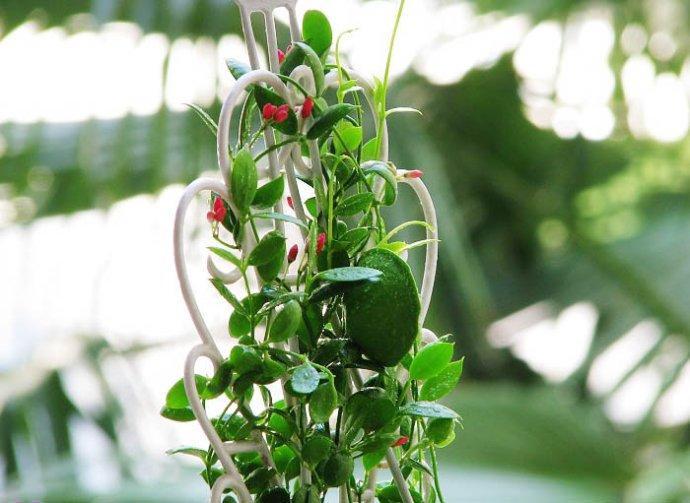
The frog vine introduced today has a shape as unusual as the staghorn fern, also has two forms of leaves, and is famous for its quirky style. Exceptionally gifted, it grows pouch-like hollow modified leaves, and at first glance looks like a frog with a puffed-up belly, jelly-green and sparkling. Squirrel Jun dares to guarantee that this lyric should be used here to describe your first meeting: only because I took one more glance at you among the flowers and plants, I could never forget your face again!
Just what kind of wondrous thing is it?
The frog vine is native to Southeast Asia and is a perennial herbaceous climbing plant of the genus Dischidia in the family Apocynaceae. It has quite a few Chinese names; merchants call it "Brazilian Kiss" because of its pointed red flowers, and it is also known by other names such as Ai Yuan Guo and Yu He Bao.
The pouch-like hollow modified leaves are specialized plant organs of the frog vine. The modified leaves are hollow and thick, and at first glance look quite like fruits, round and plump and very quirky. In addition, its flowers are red; although the flower shape is small, it is quite vivid, like neon lights placed on the branches, enough to make people stop and admire.
Why does it have such unusual leaves?
Speaking of unusual leaf shapes, one cannot help but reveal its other identity: it is a well-known myrmecophyte. That's right, the plump pouches are for ants to live in. When speaking of myrmecophytes, a few more words must be said. As the name suggests, this type of plant forms a mutually beneficial win-win relationship with ants.
Myrmecophytes produce enlarged stems, thorns, petioles, tuberous roots, and pouch-like leaves through variation, providing "lodging" conditions for ants. The frog vine can provide ants with a place to settle, live, and reproduce. Once the ants have a home, the organic matter they bring when foraging, the excrement they produce, and their corpses provide nutrients for the frog vine. In addition, it can reduce damage to the plant from pests, thus providing indirect protection.
There is a kind of showing off called: I have multiple identities!
Besides being a myrmecophyte, the frog vine has legendary pouch-like modified leaves. In tropical rainforests, like orchids, bromeliads, aroids, and ferns, they also have another identity, namely epiphytes. As epiphytes, frog vines are not as aggressive as parasitic plants, insisting on fighting to the death. They usually do not grow too tall, carry out photosynthesis self-sufficiently, and do not plunder the nutrients and water of the plants they attach to.
It is also because the frog vine is an epiphyte that climbing is indispensable. Growing upward by attaching to a support is essential for its survival. Moreover, to prevent a sudden break from threatening its life, the frog vine has developed stem nodes. For every section it grows, there is a root cluster, and along with it a modified leaf. In this way, even if it breaks in the middle, the stem node or modified leaf can each become self-contained and grow new branches and leaves.
How can it grow better at home?
According to the growth characteristics of wild varieties, it grows in a tropical monsoon climate with distinct dry and rainy seasons. During dry periods with little rain, it grows modified leaves, while in humid times it grows ordinary leaves.
Soil: The soil must be loose and breathable. The frog vine says clay soil is out of the question, as it cannot bear the burden.
Water: It does not need much water. The soil should be on the drier side, but the air environment should remain humid, otherwise it is prone to rot.
Light: It does not need direct sunlight and is prone to excessive dehydration. Bright indirect light is enough for it to grow very well.
Fertilizer: After all, it is an epiphyte and has low fertilizer requirements. Follow the principle of light fertilizer applied frequently, once a month is enough.
Temperature: The suitable growth temperature is 20~26°C. Below 18°C, growth will stop and cold damage will occur.
Squirrel Jun's frog vine produced lanceolate follicles after flowering. This morning the seeds burst open and drifted everywhere like dandelion seeds~
Welcome to follow Plant Fanatic. How about becoming obsessed with flowers and plants together with Squirrel Jun?
Please follow my WeChat official account
Plant Fanatic WeChat ID: zhiwum (long press to copy)