What flower is the Gesang flower? Care methods for a flower with Tibetan charm
A few days ago I happened to make plans with a relative to go out together, and she brought me a bottle of water with "Gesang Spring" written on it. Next to the text there was an accompanying picture of a pink flower. Calling it pink is not really accurate, because this kind of pink is slightly deeper; I think it is more like rose red. On the bottle it said that it originated from Tibet and Tibetan culture, and the flower associated with it is the Gesang flower, but before that I had never known exactly what kind of flower the Gesang flower is. Actually, I do not even remember when I first started hearing about the Gesang flower, but I am certain I have never seen one. I think perhaps many friends are curious about the Gesang flower and want to know what it looks like, and what its status is in Tibetan culture.
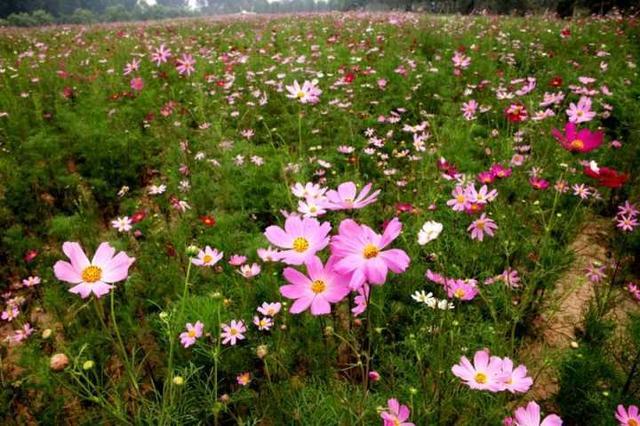
1. First we need to know what kind of flower the Gesang flower actually is. The Gesang flower is exactly the same as the picture on that mineral water packaging I mentioned. It is pink, but a little deep, close to purple, so if you call it rose red, that is actually more accurate. Generally speaking, one Gesang flower has 7 to 8 petals, and the center of the flower, that is, the very middle of the Gesang flower, is golden yellow. The stem of the Gesang flower is on the slender side, making people wonder whether it would break as soon as the wind blows.
I remember there used to be travel films that showed Tibet. Although the shots flashed by, the Gesang flowers appearing in groups still left a deep impression on me. Of course, when I watched those travel films back then, I did not know that they were Gesang flowers. It was only recently, after I learned what Gesang flowers look like, that I realized those clusters of beautiful flowers I saw at the time were Gesang flowers. Tibet really can be called a rather magical place.
First, its environmental protection is done very well, so everyone who travels there can have a relatively good travel experience. In the dormitory, well, wherever people go there, they can interact very well with nature. Just imagine, if we are tired, we lie down in a field of Gesang flowers, and above our heads are those circling birds. What a wonderful thing that would be.
2. When it comes to the Gesang flower, it is indeed a rather special plant in Tibetan culture. The word "Gesang" in the Tibetan language means beautiful, so in the eyes of Tibetan people, the Gesang flower is the embodiment of beauty. About the Gesang flower, there are actually many stories and many legends from Tibet. I will not go into them one by one here, since the versions differ and the stories are different too. Friends who are interested can search for it themselves on Baidu Baike and take a look.
About the Gesang flower, there has actually always been a controversy, namely what kind of plant the Gesang flower refers to. Although I mentioned earlier that the Gesang flower is a rose-red flower, of course what I am talking about is the more generally recognized Gesang flower. In fact, some experts have also pointed out that according to the growth habits and characteristics of the Gesang flower as described by Tibetan people, this Gesang flower may also refer to a kind of wildflower that is relatively abundant in Tibet, a plant with no name and not recorded in encyclopedias. In that case, it becomes more difficult for everyone to recognize the Gesang flower.
3. The kind of Gesang flower I mentioned earlier is actually the kind that everyone relatively recognizes, namely a type of cosmos. Cosmos originally comes from places such as Mexico, and also grows in large quantities in the Tibet region. The cosmos we usually see in parks is generally yellow or orange, and rose-red ones like this are actually not very common. But over in Tibet, well, there are mainly two colors, one is rose red and one is white. On grasslands mixed with rose red and white, cattle and sheep graze freely and horses run swiftly. What a magnificent grassland scene.