These are the flowers scam sellers love to sell most: either fake flowers or dead seedlings, buy one and it dies.
In everyday life, some flower lovers find that after buying flowers, the plants die very quickly. Sometimes it is not a problem with care, but a problem at the time of purchase. Let's take a look at these tricks in the flower trade!
“
Flower-selling tricks
”
- Chemically variegated succulents -
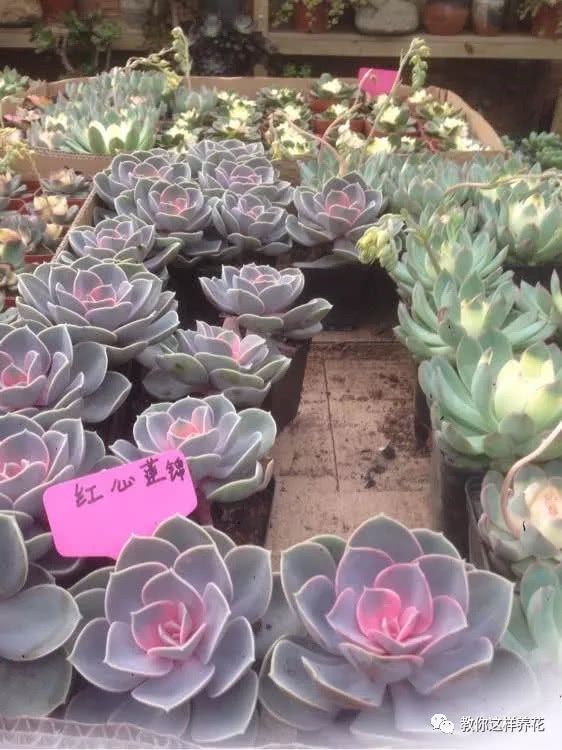
For a while, variegated succulents were very popular, so many succulents treated with corn herbicide appeared on the market, called chemically induced variegation. Compared with ordinary succulents, the price is also quite a bit higher. After growing these chemically variegated succulents for a while, not only is the death rate extremely high, but even if they survive they revert to their original color, so they are not worth buying.
Chemically induced variegation is fairly common in some ordinary varieties: Black Prince (Echeveria 'Black Prince'), Gunanlian (Sempervivum tectorum), Purple Pearl (Graptopetalum paraguayense), Deer Antler Begonia (Astridia velutina), Huangli (Sedum adolphi), and Gilongyue (Graptosedum 'Bronze'). For example, ordinary Gunanlian, after being sprayed, turns into a rainbow lotus; some well-sprayed chemically variegated plants really do look good, and the key is they sell very well... but the death rate is indeed very high, many people end up with an empty pot within 1 month, and even if they survive they turn green again.
- Unknown tree stumps and saplings -
In many vegetable markets you can see small vendors selling flowers, with only bare sticks and no leaves. There are Chinese roses, bougainvillea, camellias, crabapples and so on, and there may also be all kinds of fruit tree saplings; in fact, they might be some wild tree roots, or they may not grow at all. I suggest everyone not buy flowers in these places, because after buying you won't be able to find the person again.
- Vegetable lotus and bowl lotus -
Many flower lovers like bowl lotus and buy some bowl lotus seeds online. After buying them, the germination rate is also especially high, but after planting they do not bloom for years. In fact, 90% of the bowl lotus on the market is passed off as vegetable lotus, and many flower lovers are also given some bowl lotus seeds as gifts when shopping online, which are basically all fake.
Bowl lotus and vegetable lotus seeds are hard to distinguish. Vegetable lotus seeds are mostly oval and elliptical, while bowl lotus is closer to spherical. But there are exceptions: Hunan's Xiang lotus seeds are also very spherical, while many bowl lotus seeds are actually oval and elliptical, and even flower lovers who have grown bowl lotus for a long time cannot tell them apart. It is best to directly buy seedlings with flowers, or find some reliable shops, so that after-sales problems can be solved.
- Fragrant wood and pepper wood -
Many flower lovers like fragrant wood, but much of the fragrant wood on the market is fake. Fragrant wood has a faint fresh fragrance, and the tip is a pair of leaves. Pepper wood has no smell, and the tip has 1 leaf; this is how you can tell them apart.
Fragrant wood
Pepper wood
- Fake four-season plum -
The same trick as fake saplings: they say it is a four-season plum or peony plum, use a very pretty picture, and exaggerate by saying each branch can produce flowers of different colors, with the quantity also especially small; sometimes there may even be shills, saying if you don't buy it will be taken by someone else.
These are actually made by sticking a few poplar branches onto a wooden stick, with the joints smeared over with mud.
- Fake flowers on jade-leaf plant -
You can often see jade-leaf plants covered with flower buds, with very beautiful colors. After buying them home, you find they never wither; in fact, these little red flowers are plastic flowers.
The real flowers look like this, and they are not pretty. If they are sold very expensively because some fake flowers are stuck in, that is not right.
- Rainbow roses, blue crab claw orchids -
Flower lovers often buy flowers online, and often buy fake flowers too. Many shops give exaggerated descriptions: blue crab claw orchid, blue succulents, rainbow roses and so on. If you see plants with such strange colors, do not buy flowers from that shop...
Rainbow rose
Blue Chinese rose
Blue Haworthia cooperi
Red Haworthia cooperi
Ice Beauty succulent
This color is so bright it will dazzle your eyes!
Flower lovers, pay close attention
If you come across these flowers, do not buy them
Many flower lovers have already been scammed
Show this to flower lovers who need it!