The tardigrade may be the cutest cameo in Marvel movie history, and it looks set to dominate the screen for a week
Calendar Girl went to see Ant-Man 2 tonight, and knowing you haven't seen it yet, I won't spoil it. But getting to know this little thing below will really help with watching the film.
Note: don't trespass on their territory, because although they're adorable, they really will "eat" you!
As Guokr's chief tardigrade enthusiast (???), a question I often run into is: where exactly is the charm in these things?!
True, these little creatures crawling around under a microscope probably don't look that different from shrunken big-tailed maggots if you don't look closely... but! Look closely at their little claws, they really are adorable... if you don't believe me, keep reading.
Tardigrades? A super-tiny bunch of cuties
Water Bearsdoesn't refer to a single species; this is actually a huge group:the phylum Tardigrada. Yes, an entire phylum, and the number of species known to humans already exceeds a thousand, with possibly more species still undiscovered.
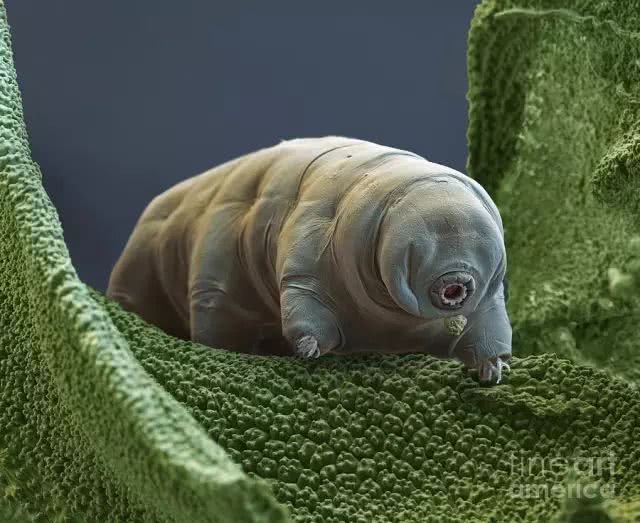
Super-cute little darlings with a massive family. Image: fineartamerica
Of course, introducing over a thousand species all at once is impossible, so what we'll get to know here isa representative of the tardigrade world: Hypsibius dujardini(Hypsibius dujardini), which is one of the most common tardigrade species.
This is its ID photo on wiki (whose ID photo doesn't look dazed). Image: Bob Goldstein and Vicky Madden, UNC Chapel Hill / wikimedia commons
These little creatures live in freshwater, feed on algae, and can also make their homes on moss.The "dujardini" in their name comes from the French biologist Félix Dujardin. An adult Hypsibius dujardini is about 0.5 mm long, and can only be seen clearly with a microscope.
You may need a scale bar to get a sense of its size; the image shows Macrobiotus sp. under a scanning electron microscope, where you can clearly see the mouthparts it uses to pierce plant cells. Image: SaguaroNPS / flickr
They are transparent throughout, covered with a waxy cuticle. The body consists of a head and four body segments, each segment bearing a pair of limbs, and each leg has super-cute little claws.A bear has only four claws, but a single tardigrade has eight little claws,which is enough to show the tardigrade's superiority as a cute creature (not really)...
A tardigrade in a 3D render, come see the cute claws! Image: letemps.ch
The gashapon of Hypsibius dujardini released by the toy company Takara Tomy. It is less than 5 cm long, about 100 times the size of the real thing. Image: Chuangqiaoyu
A scientific cutie with super-high popularity
In the scientific world, Hypsibius dujardini is very popular, and many studies choose it as a test subject.Scientists love it mainly for two reasons: first, it is relatively easy to raise in the lab, and it only takes two weeks to get the next generation; second, it is basically completely transparent, so with a microscope you can see all its anatomical structures and cell development clearly, which couldn't be more convenient. Now,the genome data of this tardigrade has also been obtained by humans.
Designed dialogue: Hmm... you've seen right through me! The image shows a truly *seen-through* tardigrade under the microscope. Image: Zachary Hawn / flickr
The Micropia museum in Amsterdam, the Netherlands, even made a tardigrade sculpture. Image: Iso Brown FR / flickr
Of course, the most fascinating thing about tardigrades is still their astonishing tolerance for extreme environments.If you look through the extreme survival records left by tardigrades, you'd think they could live to the end of the world.
Exposed to the vacuum of space? Didn't die.
High temperature of 150°C? Didn't die.
Low temperature down to -272°C? Didn't die.
Hit with an enormous dose of radiation? No problem, they can still pull through.
Piece of cake! Look at me, alive and well. Image: linnetmoss.com
In a paper published in 2017, three astrophysicists came up with some wildly imaginative scenarios: what kind of astrophysical catastrophe could kill off all life on Earth? Not surprisingly,they chose the tardigrade as the last line of defense for all life on Earth.As for humans, well, they would have died out long before that anyway.
The tardigrade may be the toughest creature on Earth... Image: m.carroil, Sredni Eel / flickr
Attack, little monster! Image: Martin Whitmore / flickr
The tardigrade's secret weapon for withstanding extreme environments is"cryptobiosis"——shedding most of the water in their bodies and entering a dormant state in which metabolism nearly stops.When the environment becomes suitable again, they can wake from dormancy and still look as lively as ever. Today, scientists are still investigating the specific details behind this process.
A cryptobiotic (playing-dead) tardigrade probably looks like this. Image: elciudadano.cl
Super-tough tardigrades? Not immortal
The tardigrade's incredibly powerful vitality has become quite famous, but I have to say there are still some points here that are easy to misunderstand and need clarification.
First, individual tardigrades are not immortal.They actually can't even manage to "live to a ripe old age"; if you exclude the cheat-like time spent in cryptobiosis,a tardigrade's lifespan is estimated at only 3 to 30 months.Even counting cryptobiosis, the longest clear record I know of is actually just waking up after 30 years of frozen "sleep" (not Hypsibius dujardini, but another species found on Antarctic moss) - that's already impressive, but not so impressive that it becomes a horror story outright.
I have to admit, their cheating skills are pretty impressive too. Image: edaccessible.com
Second, not all tardigrades are that tough.Many tardigrades can get through extremely harsh periods through cryptobiosis, but not all of them; and their tolerance in the cryptobiotic state also differs, and Hypsibius dujardini actually isn't considered especially tough among them.
Three awkwardly huddled tardigrades under a scanning electron microscope. Image: Willow Gabriel
Finally, even with impressive cryptobiosis, tardigrades can't survive every hardship.They cannot tolerate mechanical damage, so crushing a few of them is still no problem - but don't do that, they are harmless to humans, and they're so cute, why would you...
Go find tardigrades around you!
Tardigrades are very widely distributed, which means you can actually go out and find a few yourself; they might be living right beside you. Although there's no guarantee you'll see the species introduced today, still,finding tardigrades actually isn't that difficult.
Just grab some moss and that's sampling? Yep. Image: foldscope.com
When looking for tardigrades on land,lichens and moss are the best targets, as these can provide the food and moist environment tardigrades need to survive.You can look for moss in a yard near you, cut off some moss with a blade, add some clean water and soak it thoroughly. Next, observe the water in which the moss was soaked under a microscope, and you may be able to find the eight-clawed little cuties crawling around in it!
Of course, don't miss the eight-clawed "big" cutie in Ant-Man 2 either. Image: Marvel
This article is a 2017 article from Species Calendar, from Species Calendar author @Chuangqiaoyu.
Calendar Girl's Recommendations
-If you love movies, don't miss these-
Want to learn about more amazing creatures?
Follow Species Calendar
One species a day, taking you to rediscover the world
Calendar Girl's avatar today
Hypsibius sp., family Hypsibiidae