Iris planting has its tricks, and with so many types you need to choose the right approach
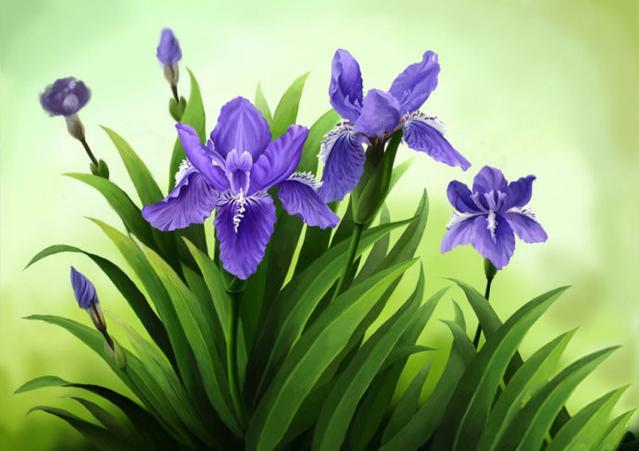
Iris is also called Alice, and the name sounds very Western at first hearing, with a touch of the elegance of a European lady. Iris is a perennial herbaceous flower, and its blooms are by no means small; its flower colors are quite unique, and you rarely see flowers that are blue-purple with long, lance-shaped leaves that stay verdant all year round and are truly beautiful. Today we are going to get to know it properly together.
I. Variety classification
The varieties of iris are not uniform, but there are not too many of them either, and they are fairly easy to tell apart; the variety directly affects its growing habits, so when caring for irises you must first figure out which variety you have in order to manage it better. Irises are generally divided into three major variety groups, and their growing habits directly affect the regions where they can grow as well as the areas in which they can be used.
1. Aquatic. Aquatic ones naturally prefer water; irises of this variety generally grow by the water's edge and are excellent decorative flowers for ponds, and can be used in fields such as pond flowers and cut flowers. This type of moisture-loving iris includes the common rabbit-ear iris (Iris laevigata) and Japanese iris (Iris ensata).
2. Mesic. Mesic irises can grow in moist soil and also on dry ground, so their environmental requirements are fairly intermediate. Irises of this variety are the butterfly iris, German iris (Iris germanica), and Iris tectorum, and they can be planted in flower beds, gardens, and as ground cover.
3. Xerophytic. Xerophytic irises include yellow flag (Iris pseudacorus) and Iris lactea var. chinensis. This variety is mostly planted in the ground for edging and accent purposes; its water requirements are relatively low, and its drought tolerance is extremely strong.
II. Care and management
1. Disease prevention. During growth, irises often become infected with soft rot. As soon as soft rot is found it must be dealt with promptly, otherwise it can very easily cause the plant to die. First, pull out the seedling together with its roots, carefully check the rotted parts, cut them off with a sterilized knife, then replace the soil with new soil and replant.
2. Eliminating pests. The pest of irises is not red spider mite, nor scale insect, but the scarab beetle. Physical pest control methods have no effect on scarab beetles, so chemical spraying is the only option, and it must also tackle the larvae at the root. In April each year you can mix up a chemical and spray the entire plant, which is to prevent the growth of scarab beetles. To reduce the growth of scarab beetles, you must clean up the dead branches and fallen leaves thoroughly in winter.
3. Propagation methods. There are quite a few ways to propagate irises: division, cuttings, sowing, and so on. In spring you can use division and cuttings, while in winter division is used more often. As for sowing, the seeds can be sown immediately after being collected once the flowering period is over, without needing to be stored.
4. Substrate. Irises do not like growing in acidic soil, because acidic soil causes poor growth, so when planting you must adjust the pH of the substrate so as not to affect the flowers' growth. Alkaline soil mixed with lime is excellent for irises, and adding a little bone meal, soybean cake, and so on as a base fertilizer can further help the plant grow. But when planting, be sure not to bury it too deep.
Irises can be used in many areas, such as courtyard planting, garden flowerbed arrangement, waterside viewing, cut-flower accents, and so on. Although they are common, not many people really know them. Have you gained a new understanding of them today?